
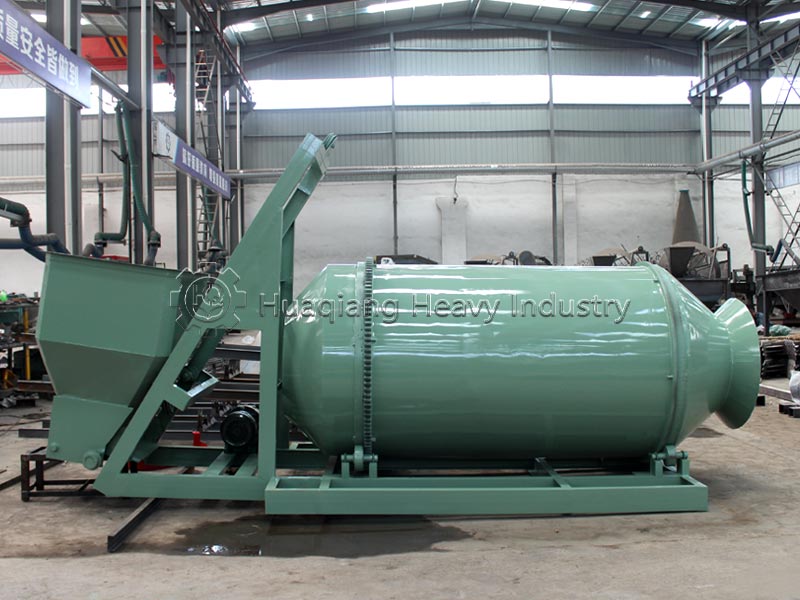
Have you ever seen a mixer like this, its belly full of colorful pellets: yellow urea, white phosphate, red potash, and some dark micronutrients? When it starts up, two massive shafts with paddles spin in opposite directions, tossing the material into a swirling, tumbling group dance. In less than two or three minutes, the mixture becomes so uniform you cannot spot a single off color particle. That is the BB fertilizer mixer, the “bartender” of the bulk blending line.
At the installation site, workers are wrestling with this twin shaft paddle mixer. Its body is a long U shaped trough, inside which lie two parallel main shafts, each fitted with paddles welded at precise angles. The critical parts are the shafts’ phase alignment and the paddle to trough clearance. If the phase is wrong, the paddles will strike each other, punching a hole in the trough with a deafening clang. If the clearance exceeds five millimeters, a dead layer will remain at the bottom, never to be mixed. An old hand lies on the floor, measuring with a feeler gauge: “2.5 mm here, 3 mm there. No good, adjust again.” An overhead crane holds the mixer lid, while young workers nudge the bearing housings with pry bars. Welding arcs flash in the corner.
 But the BB mixer does not work alone. Upstream sits an automatic batching system: a row of large hoppers, each with a high precision screw or belt scale underneath. At a computer command, different pellets flow out one by one, falling onto a collecting belt exactly to the recipe. A tiny error in this “hand” would ruin the whole formula. Downstream are a vibration screener machine (to remove broken pellets and dust) and an automatic packaging scale. All are linked by bucket elevators and chutes, so pellets move from raw material to bag with almost no human touch.
Time for a test run. Workers pour in bags of differently colored pellets: white, yellow, red, clearly distinguishable. They press the start button. The two shafts spin in opposite directions, paddles pushing material left, then right, then left again. The whole bed heaves like a colorful wave. After less than two minutes, they open the inspection door: those once separate colors have blended into a uniform speckled mix. The old hand grabs a handful, spreads it on his palm, and squints: “No white spots, no red lumps. Pass.” A young worker jokes, “It is more even than my salad dressing.”
What makes the BB fertilizer mixer so special is that it is both gentle and forceful. Unlike a disc granulator that crushes or squeezes, this mixer simply tumbles and folds, yet it demands that every kind of pellet stay intact and not segregate. Because bulk blended fertilizer is all about “each component doing its job while staying together.” Without this mixer, the best recipe is just a pile of colorful stones that do not get along. With it, nitrogen, phosphorus, potassium, and micronutrients unite and cooperate in the field.
So, the next time you see those uniformly colored BB fertilizer bags beside a farm field, remember the two stubborn shafts inside. They are not just spinning paddles; they are spinning the “art of balance” that brings a good harvest.
But the BB mixer does not work alone. Upstream sits an automatic batching system: a row of large hoppers, each with a high precision screw or belt scale underneath. At a computer command, different pellets flow out one by one, falling onto a collecting belt exactly to the recipe. A tiny error in this “hand” would ruin the whole formula. Downstream are a vibration screener machine (to remove broken pellets and dust) and an automatic packaging scale. All are linked by bucket elevators and chutes, so pellets move from raw material to bag with almost no human touch.
Time for a test run. Workers pour in bags of differently colored pellets: white, yellow, red, clearly distinguishable. They press the start button. The two shafts spin in opposite directions, paddles pushing material left, then right, then left again. The whole bed heaves like a colorful wave. After less than two minutes, they open the inspection door: those once separate colors have blended into a uniform speckled mix. The old hand grabs a handful, spreads it on his palm, and squints: “No white spots, no red lumps. Pass.” A young worker jokes, “It is more even than my salad dressing.”
What makes the BB fertilizer mixer so special is that it is both gentle and forceful. Unlike a disc granulator that crushes or squeezes, this mixer simply tumbles and folds, yet it demands that every kind of pellet stay intact and not segregate. Because bulk blended fertilizer is all about “each component doing its job while staying together.” Without this mixer, the best recipe is just a pile of colorful stones that do not get along. With it, nitrogen, phosphorus, potassium, and micronutrients unite and cooperate in the field.
So, the next time you see those uniformly colored BB fertilizer bags beside a farm field, remember the two stubborn shafts inside. They are not just spinning paddles; they are spinning the “art of balance” that brings a good harvest.
 But the BB mixer does not work alone. Upstream sits an automatic batching system: a row of large hoppers, each with a high precision screw or belt scale underneath. At a computer command, different pellets flow out one by one, falling onto a collecting belt exactly to the recipe. A tiny error in this “hand” would ruin the whole formula. Downstream are a vibration screener machine (to remove broken pellets and dust) and an automatic packaging scale. All are linked by bucket elevators and chutes, so pellets move from raw material to bag with almost no human touch.
Time for a test run. Workers pour in bags of differently colored pellets: white, yellow, red, clearly distinguishable. They press the start button. The two shafts spin in opposite directions, paddles pushing material left, then right, then left again. The whole bed heaves like a colorful wave. After less than two minutes, they open the inspection door: those once separate colors have blended into a uniform speckled mix. The old hand grabs a handful, spreads it on his palm, and squints: “No white spots, no red lumps. Pass.” A young worker jokes, “It is more even than my salad dressing.”
What makes the BB fertilizer mixer so special is that it is both gentle and forceful. Unlike a disc granulator that crushes or squeezes, this mixer simply tumbles and folds, yet it demands that every kind of pellet stay intact and not segregate. Because bulk blended fertilizer is all about “each component doing its job while staying together.” Without this mixer, the best recipe is just a pile of colorful stones that do not get along. With it, nitrogen, phosphorus, potassium, and micronutrients unite and cooperate in the field.
So, the next time you see those uniformly colored BB fertilizer bags beside a farm field, remember the two stubborn shafts inside. They are not just spinning paddles; they are spinning the “art of balance” that brings a good harvest.
But the BB mixer does not work alone. Upstream sits an automatic batching system: a row of large hoppers, each with a high precision screw or belt scale underneath. At a computer command, different pellets flow out one by one, falling onto a collecting belt exactly to the recipe. A tiny error in this “hand” would ruin the whole formula. Downstream are a vibration screener machine (to remove broken pellets and dust) and an automatic packaging scale. All are linked by bucket elevators and chutes, so pellets move from raw material to bag with almost no human touch.
Time for a test run. Workers pour in bags of differently colored pellets: white, yellow, red, clearly distinguishable. They press the start button. The two shafts spin in opposite directions, paddles pushing material left, then right, then left again. The whole bed heaves like a colorful wave. After less than two minutes, they open the inspection door: those once separate colors have blended into a uniform speckled mix. The old hand grabs a handful, spreads it on his palm, and squints: “No white spots, no red lumps. Pass.” A young worker jokes, “It is more even than my salad dressing.”
What makes the BB fertilizer mixer so special is that it is both gentle and forceful. Unlike a disc granulator that crushes or squeezes, this mixer simply tumbles and folds, yet it demands that every kind of pellet stay intact and not segregate. Because bulk blended fertilizer is all about “each component doing its job while staying together.” Without this mixer, the best recipe is just a pile of colorful stones that do not get along. With it, nitrogen, phosphorus, potassium, and micronutrients unite and cooperate in the field.
So, the next time you see those uniformly colored BB fertilizer bags beside a farm field, remember the two stubborn shafts inside. They are not just spinning paddles; they are spinning the “art of balance” that brings a good harvest. 