
The core reason why trough-type fertilizer compost turners have become standard equipment in large-scale organic fertilizer plants is their ability to precisely control the fermentation temperature, achieving constant-temperature aerobic fermentation throughout the entire process. Traditional windrow fermentation is prone to problems such as fluctuating temperatures, localized burning, or incomplete fermentation. However, trough-type compost turners, combined with standardized fermentation troughs, can precisely regulate the oxygen content and heat dissipation rate of the compost pile through timed and quantitative turning.
The trough-type fertilizer compost turner intelligently adjusts the turning frequency according to three stages: fermentation heating, high-temperature maintenance, and cooling and maturation. During the heating phase, the number of turns is increased to provide oxygen and promote temperature; during the high-temperature phase, turning is moderately reduced to maintain a constant temperature above 60℃ for sterilization; in the later stage, turning is increased to accelerate cooling and maturation. No manual temperature monitoring is required throughout the process; the temperature is stably controlled by the equipment's automated program.
 The constant-temperature control advantage of trough-type fertilizer compost turners not only thoroughly kills pathogens, insect eggs, and weed seeds, but also locks in organic nutrients, resulting in fermented materials with uniform color, no odor, and consistent quality. For companies that need to produce stable, long-term organic fertilizer, the constant-temperature fermentation capability of trough-type fertilizer turners is the key to ensuring product qualification rates.
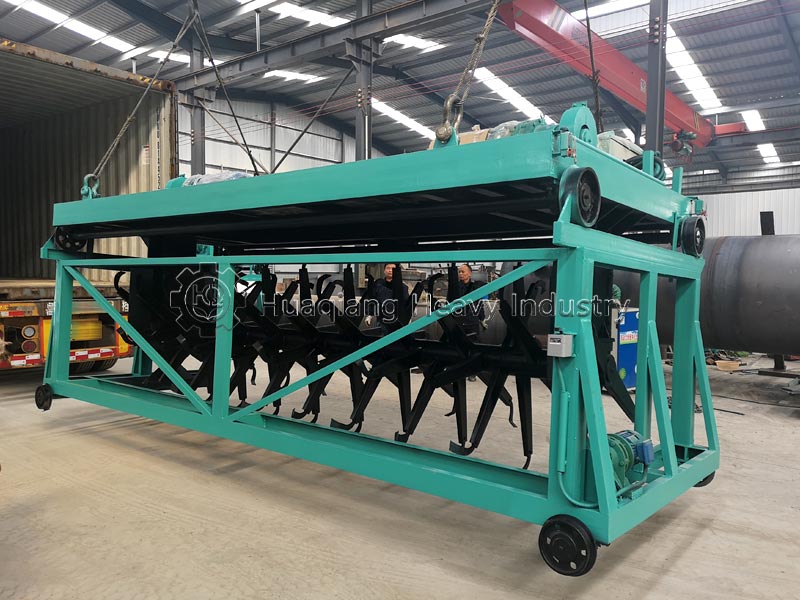 The constant-temperature control advantage of trough-type fertilizer compost turners not only thoroughly kills pathogens, insect eggs, and weed seeds, but also locks in organic nutrients, resulting in fermented materials with uniform color, no odor, and consistent quality. For companies that need to produce stable, long-term organic fertilizer, the constant-temperature fermentation capability of trough-type fertilizer turners is the key to ensuring product qualification rates.