
Simple Compost Turning Machine
Simple Compost Turning Machine
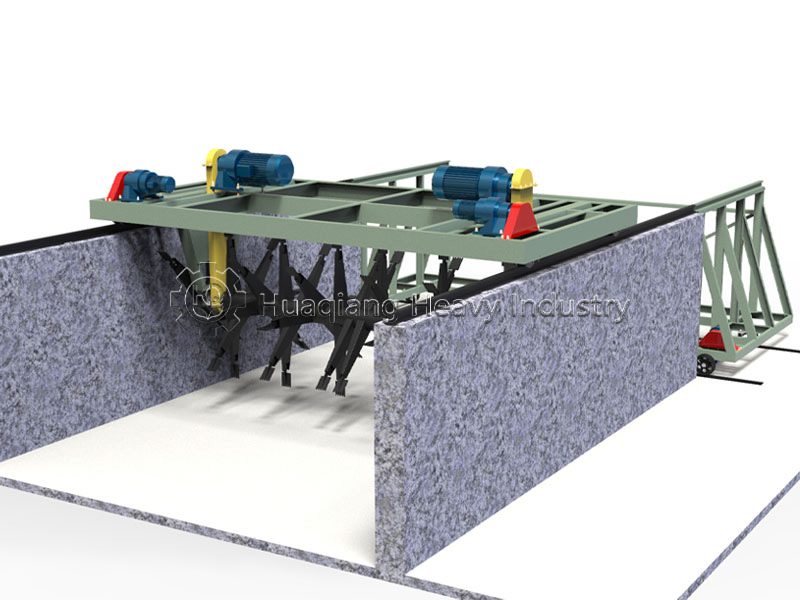
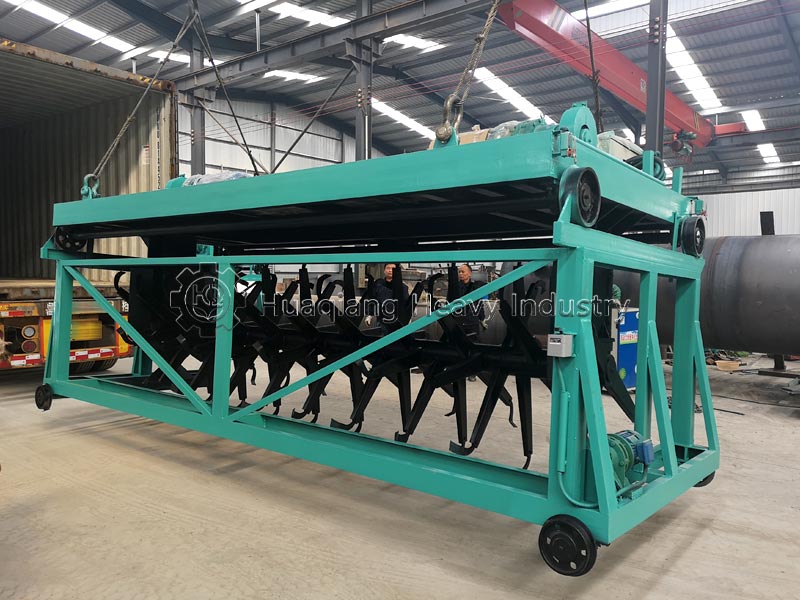
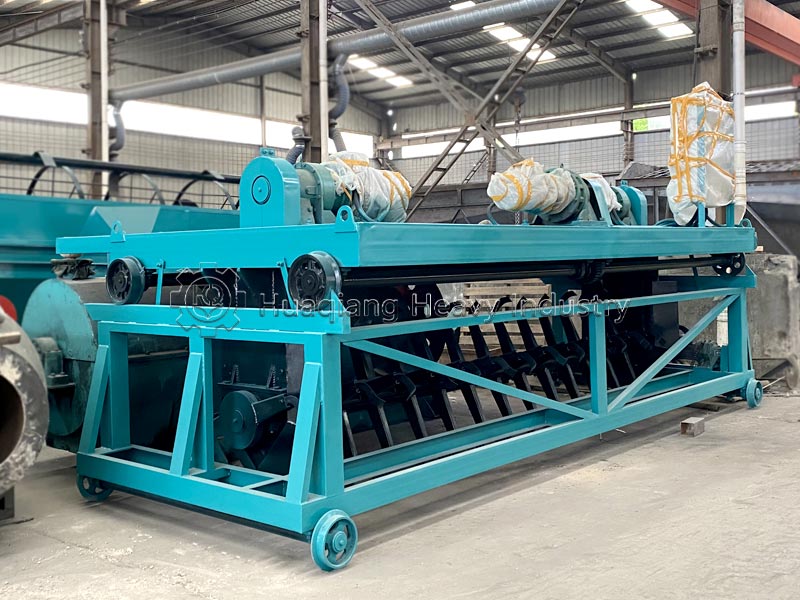
The simple trough compost turning machine is a key piece of auxiliary equipment for the trough-based organic fertilizer fermentation process. It performs the core tasks of periodically turning, aerating, and displacing the materials within the fermentation channel. Mounted on rails along both sides of the channel, the machine travels back and forth; its rotating tined roller lifts the accumulated organic material from the bottom, breaks it up, and throws it backward, thereby restoring permeability while simultaneously shifting the material’s position. Featuring a simplified structural design and a direct, reliable drive system, the equipment is easy to operate and maintain and consumes little electricity. It is ideally suited for small-to-medium-sized livestock farms, township organic fertilizer processing centers, and small-to-medium-scale composting projects. A single turner can service multiple fermentation channels by using a transfer carriage to switch between them, ensuring high equipment utilization; it is a practical choice for controlling composting quality and shortening the maturation cycle.
How does the simple trough compost turning machine process organic fertilizer raw materials?
The composting process associated with the simple trough compost turning machine—spanning from raw material preparation to the discharge of matured compost—is completed entirely within the fermentation channel.
Raw materials must be properly formulated before being loaded into the channel. Livestock manure is mixed thoroughly with bulking agents—such as powdered straw or rice husks—to achieve a carbon-to-nitrogen (C/N) ratio of 25:1 to 30:1 and a moisture content of 55% to 65%. The prepared mixture is loaded into one end of the fermentation channel and piled to a designed height, typically ranging from 0.8 to 1.6 meters.
During the initial fermentation phase—within 24 to 48 hours of loading—aerobic microorganisms multiply rapidly, causing the temperature inside the channel to rise naturally above 50°C. At this point, the compost turner begins operation, traversing the entire length of the channel once or twice daily to turn the material. The tined roller cuts into the bottom of the channel, scooping up compacted material and throwing it backward; this allows the material to make full contact with the air in mid-air. With ample oxygen, aerobic microorganisms continuously decompose the organic matter, maintaining a high temperature range of 50°C to 70°C for 7 to 10 days, which effectively kills pathogens and weed seeds.
Following the high-temperature phase, the material enters the maturation stage, and the temperature gradually subsides. The frequency of turning can be reduced to once every two to three days while maintaining oxygen supply and material uniformity within the trough. With each turning operation, the material shifts backward by approximately two to three meters; after 15 to 20 days of continuous processing, it moves from the feed end to the discharge end, completing the transformation from fresh feedstock to matured organic fertilizer, ready for subsequent crushing, screening, and granulation.
What are the common issues associated with simple trough compost turning machines, and what are the solutions?
| Common Issues | Cause Analysis | Solutions |
| Materials are not thoroughly turned during compost turning, and lower-layer materials cannot be lifted up | Severe wear on turning teeth reduces tooth length, resulting in insufficient penetration depth; or pile height exceeds equipment design specifications | Replace excessively worn turning teeth to maintain a 3-5cm gap between tooth tips and trough bottom; control pile height within design limits |
| Material temperature fails to rise or rises slowly after turning | Excessively high moisture content causes poor aeration; or imbalanced C/N ratio restricts microbial activity | Add dry amendments such as straw powder and rice husk to adjust moisture to 55%-65%; test and adjust C/N ratio to the appropriate range |
| Turning roller gets heavily entangled with long-fiber materials, increasing operational resistance | Excessive long-fiber materials such as straw in raw materials without crushing; or low moisture content increases fiber toughness | Crush long-fiber materials to below 10cm before feeding into the trough; clean entangled materials on the roller promptly after each shutdown |
| Travel wheels slip or derail | Foreign objects obstructing or deforming the track; severe wear on wheel treads causing poor contact with the track | Clear debris on the track before each operation; regularly check track straightness and levelness, and replace excessively worn travel wheels promptly |
| Abnormal vibration or noise during equipment operation | Loose or fallen turning teeth disrupt main shaft dynamic balance; increased bearing clearance due to wear | Stop immediately to check tightening of turning teeth and replace missing tooth blocks; inspect main shaft bearings and replace worn parts |
| Localized materials in fermentation trough turn black and emit foul odor | Insufficient turning frequency or depth causes localized anaerobic conditions; excessive moisture leads to water accumulation at the bottom | Increase turning frequency to twice daily during high-temperature phase; check and adjust turning tooth penetration depth; control moisture content of incoming materials |
For which types of manufacturers is the simple trough compost turning machine?
Simple trough compost turning machines are primarily suited for small-to-medium-scale organic fertilizer production and waste treatment operations.
Livestock and poultry farms are the most direct users of trough-type compost turners. Chicken, pig, and cattle farms generate daily manure and waste that require timely treatment; by constructing fermentation channels equipped with a simple turner, farms can mix manure with bulking agents (such as straw) and place the mixture directly into the channels for fermentation. The resulting organic fertilizer can be used on-site or sold externally, thereby transforming livestock waste into a valuable resource.
For township-level organic fertilizer processing sites and small-scale composting projects, the simple trough-type turner—characterized by its streamlined structure, moderate price, and low operating costs—perfectly meets user needs. These facilities can utilize raw materials from nearby farms and fields to produce commercial organic fertilizer, supporting local crop cultivation.
In new construction or expansion projects for organic fertilizer enterprises, simple trough-type turners are often selected for fermentation sections with small-to-medium capacity requirements. Multiple fermentation channels can be arranged side-by-side, with a single turner serving several channels via a transfer carriage; this setup ensures stable fermentation output while keeping total equipment investment under control.
Agricultural waste treatment centers use these turners for daily turning operations when composting materials such as straw, spent mushroom substrate, and vegetable waste. After undergoing high-temperature aerobic fermentation, the materials are converted into organic fertilizer or soil conditioners, achieving both the safe disposal and resource recovery of agricultural waste.
Some compound fertilizer and bio-organic fertilizer manufacturers also require fermentation facilities to process organic raw materials. In these cases, the simple trough-type turner serves as the fermentation equipment in the pre-processing stage, providing uniformly decomposed organic material for subsequent steps such as crushing, batching, and granulation.
Specifications of the Simple Trough Compost Turning Machine
| Model | Main Motor | Walking Motor | Lifting Motor | Mobile Car Motor |
| FD3 | 7.5kw*2 | 1.5kw | / | 1.5Kw |
| FD4 | 11kw*2 | 1.5kw | / | 1.5Kw |
| FD5 | 15kw*2 | 2.2kw | 0.75kw | 1.5Kw |
| FDT3 | 7.5 kw*2 | 1.5kw | 0.75 kw | 1.5Kw |
| FDT4 | 11kw*2 | 1.5 kw | 0.75 kw | 1.5Kw |
| FDT5 | 15kw*2 | 2.2 kw | 0.75 kw | 1.5Kw |
