
Have you ever seen a machine that looks like a big steel cage, with two layers of rotor bars spinning in opposite directions, reducing material to fine powder in just a few seconds? That’s the cage crusher the embodiment of “violent beauty” on a fertilizer production line. Today, let’s stand at its installation site, listen to the story of this fierce fellow, and see how it teams up with its upstream and downstream partners.
The cage crusher has a unique design: inner and outer layers of cage bars, each mounted on its own rotor, spinning at high speed in opposite directions. Material drops in from the top, strikes the inner cage, gets flung outward to the outer cage, and is repeatedly impacted, sheared, and ground between the two layers all in less than three seconds. Clumped, caked, or even semi-wet materials turn into a cloud of fine powder. Some joke that this thing is like a “violent centrifuge” – it doesn’t argue, it just crushes.
 At the installation site, workers are busy hoisting this two-to-three-ton beast onto its foundation. The cage crusher demands near-perfect dynamic balance – even a slight misalignment in speed or concentricity between the two cage layers will make the machine shake like a drunken giant. An old hand uses a laser alignment tool, muttering, “If this cage is off by just one millimeter, the bearings will be toast in half a month.” A younger worker kneels by the feed inlet, shining a flashlight to check the cage bars for any welding cracks. Vibration sensors and a temperature gun lie on the floor, and the air smells of lubricating oil.
As fierce as the cage crusher is, it never fights alone. Upstream, there’s usually a twin-shaft mixer or a horizontal mixer – these first blend raw materials with water evenly, preventing excessive dust during crushing. Downstream, a disc granulator or a double roller press granulator waits – only the fine powder (over 90% passing through a 40-mesh screen) produced by the cage crusher can form round, hard pellets. Further down the line come the drum fertilizer dryer, cooler, screener, and automatic packaging scale – all linked by enclosed belt conveyors that keep dust inside while productivity soars.
On test day, workers put on masks and goggles. The machine starts up, and the two cage layers produce a sharp whirring sound. A few chunks of fermented material are fed into the inlet – a crisp “clattering” noise follows, and out of the discharge port drifts a cloud of fine gray-brown powder. Pinched between fingers, not a single hard lump remains. The workshop supervisor nods: “That’s exactly what we wanted.” Someone pats the housing and says, “Old buddy, you handle the demolition – leave the rest to the granulator.”
So don’t let the cage crusher’s rough appearance fool you. It’s like a well-trained beast – fierce, but with precision. Without it, stubborn clumps would become a nightmare for the granulator. With it, even the hardest “bones” turn to powder, ready to be reborn as smooth pellets. Next time you see a handful of fine, uniform organic fertilizer powder, think of that moment inside the steel cage – being torn to pieces can be a kind of talent, too.
At the installation site, workers are busy hoisting this two-to-three-ton beast onto its foundation. The cage crusher demands near-perfect dynamic balance – even a slight misalignment in speed or concentricity between the two cage layers will make the machine shake like a drunken giant. An old hand uses a laser alignment tool, muttering, “If this cage is off by just one millimeter, the bearings will be toast in half a month.” A younger worker kneels by the feed inlet, shining a flashlight to check the cage bars for any welding cracks. Vibration sensors and a temperature gun lie on the floor, and the air smells of lubricating oil.
As fierce as the cage crusher is, it never fights alone. Upstream, there’s usually a twin-shaft mixer or a horizontal mixer – these first blend raw materials with water evenly, preventing excessive dust during crushing. Downstream, a disc granulator or a double roller press granulator waits – only the fine powder (over 90% passing through a 40-mesh screen) produced by the cage crusher can form round, hard pellets. Further down the line come the drum fertilizer dryer, cooler, screener, and automatic packaging scale – all linked by enclosed belt conveyors that keep dust inside while productivity soars.
On test day, workers put on masks and goggles. The machine starts up, and the two cage layers produce a sharp whirring sound. A few chunks of fermented material are fed into the inlet – a crisp “clattering” noise follows, and out of the discharge port drifts a cloud of fine gray-brown powder. Pinched between fingers, not a single hard lump remains. The workshop supervisor nods: “That’s exactly what we wanted.” Someone pats the housing and says, “Old buddy, you handle the demolition – leave the rest to the granulator.”
So don’t let the cage crusher’s rough appearance fool you. It’s like a well-trained beast – fierce, but with precision. Without it, stubborn clumps would become a nightmare for the granulator. With it, even the hardest “bones” turn to powder, ready to be reborn as smooth pellets. Next time you see a handful of fine, uniform organic fertilizer powder, think of that moment inside the steel cage – being torn to pieces can be a kind of talent, too.
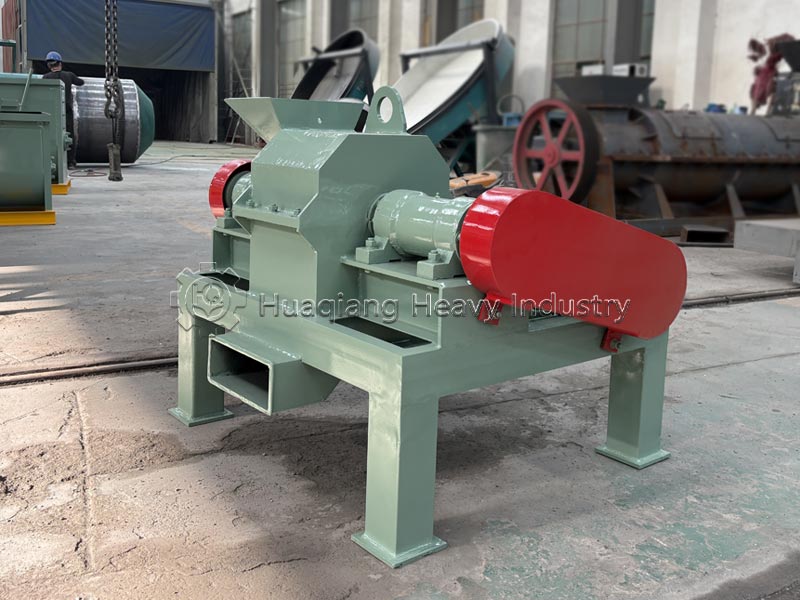 At the installation site, workers are busy hoisting this two-to-three-ton beast onto its foundation. The cage crusher demands near-perfect dynamic balance – even a slight misalignment in speed or concentricity between the two cage layers will make the machine shake like a drunken giant. An old hand uses a laser alignment tool, muttering, “If this cage is off by just one millimeter, the bearings will be toast in half a month.” A younger worker kneels by the feed inlet, shining a flashlight to check the cage bars for any welding cracks. Vibration sensors and a temperature gun lie on the floor, and the air smells of lubricating oil.
As fierce as the cage crusher is, it never fights alone. Upstream, there’s usually a twin-shaft mixer or a horizontal mixer – these first blend raw materials with water evenly, preventing excessive dust during crushing. Downstream, a disc granulator or a double roller press granulator waits – only the fine powder (over 90% passing through a 40-mesh screen) produced by the cage crusher can form round, hard pellets. Further down the line come the drum fertilizer dryer, cooler, screener, and automatic packaging scale – all linked by enclosed belt conveyors that keep dust inside while productivity soars.
On test day, workers put on masks and goggles. The machine starts up, and the two cage layers produce a sharp whirring sound. A few chunks of fermented material are fed into the inlet – a crisp “clattering” noise follows, and out of the discharge port drifts a cloud of fine gray-brown powder. Pinched between fingers, not a single hard lump remains. The workshop supervisor nods: “That’s exactly what we wanted.” Someone pats the housing and says, “Old buddy, you handle the demolition – leave the rest to the granulator.”
So don’t let the cage crusher’s rough appearance fool you. It’s like a well-trained beast – fierce, but with precision. Without it, stubborn clumps would become a nightmare for the granulator. With it, even the hardest “bones” turn to powder, ready to be reborn as smooth pellets. Next time you see a handful of fine, uniform organic fertilizer powder, think of that moment inside the steel cage – being torn to pieces can be a kind of talent, too.
At the installation site, workers are busy hoisting this two-to-three-ton beast onto its foundation. The cage crusher demands near-perfect dynamic balance – even a slight misalignment in speed or concentricity between the two cage layers will make the machine shake like a drunken giant. An old hand uses a laser alignment tool, muttering, “If this cage is off by just one millimeter, the bearings will be toast in half a month.” A younger worker kneels by the feed inlet, shining a flashlight to check the cage bars for any welding cracks. Vibration sensors and a temperature gun lie on the floor, and the air smells of lubricating oil.
As fierce as the cage crusher is, it never fights alone. Upstream, there’s usually a twin-shaft mixer or a horizontal mixer – these first blend raw materials with water evenly, preventing excessive dust during crushing. Downstream, a disc granulator or a double roller press granulator waits – only the fine powder (over 90% passing through a 40-mesh screen) produced by the cage crusher can form round, hard pellets. Further down the line come the drum fertilizer dryer, cooler, screener, and automatic packaging scale – all linked by enclosed belt conveyors that keep dust inside while productivity soars.
On test day, workers put on masks and goggles. The machine starts up, and the two cage layers produce a sharp whirring sound. A few chunks of fermented material are fed into the inlet – a crisp “clattering” noise follows, and out of the discharge port drifts a cloud of fine gray-brown powder. Pinched between fingers, not a single hard lump remains. The workshop supervisor nods: “That’s exactly what we wanted.” Someone pats the housing and says, “Old buddy, you handle the demolition – leave the rest to the granulator.”
So don’t let the cage crusher’s rough appearance fool you. It’s like a well-trained beast – fierce, but with precision. Without it, stubborn clumps would become a nightmare for the granulator. With it, even the hardest “bones” turn to powder, ready to be reborn as smooth pellets. Next time you see a handful of fine, uniform organic fertilizer powder, think of that moment inside the steel cage – being torn to pieces can be a kind of talent, too. 