
If you think a bucket elevator is just a "big chain of buckets," you're underestimating it. At the installation site of an organic fertilizer production line, this conveyor stands like a silent giant, reaching from the floor all the way to the ceiling. It has no tracks or tires, yet it can lift material from tens of meters below, bucket by bucket, up into the air – isn't that amazing?
On installation day, the workers first splice the casing sections together on the ground. The long housing looks like a train of railway cars waiting to depart. The most critical part is the circular chain or belt, densely fitted with steel or plastic buckets. The technicians carefully thread the chain over the head and boot pulleys, then tighten each bucket bolt one by one. "You can't rush this," says an old fitter. "If just one bucket is crooked, the whole elevator will start coughing." His joke draws laughter, but everyone knows: precision is everything.
 A crane slowly lifts the assembled casing upright, aligning it with the base flange while workers repeatedly check verticality with a spirit level. Even a slight deviation will cause the chain to run off track and the buckets to scrape against the casing. Meanwhile, the electrical control cabinet is being wired: a variable frequency drive, limit switches, an anti runback device – every component awaits its command. When the last section is secured, the elevator stands like a straight steel pillar, piercing toward the roof.
Around it, other fertilizer equipment is also taking its place. The twin screw compost turner is undergoing final hydraulic tests above the fermentation trough, its two giant screws rising and falling slowly. The mobile belt conveyor is pushed next to the elevator's inlet, ready to feed material. The chain crusher is no load testing, its rotor humming steadily. Beside the rotary screener machine, a worker adjusts the screen tension with a feeler gauge. And an automatic packing scale sits nearby, its sensors carefully covered with a dust cloth.
The whole installation feels like an orchestra rehearsal: the turner is the double bass, the cage crusher the brass section, and the bucket elevator – that harp – quiet and upright, yet capable of playing notes from the floor to the rafters. You might ask: with so many machines crowded together, how do they coordinate? The answer lies in the crisscrossing conveyors and chutes. Material flows from the turner to the crusher, from the crusher to the screener, and from the screener to the elevator's boot – then is lifted bucket by bucket to a high level dryer or cooler. Without the elevator, all horizontal conveying would just be a story of "Flatland."
On test day, the start button is pressed. The motor turns the head pulley slowly, the chain begins to circulate, and empty buckets climb one after another, tip over, and descend. When the first material pours into the inlet, the buckets gobble like hungry sparrows – dipping down, then rising high. At the top, centrifugal force flings the material into the discharge chute – the whole process flows like a short poem. A young technician can't resist taking a photo and captioning it: "This guy eats fast, climbs high, and never complains about being tired."
The setting sun casts a faint golden glow on the elevator casing. It still stands straight – a tireless worker, lifting waste from the ground, bucket by bucket, toward the bright road of becoming fertilizer. Do you still think it's just a "big chain of buckets"? No. It is the humblest and most persistent dreamer in the fertilizer plant – a dreamer heading straight up.
A crane slowly lifts the assembled casing upright, aligning it with the base flange while workers repeatedly check verticality with a spirit level. Even a slight deviation will cause the chain to run off track and the buckets to scrape against the casing. Meanwhile, the electrical control cabinet is being wired: a variable frequency drive, limit switches, an anti runback device – every component awaits its command. When the last section is secured, the elevator stands like a straight steel pillar, piercing toward the roof.
Around it, other fertilizer equipment is also taking its place. The twin screw compost turner is undergoing final hydraulic tests above the fermentation trough, its two giant screws rising and falling slowly. The mobile belt conveyor is pushed next to the elevator's inlet, ready to feed material. The chain crusher is no load testing, its rotor humming steadily. Beside the rotary screener machine, a worker adjusts the screen tension with a feeler gauge. And an automatic packing scale sits nearby, its sensors carefully covered with a dust cloth.
The whole installation feels like an orchestra rehearsal: the turner is the double bass, the cage crusher the brass section, and the bucket elevator – that harp – quiet and upright, yet capable of playing notes from the floor to the rafters. You might ask: with so many machines crowded together, how do they coordinate? The answer lies in the crisscrossing conveyors and chutes. Material flows from the turner to the crusher, from the crusher to the screener, and from the screener to the elevator's boot – then is lifted bucket by bucket to a high level dryer or cooler. Without the elevator, all horizontal conveying would just be a story of "Flatland."
On test day, the start button is pressed. The motor turns the head pulley slowly, the chain begins to circulate, and empty buckets climb one after another, tip over, and descend. When the first material pours into the inlet, the buckets gobble like hungry sparrows – dipping down, then rising high. At the top, centrifugal force flings the material into the discharge chute – the whole process flows like a short poem. A young technician can't resist taking a photo and captioning it: "This guy eats fast, climbs high, and never complains about being tired."
The setting sun casts a faint golden glow on the elevator casing. It still stands straight – a tireless worker, lifting waste from the ground, bucket by bucket, toward the bright road of becoming fertilizer. Do you still think it's just a "big chain of buckets"? No. It is the humblest and most persistent dreamer in the fertilizer plant – a dreamer heading straight up.
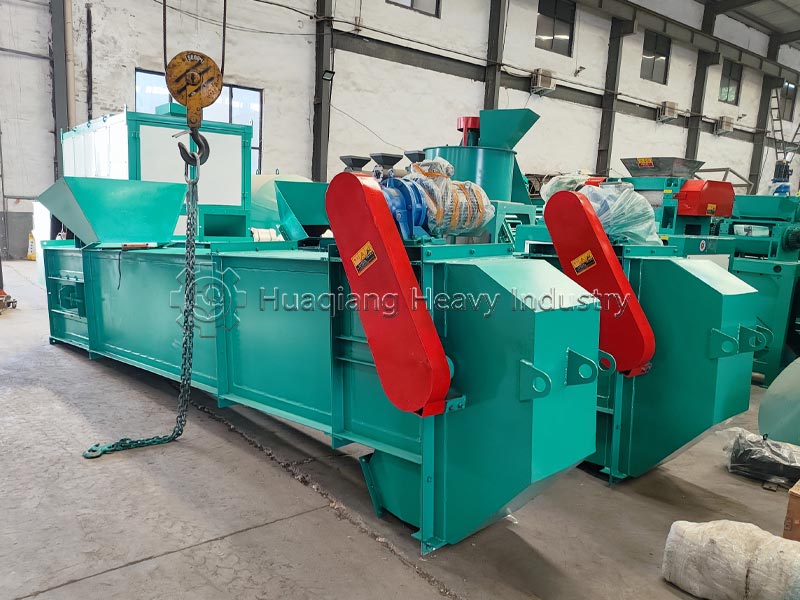 A crane slowly lifts the assembled casing upright, aligning it with the base flange while workers repeatedly check verticality with a spirit level. Even a slight deviation will cause the chain to run off track and the buckets to scrape against the casing. Meanwhile, the electrical control cabinet is being wired: a variable frequency drive, limit switches, an anti runback device – every component awaits its command. When the last section is secured, the elevator stands like a straight steel pillar, piercing toward the roof.
Around it, other fertilizer equipment is also taking its place. The twin screw compost turner is undergoing final hydraulic tests above the fermentation trough, its two giant screws rising and falling slowly. The mobile belt conveyor is pushed next to the elevator's inlet, ready to feed material. The chain crusher is no load testing, its rotor humming steadily. Beside the rotary screener machine, a worker adjusts the screen tension with a feeler gauge. And an automatic packing scale sits nearby, its sensors carefully covered with a dust cloth.
The whole installation feels like an orchestra rehearsal: the turner is the double bass, the cage crusher the brass section, and the bucket elevator – that harp – quiet and upright, yet capable of playing notes from the floor to the rafters. You might ask: with so many machines crowded together, how do they coordinate? The answer lies in the crisscrossing conveyors and chutes. Material flows from the turner to the crusher, from the crusher to the screener, and from the screener to the elevator's boot – then is lifted bucket by bucket to a high level dryer or cooler. Without the elevator, all horizontal conveying would just be a story of "Flatland."
On test day, the start button is pressed. The motor turns the head pulley slowly, the chain begins to circulate, and empty buckets climb one after another, tip over, and descend. When the first material pours into the inlet, the buckets gobble like hungry sparrows – dipping down, then rising high. At the top, centrifugal force flings the material into the discharge chute – the whole process flows like a short poem. A young technician can't resist taking a photo and captioning it: "This guy eats fast, climbs high, and never complains about being tired."
The setting sun casts a faint golden glow on the elevator casing. It still stands straight – a tireless worker, lifting waste from the ground, bucket by bucket, toward the bright road of becoming fertilizer. Do you still think it's just a "big chain of buckets"? No. It is the humblest and most persistent dreamer in the fertilizer plant – a dreamer heading straight up.
A crane slowly lifts the assembled casing upright, aligning it with the base flange while workers repeatedly check verticality with a spirit level. Even a slight deviation will cause the chain to run off track and the buckets to scrape against the casing. Meanwhile, the electrical control cabinet is being wired: a variable frequency drive, limit switches, an anti runback device – every component awaits its command. When the last section is secured, the elevator stands like a straight steel pillar, piercing toward the roof.
Around it, other fertilizer equipment is also taking its place. The twin screw compost turner is undergoing final hydraulic tests above the fermentation trough, its two giant screws rising and falling slowly. The mobile belt conveyor is pushed next to the elevator's inlet, ready to feed material. The chain crusher is no load testing, its rotor humming steadily. Beside the rotary screener machine, a worker adjusts the screen tension with a feeler gauge. And an automatic packing scale sits nearby, its sensors carefully covered with a dust cloth.
The whole installation feels like an orchestra rehearsal: the turner is the double bass, the cage crusher the brass section, and the bucket elevator – that harp – quiet and upright, yet capable of playing notes from the floor to the rafters. You might ask: with so many machines crowded together, how do they coordinate? The answer lies in the crisscrossing conveyors and chutes. Material flows from the turner to the crusher, from the crusher to the screener, and from the screener to the elevator's boot – then is lifted bucket by bucket to a high level dryer or cooler. Without the elevator, all horizontal conveying would just be a story of "Flatland."
On test day, the start button is pressed. The motor turns the head pulley slowly, the chain begins to circulate, and empty buckets climb one after another, tip over, and descend. When the first material pours into the inlet, the buckets gobble like hungry sparrows – dipping down, then rising high. At the top, centrifugal force flings the material into the discharge chute – the whole process flows like a short poem. A young technician can't resist taking a photo and captioning it: "This guy eats fast, climbs high, and never complains about being tired."
The setting sun casts a faint golden glow on the elevator casing. It still stands straight – a tireless worker, lifting waste from the ground, bucket by bucket, toward the bright road of becoming fertilizer. Do you still think it's just a "big chain of buckets"? No. It is the humblest and most persistent dreamer in the fertilizer plant – a dreamer heading straight up.
