
Granulation and drying are key, interdependent processes in NPK production; parameter imbalances can directly lead to granule defects. The key lies in precisely matching the moisture content of the feed material, the granule size distribution, and the drying curve.
 Granulation Control: When using a rotary granulator, the material moisture content should be stabilized between 30% and 35%. An appropriate amount of recycle material (fines) should be added to serve as "nuclei," promoting layer-by-layer growth. If granules larger than 5mm exceed 15% of the granulator's output, the disparity in residence time between large and small granules within the dryer increases; small granules may over-dry and pulverize, while large granules may retain internal moisture. In this case, adjust the drum inclination (typically 2°–4°) or rotation speed (10–15 rpm) and check the atomization quality of the steam or spray water.
Drying Process Matching: The hot air temperature and material residence time in the rotary dryer must be coordinated. Typically, the inlet air temperature is controlled at 180°C–220°C, the outlet air temperature at 70°C–90°C, and the drum rotation speed at 6–8 rpm. Crucial factors include controlling the material fill rate (usually 10%–15%) and the angle of the lifting flights to ensure a uniform material curtain and prevent localized overheating. If the drying rate is too rapid (e.g., moisture dropping abruptly from 8% to 1%), uneven surface shrinkage and internal expansion can cause micro-cracks; conversely, if the discharge moisture exceeds 3%, the product is prone to moisture absorption and caking after packaging.
Practical Recommendation: For high-nitrogen formulations (e.g., 25-10-5), which are highly hygroscopic, the drying temperature should be lowered (≤200°C), and an anti-caking agent spraying system should be installed after the cooling stage to enhance product storage stability. We recommend that clients employ the "moisture gradient method" during the production commissioning phase: sampling and testing the moisture content at the dryer outlet every half hour to plot a moisture variation curve, and using this data to fine-tune the feed rate and hot air valve opening until a stable equilibrium is achieved.
Granulation Control: When using a rotary granulator, the material moisture content should be stabilized between 30% and 35%. An appropriate amount of recycle material (fines) should be added to serve as "nuclei," promoting layer-by-layer growth. If granules larger than 5mm exceed 15% of the granulator's output, the disparity in residence time between large and small granules within the dryer increases; small granules may over-dry and pulverize, while large granules may retain internal moisture. In this case, adjust the drum inclination (typically 2°–4°) or rotation speed (10–15 rpm) and check the atomization quality of the steam or spray water.
Drying Process Matching: The hot air temperature and material residence time in the rotary dryer must be coordinated. Typically, the inlet air temperature is controlled at 180°C–220°C, the outlet air temperature at 70°C–90°C, and the drum rotation speed at 6–8 rpm. Crucial factors include controlling the material fill rate (usually 10%–15%) and the angle of the lifting flights to ensure a uniform material curtain and prevent localized overheating. If the drying rate is too rapid (e.g., moisture dropping abruptly from 8% to 1%), uneven surface shrinkage and internal expansion can cause micro-cracks; conversely, if the discharge moisture exceeds 3%, the product is prone to moisture absorption and caking after packaging.
Practical Recommendation: For high-nitrogen formulations (e.g., 25-10-5), which are highly hygroscopic, the drying temperature should be lowered (≤200°C), and an anti-caking agent spraying system should be installed after the cooling stage to enhance product storage stability. We recommend that clients employ the "moisture gradient method" during the production commissioning phase: sampling and testing the moisture content at the dryer outlet every half hour to plot a moisture variation curve, and using this data to fine-tune the feed rate and hot air valve opening until a stable equilibrium is achieved.
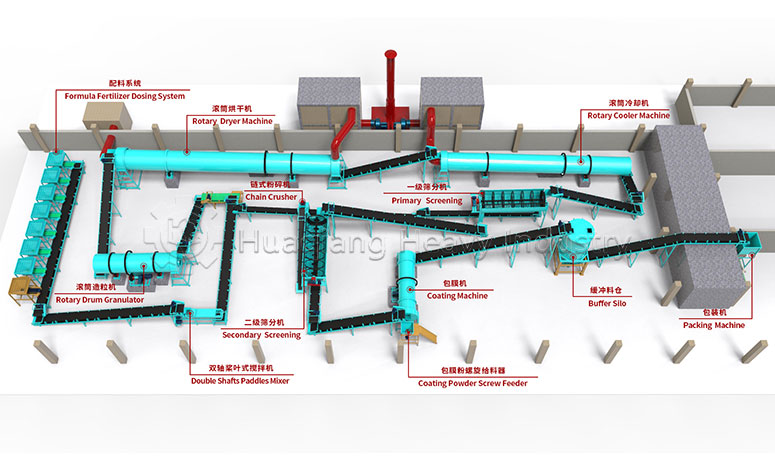 Granulation Control: When using a rotary granulator, the material moisture content should be stabilized between 30% and 35%. An appropriate amount of recycle material (fines) should be added to serve as "nuclei," promoting layer-by-layer growth. If granules larger than 5mm exceed 15% of the granulator's output, the disparity in residence time between large and small granules within the dryer increases; small granules may over-dry and pulverize, while large granules may retain internal moisture. In this case, adjust the drum inclination (typically 2°–4°) or rotation speed (10–15 rpm) and check the atomization quality of the steam or spray water.
Drying Process Matching: The hot air temperature and material residence time in the rotary dryer must be coordinated. Typically, the inlet air temperature is controlled at 180°C–220°C, the outlet air temperature at 70°C–90°C, and the drum rotation speed at 6–8 rpm. Crucial factors include controlling the material fill rate (usually 10%–15%) and the angle of the lifting flights to ensure a uniform material curtain and prevent localized overheating. If the drying rate is too rapid (e.g., moisture dropping abruptly from 8% to 1%), uneven surface shrinkage and internal expansion can cause micro-cracks; conversely, if the discharge moisture exceeds 3%, the product is prone to moisture absorption and caking after packaging.
Practical Recommendation: For high-nitrogen formulations (e.g., 25-10-5), which are highly hygroscopic, the drying temperature should be lowered (≤200°C), and an anti-caking agent spraying system should be installed after the cooling stage to enhance product storage stability. We recommend that clients employ the "moisture gradient method" during the production commissioning phase: sampling and testing the moisture content at the dryer outlet every half hour to plot a moisture variation curve, and using this data to fine-tune the feed rate and hot air valve opening until a stable equilibrium is achieved.
Granulation Control: When using a rotary granulator, the material moisture content should be stabilized between 30% and 35%. An appropriate amount of recycle material (fines) should be added to serve as "nuclei," promoting layer-by-layer growth. If granules larger than 5mm exceed 15% of the granulator's output, the disparity in residence time between large and small granules within the dryer increases; small granules may over-dry and pulverize, while large granules may retain internal moisture. In this case, adjust the drum inclination (typically 2°–4°) or rotation speed (10–15 rpm) and check the atomization quality of the steam or spray water.
Drying Process Matching: The hot air temperature and material residence time in the rotary dryer must be coordinated. Typically, the inlet air temperature is controlled at 180°C–220°C, the outlet air temperature at 70°C–90°C, and the drum rotation speed at 6–8 rpm. Crucial factors include controlling the material fill rate (usually 10%–15%) and the angle of the lifting flights to ensure a uniform material curtain and prevent localized overheating. If the drying rate is too rapid (e.g., moisture dropping abruptly from 8% to 1%), uneven surface shrinkage and internal expansion can cause micro-cracks; conversely, if the discharge moisture exceeds 3%, the product is prone to moisture absorption and caking after packaging.
Practical Recommendation: For high-nitrogen formulations (e.g., 25-10-5), which are highly hygroscopic, the drying temperature should be lowered (≤200°C), and an anti-caking agent spraying system should be installed after the cooling stage to enhance product storage stability. We recommend that clients employ the "moisture gradient method" during the production commissioning phase: sampling and testing the moisture content at the dryer outlet every half hour to plot a moisture variation curve, and using this data to fine-tune the feed rate and hot air valve opening until a stable equilibrium is achieved. 