
In the wave of modern agricultural transformation and upgrading, the precise upgrading of NPK fertilizer production lines has become key to solving agricultural nutrient waste and improving production efficiency. Traditional compound fertilizer production suffers from problems such as imprecise formulations and outdated processes, making it difficult to meet the individualized needs of different crops and soils. However, technological innovations in modern NPK fertilizer production lines are fundamentally changing this situation.
Today's NPK fertilizer production lines, relying on automated batching systems and intelligent detection technology, achieve precise proportioning of the three major elements: nitrogen, phosphorus, and potassium, with an error rate controllable to below 0.2%. Real-time monitoring of raw material input through electronic scales, combined with big data analysis of soil fertility and crop needs, allows for rapid customization of specific formulas. For example, a high-nitrogen formula can be developed for wheat cultivation to promote tillering and strong seedlings; a high-phosphorus and potassium formula can be designed for fruit tree cultivation to promote flower bud differentiation and fruit coloring.
 Upgrades to core processes such as granulation and coating further improve fertilizer quality. Drum granulation technology produces uniform and rounded granules, facilitating mechanized sowing and reducing labor costs; polymer coating technology allows for slow nutrient release, extending the effective period by more than 30%, effectively reducing nutrient loss and soil compaction. At the same time, standardized management throughout the entire process, from raw material selection to finished product testing, ensures stable fertilizer quality with strict standards at every stage.
The precisely upgraded NPK fertilizer production lines not only improve fertilizer utilization efficiency but also promote the transformation of agriculture towards cost reduction, increased efficiency, and environmental protection. Data shows that using precisely formulated compound fertilizers can increase crop yields by 15%-20% and reduce fertilizer consumption by 30%, ensuring food security while reducing environmental burden, becoming an important support for the high-quality development of modern agriculture.
Upgrades to core processes such as granulation and coating further improve fertilizer quality. Drum granulation technology produces uniform and rounded granules, facilitating mechanized sowing and reducing labor costs; polymer coating technology allows for slow nutrient release, extending the effective period by more than 30%, effectively reducing nutrient loss and soil compaction. At the same time, standardized management throughout the entire process, from raw material selection to finished product testing, ensures stable fertilizer quality with strict standards at every stage.
The precisely upgraded NPK fertilizer production lines not only improve fertilizer utilization efficiency but also promote the transformation of agriculture towards cost reduction, increased efficiency, and environmental protection. Data shows that using precisely formulated compound fertilizers can increase crop yields by 15%-20% and reduce fertilizer consumption by 30%, ensuring food security while reducing environmental burden, becoming an important support for the high-quality development of modern agriculture.
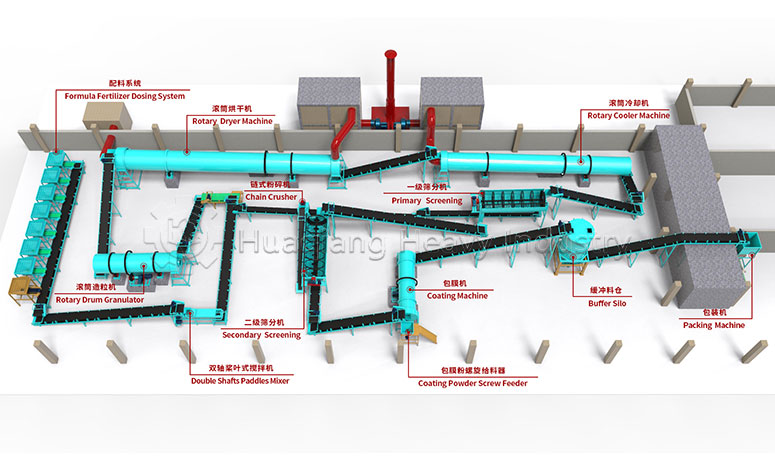 Upgrades to core processes such as granulation and coating further improve fertilizer quality. Drum granulation technology produces uniform and rounded granules, facilitating mechanized sowing and reducing labor costs; polymer coating technology allows for slow nutrient release, extending the effective period by more than 30%, effectively reducing nutrient loss and soil compaction. At the same time, standardized management throughout the entire process, from raw material selection to finished product testing, ensures stable fertilizer quality with strict standards at every stage.
The precisely upgraded NPK fertilizer production lines not only improve fertilizer utilization efficiency but also promote the transformation of agriculture towards cost reduction, increased efficiency, and environmental protection. Data shows that using precisely formulated compound fertilizers can increase crop yields by 15%-20% and reduce fertilizer consumption by 30%, ensuring food security while reducing environmental burden, becoming an important support for the high-quality development of modern agriculture.
Upgrades to core processes such as granulation and coating further improve fertilizer quality. Drum granulation technology produces uniform and rounded granules, facilitating mechanized sowing and reducing labor costs; polymer coating technology allows for slow nutrient release, extending the effective period by more than 30%, effectively reducing nutrient loss and soil compaction. At the same time, standardized management throughout the entire process, from raw material selection to finished product testing, ensures stable fertilizer quality with strict standards at every stage.
The precisely upgraded NPK fertilizer production lines not only improve fertilizer utilization efficiency but also promote the transformation of agriculture towards cost reduction, increased efficiency, and environmental protection. Data shows that using precisely formulated compound fertilizers can increase crop yields by 15%-20% and reduce fertilizer consumption by 30%, ensuring food security while reducing environmental burden, becoming an important support for the high-quality development of modern agriculture. 