
Once decomposed, pig manure features a fine texture and moderate stickiness, making it an excellent raw material for granulation. However, disc granulators and new type organic fertilizer granulator yield different processing results; the choice depends on your product positioning.
Pig manure typically has a high moisture content. After decomposition, it becomes fine-textured and moderately sticky, but it often contains a significant amount of sand, which poses a hidden challenge in terms of equipment wear. Before granulation, the moisture content should be adjusted to 25%–35%, and the particle fineness should be controlled to below 1 mm.
Disc Granulator: Gentle Rolling for a Superior Appearance
A disc granulator operates by rotating a tilted disc at a low speed; as water is sprayed onto the powdered material, it rolls layer by layer into granules. The process involves no compression or heat generation, keeping the material temperature stable at 45–55°C—an ideal range for preserving the viability of microbial strains in bio-organic fertilizers. The resulting granules are round, smooth, and visually appealing, making them well-suited for markets serving orchards, tea plantations, and other high-value commercial crops. However, disc granulators are highly sensitive to moisture levels: if the material is too wet, it tends to stick to the disc and form clumps; if it is too dry, it fails to granulate. Furthermore, the capacity of a single unit is limited, making it better suited for small- to medium-scale operations.
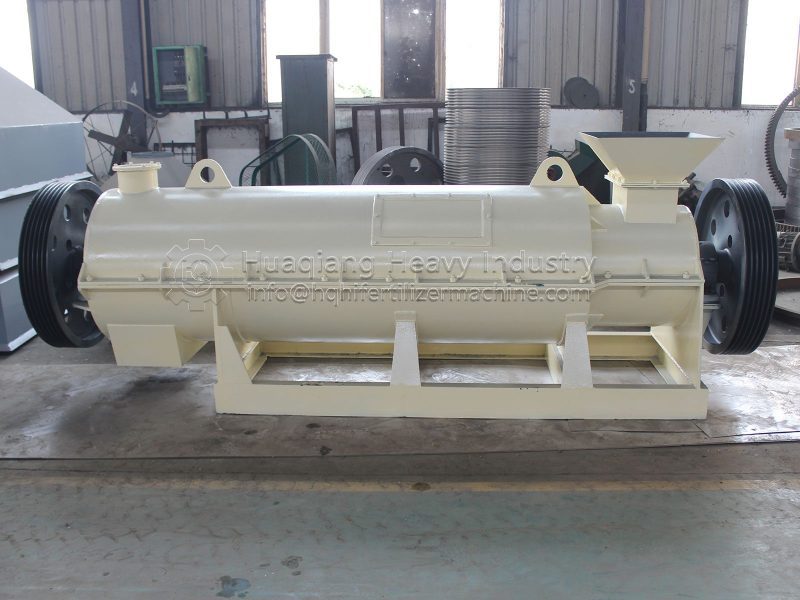 New Type Organic Fertilizer Granulator: High-Shear Processing for Maximum Efficiency
A new type organic fertilizer granulator uses a high-speed rotor equipped with "teeth" to vigorously stir, shear, and propel the material, causing the powder to rapidly aggregate into granules. This method achieves a granulation rate of over 90%, producing granules with higher density and strength than those made by a disc granulator. It is ideal for large-scale, continuous production and is more tolerant of fluctuations in moisture content, making it less prone to clogging. On the downside, the high-speed rotation causes significant wear when processing materials containing sand; consequently, the stirring teeth and the inner walls of the chamber require wear-resistant treatment. Additionally, this type of equipment entails higher energy consumption and greater initial investment.
In summary, if your priorities are round, smooth granules, the production of bio-fertilizers, or smaller-scale operations, a disc granulator is the more reliable choice. If, however, you are focused on high production capacity, granule strength, and large-scale manufacturing, a new type organic fertilizer granulator is the better option.
New Type Organic Fertilizer Granulator: High-Shear Processing for Maximum Efficiency
A new type organic fertilizer granulator uses a high-speed rotor equipped with "teeth" to vigorously stir, shear, and propel the material, causing the powder to rapidly aggregate into granules. This method achieves a granulation rate of over 90%, producing granules with higher density and strength than those made by a disc granulator. It is ideal for large-scale, continuous production and is more tolerant of fluctuations in moisture content, making it less prone to clogging. On the downside, the high-speed rotation causes significant wear when processing materials containing sand; consequently, the stirring teeth and the inner walls of the chamber require wear-resistant treatment. Additionally, this type of equipment entails higher energy consumption and greater initial investment.
In summary, if your priorities are round, smooth granules, the production of bio-fertilizers, or smaller-scale operations, a disc granulator is the more reliable choice. If, however, you are focused on high production capacity, granule strength, and large-scale manufacturing, a new type organic fertilizer granulator is the better option.
New Type Organic Fertilizer Granulator: High-Shear Processing for Maximum Efficiency
A new type organic fertilizer granulator uses a high-speed rotor equipped with "teeth" to vigorously stir, shear, and propel the material, causing the powder to rapidly aggregate into granules. This method achieves a granulation rate of over 90%, producing granules with higher density and strength than those made by a disc granulator. It is ideal for large-scale, continuous production and is more tolerant of fluctuations in moisture content, making it less prone to clogging. On the downside, the high-speed rotation causes significant wear when processing materials containing sand; consequently, the stirring teeth and the inner walls of the chamber require wear-resistant treatment. Additionally, this type of equipment entails higher energy consumption and greater initial investment.
In summary, if your priorities are round, smooth granules, the production of bio-fertilizers, or smaller-scale operations, a disc granulator is the more reliable choice. If, however, you are focused on high production capacity, granule strength, and large-scale manufacturing, a new type organic fertilizer granulator is the better option. 