
The "green" in green organic fertilizer does not refer to the color of the granules, but rather to the fact that the entire process is controllable: raw materials are safe, decomposition (fermentation) is thorough, no prohibited additives are used, and functional microbial agents remain active. A disc granulation line can indeed produce green organic fertilizer, provided that the disc granulator is integrated into a clean, well-managed production chain.
The inherent advantages of disc granulation align perfectly with the requirements for "green" standards: the process relies on the low-speed rolling of materials within an inclined disc, using water as a "liquid bridge" rather than chemical binders. Since no heat is generated through compression, the material temperature remains between ambient levels and 45–55°C; this preserves the organic matter and ensures the survival of any added beneficial microorganisms. The resulting granules are round, uniform, and commercially attractive, making them well-suited for use in high-value cash crops and branded agricultural products.
 However, disc granulation is demanding regarding the input materials; the real work happens upstream. Fermentation must be complete—incompletely decomposed material can cause "root burn" and will fail safety inspections. Before entering the production line, raw materials should be tested for heavy metals, salt content, and antibiotic residues. The material must be pulverized to a fineness of less than 1mm, with a moisture content stabilized between 25% and 35%; only clean water should be used for moistening. The drying stage following granulation is equally critical: for bio-organic products, low-temperature drying (≤50°C) is essential to prevent the inactivation of microbial strains.
Two often-overlooked details include: thoroughly clearing the equipment between batches to prevent cross-contamination between conventional and "green" fertilizers, and separately collecting "undersized" granules (fines) rather than mixing them back into the fresh raw material. Disc granulation lines have limited single-unit capacity and are highly sensitive to moisture levels; furthermore, high-fiber materials often have lower granulation rates. These limitations must be addressed through careful upstream pulverization, precise formulation, and strict moisture control.
In short, while a disc granulation production line serves as an effective "shaping tool" for green organic fertilizer, the "green" quality is the result of the entire organic fertilizer production process—ensuring clean sources, thorough fermentation, gentle granulation, and low-temperature drying. If any of these links are missing, the product cannot be considered truly "green" organic fertilizer.
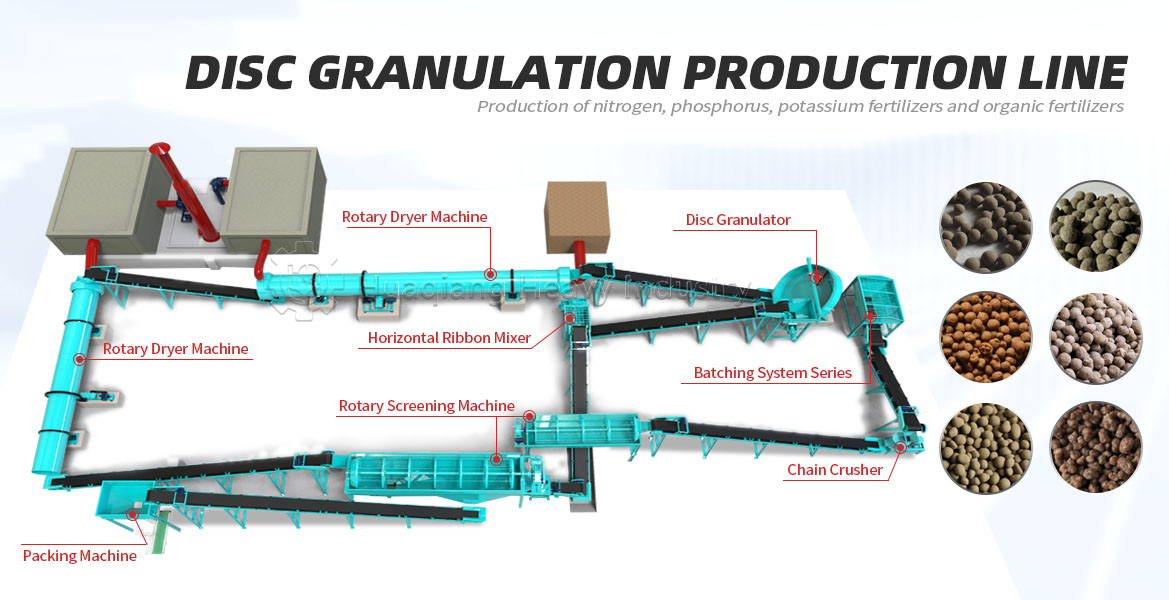 However, disc granulation is demanding regarding the input materials; the real work happens upstream. Fermentation must be complete—incompletely decomposed material can cause "root burn" and will fail safety inspections. Before entering the production line, raw materials should be tested for heavy metals, salt content, and antibiotic residues. The material must be pulverized to a fineness of less than 1mm, with a moisture content stabilized between 25% and 35%; only clean water should be used for moistening. The drying stage following granulation is equally critical: for bio-organic products, low-temperature drying (≤50°C) is essential to prevent the inactivation of microbial strains.
Two often-overlooked details include: thoroughly clearing the equipment between batches to prevent cross-contamination between conventional and "green" fertilizers, and separately collecting "undersized" granules (fines) rather than mixing them back into the fresh raw material. Disc granulation lines have limited single-unit capacity and are highly sensitive to moisture levels; furthermore, high-fiber materials often have lower granulation rates. These limitations must be addressed through careful upstream pulverization, precise formulation, and strict moisture control.
In short, while a disc granulation production line serves as an effective "shaping tool" for green organic fertilizer, the "green" quality is the result of the entire organic fertilizer production process—ensuring clean sources, thorough fermentation, gentle granulation, and low-temperature drying. If any of these links are missing, the product cannot be considered truly "green" organic fertilizer.
