Belt Conveyor: The Silent Backbone of Material Movement
In the sprawling industrial landscape of fertilizer production, where massive machines crush, mix, granulate, and pack, one unassuming workhorse operates continuously, often unnoticed yet absolutely indispensable. The Belt Conveyor is the silent circulatory system of the entire operation. It requires no dazzling technology or complex controls, yet without its steady, reliable movement, the most sophisticated granulator or precision blender would stand idle, starved of material or choked with product. It is the quiet backbone upon which all productivity rests.
Core Principle: Simplicity Engineered for Reliability
This apparent simplicity, however, conceals generations of engineering refinement. The belt must maintain precise tracking to avoid edge damage. The idler rollers supporting the belt along its length must minimize friction while withstanding constant abrasion. The loading and transfer points must absorb impact and control dust. A well-designed belt conveyor is a study in balanced mechanical harmony.
Key Advantages: Why This Technology Endures
Despite its basic appearance, the belt conveyor offers a suite of capabilities that no alternative has surpassed in general material handling.
Unrivaled Capacity and Distance
Belt conveyors can move thousands of tons per hour over distances of many kilometers with a single continuous drive system. No truck fleet, screw conveyor, or pneumatic system approaches this combination of volume and range.
Gentle and Consistent Material Handling
The material rests stationary on the belt surface, moving at a uniform speed without vibration, tumbling, or agitation. This is critical for friable granules and coated products that cannot tolerate degradation. Once a premium fertilizer granule is formed, the belt conveyor is the safest way to transport it to storage or packaging.
Exceptional Energy Efficiency
Moving material on a belt over flat terrain requires remarkably little power. The rolling resistance of quality idlers and the flexure of the belt itself are the primary energy demands. For equivalent tonnage over distance, a belt conveyor consumes a fraction of the energy required by truck haulage or pneumatic systems.
Complete Flexibility in Configuration
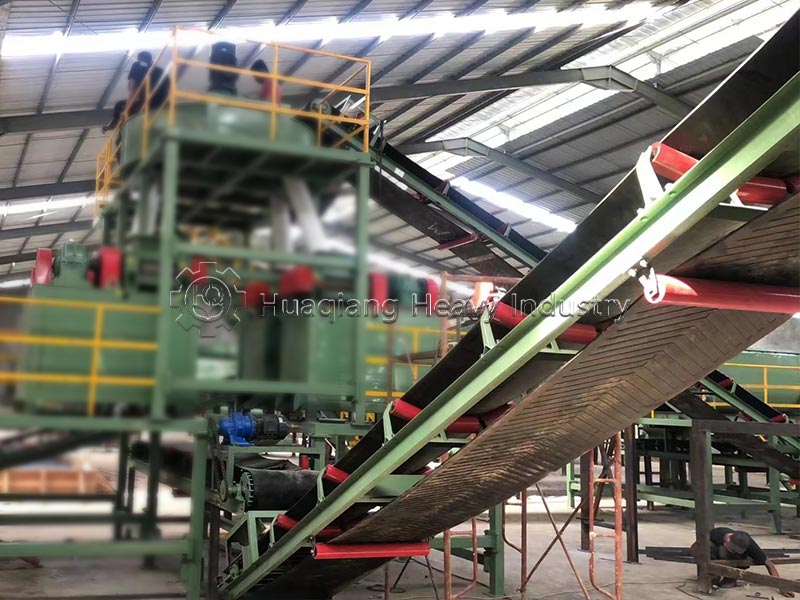
Belt conveyors are not limited to straight, horizontal paths. They can be configured to ascend at angles up to 20 degrees with smooth belts, and much steeper angles using specialized cleated or pocket belt designs. They can curve horizontally, incorporate multiple discharge points via trippers or plows, and be arranged in complex networks to serve an entire facility.
Synergistic Role: The Integrator of Processes
In a fertilizer plant, individual machines perform specialized transformations. The belt conveyor is the integrator that links them into a coherent system.
Reception and Feed: Heavy-duty apron feeders or belt feeders beneath loader feeding hoppers transfer raw materials onto conveyors that supply crushers, screens, and mixers.
Inter-Process Transfer: From the discharge of a double shaft mixer to the inlet of a disc granulator or rotary drum, belt conveyors provide the controlled, steady flow essential for uniform granulation.
Thermal Line Transport: Hot, moist granules exiting a rotary dryer are gently carried to a cooler, then to screening stations, without damaging the delicate pellets.
Finished Product Logistics: Conveyors elevate finished goods to high-capacity storage silos, feed high-speed packaging machines, and load bulk trucks or railcars, often operating continuously for days or weeks.
Comparative Positioning: Belt vs. Alternative Conveyors
Evolution and Future: The Intelligent Conveyor
The belt conveyor of the future is evolving from a passive transport device into an intelligent, self-monitoring component of the digital plant.
Smart Idler Technology: Idler rollers equipped with wireless sensors continuously report bearing temperature, vibration, and rotational status, enabling predictive maintenance and preventing catastrophic failures.

 Key Advantages: Why This Technology Endures
Despite its basic appearance, the belt conveyor offers a suite of capabilities that no alternative has surpassed in general material handling.
Unrivaled Capacity and Distance
Belt conveyors can move thousands of tons per hour over distances of many kilometers with a single continuous drive system. No truck fleet, screw conveyor, or pneumatic system approaches this combination of volume and range.
Gentle and Consistent Material Handling
The material rests stationary on the belt surface, moving at a uniform speed without vibration, tumbling, or agitation. This is critical for friable granules and coated products that cannot tolerate degradation. Once a premium fertilizer granule is formed, the belt conveyor is the safest way to transport it to storage or packaging.
Exceptional Energy Efficiency
Moving material on a belt over flat terrain requires remarkably little power. The rolling resistance of quality idlers and the flexure of the belt itself are the primary energy demands. For equivalent tonnage over distance, a belt conveyor consumes a fraction of the energy required by truck haulage or pneumatic systems.
Complete Flexibility in Configuration
Belt conveyors are not limited to straight, horizontal paths. They can be configured to ascend at angles up to 20 degrees with smooth belts, and much steeper angles using specialized cleated or pocket belt designs. They can curve horizontally, incorporate multiple discharge points via trippers or plows, and be arranged in complex networks to serve an entire facility.
Synergistic Role: The Integrator of Processes
In a fertilizer plant, individual machines perform specialized transformations. The belt conveyor is the integrator that links them into a coherent system.
Reception and Feed: Heavy-duty apron feeders or belt feeders beneath loader feeding hoppers transfer raw materials onto conveyors that supply crushers, screens, and mixers.
Inter-Process Transfer: From the discharge of a double shaft mixer to the inlet of a disc granulator or rotary drum, belt conveyors provide the controlled, steady flow essential for uniform granulation.
Thermal Line Transport: Hot, moist granules exiting a rotary dryer are gently carried to a cooler, then to screening stations, without damaging the delicate pellets.
Finished Product Logistics: Conveyors elevate finished goods to high-capacity storage silos, feed high-speed packaging machines, and load bulk trucks or railcars, often operating continuously for days or weeks.
Comparative Positioning: Belt vs. Alternative Conveyors
Key Advantages: Why This Technology Endures
Despite its basic appearance, the belt conveyor offers a suite of capabilities that no alternative has surpassed in general material handling.
Unrivaled Capacity and Distance
Belt conveyors can move thousands of tons per hour over distances of many kilometers with a single continuous drive system. No truck fleet, screw conveyor, or pneumatic system approaches this combination of volume and range.
Gentle and Consistent Material Handling
The material rests stationary on the belt surface, moving at a uniform speed without vibration, tumbling, or agitation. This is critical for friable granules and coated products that cannot tolerate degradation. Once a premium fertilizer granule is formed, the belt conveyor is the safest way to transport it to storage or packaging.
Exceptional Energy Efficiency
Moving material on a belt over flat terrain requires remarkably little power. The rolling resistance of quality idlers and the flexure of the belt itself are the primary energy demands. For equivalent tonnage over distance, a belt conveyor consumes a fraction of the energy required by truck haulage or pneumatic systems.
Complete Flexibility in Configuration
Belt conveyors are not limited to straight, horizontal paths. They can be configured to ascend at angles up to 20 degrees with smooth belts, and much steeper angles using specialized cleated or pocket belt designs. They can curve horizontally, incorporate multiple discharge points via trippers or plows, and be arranged in complex networks to serve an entire facility.
Synergistic Role: The Integrator of Processes
In a fertilizer plant, individual machines perform specialized transformations. The belt conveyor is the integrator that links them into a coherent system.
Reception and Feed: Heavy-duty apron feeders or belt feeders beneath loader feeding hoppers transfer raw materials onto conveyors that supply crushers, screens, and mixers.
Inter-Process Transfer: From the discharge of a double shaft mixer to the inlet of a disc granulator or rotary drum, belt conveyors provide the controlled, steady flow essential for uniform granulation.
Thermal Line Transport: Hot, moist granules exiting a rotary dryer are gently carried to a cooler, then to screening stations, without damaging the delicate pellets.
Finished Product Logistics: Conveyors elevate finished goods to high-capacity storage silos, feed high-speed packaging machines, and load bulk trucks or railcars, often operating continuously for days or weeks.
Comparative Positioning: Belt vs. Alternative Conveyors
 Key Advantages: Why This Technology Endures
Despite its basic appearance, the belt conveyor offers a suite of capabilities that no alternative has surpassed in general material handling.
Unrivaled Capacity and Distance
Belt conveyors can move thousands of tons per hour over distances of many kilometers with a single continuous drive system. No truck fleet, screw conveyor, or pneumatic system approaches this combination of volume and range.
Gentle and Consistent Material Handling
The material rests stationary on the belt surface, moving at a uniform speed without vibration, tumbling, or agitation. This is critical for friable granules and coated products that cannot tolerate degradation. Once a premium fertilizer granule is formed, the belt conveyor is the safest way to transport it to storage or packaging.
Exceptional Energy Efficiency
Moving material on a belt over flat terrain requires remarkably little power. The rolling resistance of quality idlers and the flexure of the belt itself are the primary energy demands. For equivalent tonnage over distance, a belt conveyor consumes a fraction of the energy required by truck haulage or pneumatic systems.
Complete Flexibility in Configuration
Belt conveyors are not limited to straight, horizontal paths. They can be configured to ascend at angles up to 20 degrees with smooth belts, and much steeper angles using specialized cleated or pocket belt designs. They can curve horizontally, incorporate multiple discharge points via trippers or plows, and be arranged in complex networks to serve an entire facility.
Synergistic Role: The Integrator of Processes
In a fertilizer plant, individual machines perform specialized transformations. The belt conveyor is the integrator that links them into a coherent system.
Reception and Feed: Heavy-duty apron feeders or belt feeders beneath loader feeding hoppers transfer raw materials onto conveyors that supply crushers, screens, and mixers.
Inter-Process Transfer: From the discharge of a double shaft mixer to the inlet of a disc granulator or rotary drum, belt conveyors provide the controlled, steady flow essential for uniform granulation.
Thermal Line Transport: Hot, moist granules exiting a rotary dryer are gently carried to a cooler, then to screening stations, without damaging the delicate pellets.
Finished Product Logistics: Conveyors elevate finished goods to high-capacity storage silos, feed high-speed packaging machines, and load bulk trucks or railcars, often operating continuously for days or weeks.
Comparative Positioning: Belt vs. Alternative Conveyors
Key Advantages: Why This Technology Endures
Despite its basic appearance, the belt conveyor offers a suite of capabilities that no alternative has surpassed in general material handling.
Unrivaled Capacity and Distance
Belt conveyors can move thousands of tons per hour over distances of many kilometers with a single continuous drive system. No truck fleet, screw conveyor, or pneumatic system approaches this combination of volume and range.
Gentle and Consistent Material Handling
The material rests stationary on the belt surface, moving at a uniform speed without vibration, tumbling, or agitation. This is critical for friable granules and coated products that cannot tolerate degradation. Once a premium fertilizer granule is formed, the belt conveyor is the safest way to transport it to storage or packaging.
Exceptional Energy Efficiency
Moving material on a belt over flat terrain requires remarkably little power. The rolling resistance of quality idlers and the flexure of the belt itself are the primary energy demands. For equivalent tonnage over distance, a belt conveyor consumes a fraction of the energy required by truck haulage or pneumatic systems.
Complete Flexibility in Configuration
Belt conveyors are not limited to straight, horizontal paths. They can be configured to ascend at angles up to 20 degrees with smooth belts, and much steeper angles using specialized cleated or pocket belt designs. They can curve horizontally, incorporate multiple discharge points via trippers or plows, and be arranged in complex networks to serve an entire facility.
Synergistic Role: The Integrator of Processes
In a fertilizer plant, individual machines perform specialized transformations. The belt conveyor is the integrator that links them into a coherent system.
Reception and Feed: Heavy-duty apron feeders or belt feeders beneath loader feeding hoppers transfer raw materials onto conveyors that supply crushers, screens, and mixers.
Inter-Process Transfer: From the discharge of a double shaft mixer to the inlet of a disc granulator or rotary drum, belt conveyors provide the controlled, steady flow essential for uniform granulation.
Thermal Line Transport: Hot, moist granules exiting a rotary dryer are gently carried to a cooler, then to screening stations, without damaging the delicate pellets.
Finished Product Logistics: Conveyors elevate finished goods to high-capacity storage silos, feed high-speed packaging machines, and load bulk trucks or railcars, often operating continuously for days or weeks.
Comparative Positioning: Belt vs. Alternative Conveyors
