
When you walk into the installation site of an organic fertilizer production line, it’s easy to be drawn to the towering granulators and dryers. But have you ever noticed that unassuming black belt lying quietly on the ground? That’s the belt conveyor – the line’s humble mover, and its most overlooked yet indispensable backbone.
A belt conveyor looks simple: a loop of rubber belt, two drums at each end, rollers supporting the middle, and a motor that turns the whole thing. But this “honest worker” carries all the material flow from crushing to packaging. Without it, raw materials would have to be moved shovel by shovel – workers’ backs would break, and output would stay low.
 On the installation site, workers are piecing together the conveyor sections like building blocks. Each section must be leveled and aligned – if a leg is off by one centimeter, the belt will run to one side, fray, spill material, or even tear. An old hand crouches on the floor with a level, shouting, “Two more millimeters on the left!” A younger worker quickly slides in a shim and tightens the bolt with a clank. Idlers are installed one by one, with just the right spacing – too far apart, and the belt sags into a hammock where material won’t move. The belt splice is the trickiest part: either a mechanical fastener or hot vulcanization. Mechanical fasteners are easy but can damage the drum. Hot vulcanization takes time and effort, but the result is a seamless belt – no joint mark. Large production lines usually choose hot vulcanization. Several workers gather around the vulcanizer, waiting for the temperature to hit 140°C, then apply pressure and hold it. One splice can take an hour or two.
Belt conveyors come in many “brothers.” Horizontal ones for long hauls; inclined ones to lift material from low to high, feeding the rotary drum granulator; and chevron belt conveyors with cleats to stop pellets from rolling back. They link end to end, tying the chain fertilizer crusher, mixer, granulator, dryer, cooler, screener, and packaging scale into one complete dragon. Material slides out of the crusher onto a belt; the belt carries it up and over, dumping it into the mixer; out of the mixer onto another belt, headed to the granulator… on and on until finally, golden pellets fall into bags. Tired? The belt never stops. A good belt can move hundreds of thousands of tons before retirement.
During testing, workers watch the belt like hawks. No running off center, no slipping. Idlers must spin freely, drums must stay quiet. Someone grabs a handful of material and lays it on the belt to see how steady the ride is. If the material drifts to one side, they adjust the training idler. Only when the belt glides smoothly forward, loaded and steady, does everyone breathe easy.
So don’t look down on that black, rubbery belt. It doesn’t have the glamorous spin of a disc granulator or the crushing power of a ring die pellet machine. But with its flexibility and endurance, it wraps every isolated piece of equipment into a tight, working family. Sure, a granulator can make pellets – but without the belt conveyor, how would those pellets ever leave the workshop and reach the fields? Soft as it is, the belt carries the hard bone of the whole line on its back.
On the installation site, workers are piecing together the conveyor sections like building blocks. Each section must be leveled and aligned – if a leg is off by one centimeter, the belt will run to one side, fray, spill material, or even tear. An old hand crouches on the floor with a level, shouting, “Two more millimeters on the left!” A younger worker quickly slides in a shim and tightens the bolt with a clank. Idlers are installed one by one, with just the right spacing – too far apart, and the belt sags into a hammock where material won’t move. The belt splice is the trickiest part: either a mechanical fastener or hot vulcanization. Mechanical fasteners are easy but can damage the drum. Hot vulcanization takes time and effort, but the result is a seamless belt – no joint mark. Large production lines usually choose hot vulcanization. Several workers gather around the vulcanizer, waiting for the temperature to hit 140°C, then apply pressure and hold it. One splice can take an hour or two.
Belt conveyors come in many “brothers.” Horizontal ones for long hauls; inclined ones to lift material from low to high, feeding the rotary drum granulator; and chevron belt conveyors with cleats to stop pellets from rolling back. They link end to end, tying the chain fertilizer crusher, mixer, granulator, dryer, cooler, screener, and packaging scale into one complete dragon. Material slides out of the crusher onto a belt; the belt carries it up and over, dumping it into the mixer; out of the mixer onto another belt, headed to the granulator… on and on until finally, golden pellets fall into bags. Tired? The belt never stops. A good belt can move hundreds of thousands of tons before retirement.
During testing, workers watch the belt like hawks. No running off center, no slipping. Idlers must spin freely, drums must stay quiet. Someone grabs a handful of material and lays it on the belt to see how steady the ride is. If the material drifts to one side, they adjust the training idler. Only when the belt glides smoothly forward, loaded and steady, does everyone breathe easy.
So don’t look down on that black, rubbery belt. It doesn’t have the glamorous spin of a disc granulator or the crushing power of a ring die pellet machine. But with its flexibility and endurance, it wraps every isolated piece of equipment into a tight, working family. Sure, a granulator can make pellets – but without the belt conveyor, how would those pellets ever leave the workshop and reach the fields? Soft as it is, the belt carries the hard bone of the whole line on its back.
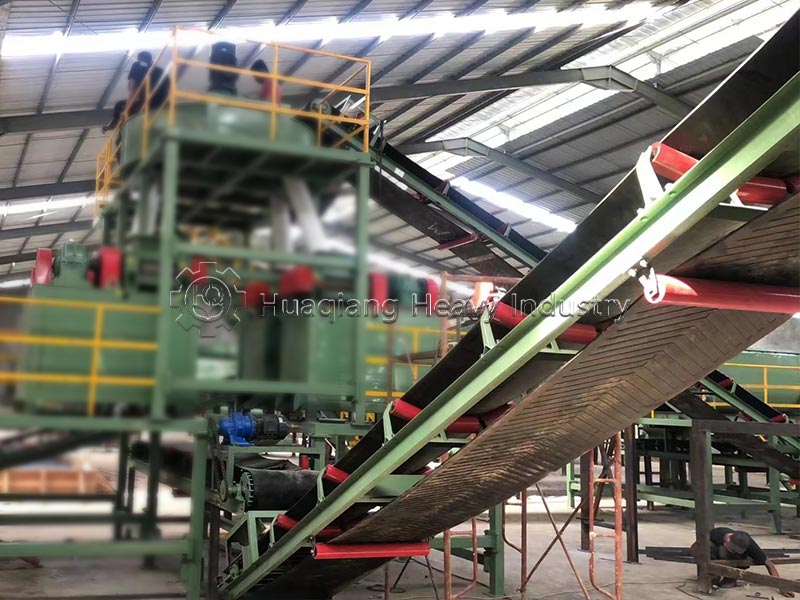 On the installation site, workers are piecing together the conveyor sections like building blocks. Each section must be leveled and aligned – if a leg is off by one centimeter, the belt will run to one side, fray, spill material, or even tear. An old hand crouches on the floor with a level, shouting, “Two more millimeters on the left!” A younger worker quickly slides in a shim and tightens the bolt with a clank. Idlers are installed one by one, with just the right spacing – too far apart, and the belt sags into a hammock where material won’t move. The belt splice is the trickiest part: either a mechanical fastener or hot vulcanization. Mechanical fasteners are easy but can damage the drum. Hot vulcanization takes time and effort, but the result is a seamless belt – no joint mark. Large production lines usually choose hot vulcanization. Several workers gather around the vulcanizer, waiting for the temperature to hit 140°C, then apply pressure and hold it. One splice can take an hour or two.
Belt conveyors come in many “brothers.” Horizontal ones for long hauls; inclined ones to lift material from low to high, feeding the rotary drum granulator; and chevron belt conveyors with cleats to stop pellets from rolling back. They link end to end, tying the chain fertilizer crusher, mixer, granulator, dryer, cooler, screener, and packaging scale into one complete dragon. Material slides out of the crusher onto a belt; the belt carries it up and over, dumping it into the mixer; out of the mixer onto another belt, headed to the granulator… on and on until finally, golden pellets fall into bags. Tired? The belt never stops. A good belt can move hundreds of thousands of tons before retirement.
During testing, workers watch the belt like hawks. No running off center, no slipping. Idlers must spin freely, drums must stay quiet. Someone grabs a handful of material and lays it on the belt to see how steady the ride is. If the material drifts to one side, they adjust the training idler. Only when the belt glides smoothly forward, loaded and steady, does everyone breathe easy.
So don’t look down on that black, rubbery belt. It doesn’t have the glamorous spin of a disc granulator or the crushing power of a ring die pellet machine. But with its flexibility and endurance, it wraps every isolated piece of equipment into a tight, working family. Sure, a granulator can make pellets – but without the belt conveyor, how would those pellets ever leave the workshop and reach the fields? Soft as it is, the belt carries the hard bone of the whole line on its back.
On the installation site, workers are piecing together the conveyor sections like building blocks. Each section must be leveled and aligned – if a leg is off by one centimeter, the belt will run to one side, fray, spill material, or even tear. An old hand crouches on the floor with a level, shouting, “Two more millimeters on the left!” A younger worker quickly slides in a shim and tightens the bolt with a clank. Idlers are installed one by one, with just the right spacing – too far apart, and the belt sags into a hammock where material won’t move. The belt splice is the trickiest part: either a mechanical fastener or hot vulcanization. Mechanical fasteners are easy but can damage the drum. Hot vulcanization takes time and effort, but the result is a seamless belt – no joint mark. Large production lines usually choose hot vulcanization. Several workers gather around the vulcanizer, waiting for the temperature to hit 140°C, then apply pressure and hold it. One splice can take an hour or two.
Belt conveyors come in many “brothers.” Horizontal ones for long hauls; inclined ones to lift material from low to high, feeding the rotary drum granulator; and chevron belt conveyors with cleats to stop pellets from rolling back. They link end to end, tying the chain fertilizer crusher, mixer, granulator, dryer, cooler, screener, and packaging scale into one complete dragon. Material slides out of the crusher onto a belt; the belt carries it up and over, dumping it into the mixer; out of the mixer onto another belt, headed to the granulator… on and on until finally, golden pellets fall into bags. Tired? The belt never stops. A good belt can move hundreds of thousands of tons before retirement.
During testing, workers watch the belt like hawks. No running off center, no slipping. Idlers must spin freely, drums must stay quiet. Someone grabs a handful of material and lays it on the belt to see how steady the ride is. If the material drifts to one side, they adjust the training idler. Only when the belt glides smoothly forward, loaded and steady, does everyone breathe easy.
So don’t look down on that black, rubbery belt. It doesn’t have the glamorous spin of a disc granulator or the crushing power of a ring die pellet machine. But with its flexibility and endurance, it wraps every isolated piece of equipment into a tight, working family. Sure, a granulator can make pellets – but without the belt conveyor, how would those pellets ever leave the workshop and reach the fields? Soft as it is, the belt carries the hard bone of the whole line on its back. 