
While NPK blending machines and mixers for organic or compound fertilizers may appear similar, they operate based on entirely different mixing philosophies.
1.NPK blending machines: Aiming for "Harmony Amidst Diversity"
NPK blenders handle pre-formed, dry granules—such as urea, diammonium phosphate (DAP), and potash—which share similar particle sizes and good flowability. The mixing process is essentially one of "arrangement and combination": distributing different granules evenly while ensuring each particle remains intact and distinct. Consequently, the equipment prioritizes "gentleness," typically employing low-speed drums or ribbon agitators. These operate at moderate speeds with minimal shear force and feature anti-segregation mechanisms to ensure consistent ingredient ratios in the output. Requirements dictate a coefficient of variation for mixing uniformity of less than 7% and the lowest possible rate of particle breakage. The process is one of physical aggregation—uniformly combining distinct granules without altering their individual forms.
 2.Organic/Compound Fertilizer Mixers: Aiming for "Integration into a Unified Whole"
Mixers for organic or compound fertilizers handle raw materials requiring processing—such as wet, sticky manure, powdered fertilizers, or mixtures needing added water or steam. The mixing process is one of "transformation," involving intense shearing, the breaking up of clumps, humidification, conditioning, and sometimes even chemical reactions. These machines typically utilize high-speed rotating paddles or blades; they operate at high speeds and high torque, requiring wear- and corrosion-resistant materials. They do not aim to preserve the material's original form; in fact, breaking up clumps is essential to achieving a uniform mix. The process involves physicochemical transformation—breaking down existing forms to create a new material.
3.The Key Difference
NPK blenders act as "guardians of the granules," with a core mission of achieving uniform distribution without damaging the particles. In contrast, organic or compound fertilizer mixers act as "material transformers," with a core mission of achieving intense homogenization while allowing for changes in physical form.
2.Organic/Compound Fertilizer Mixers: Aiming for "Integration into a Unified Whole"
Mixers for organic or compound fertilizers handle raw materials requiring processing—such as wet, sticky manure, powdered fertilizers, or mixtures needing added water or steam. The mixing process is one of "transformation," involving intense shearing, the breaking up of clumps, humidification, conditioning, and sometimes even chemical reactions. These machines typically utilize high-speed rotating paddles or blades; they operate at high speeds and high torque, requiring wear- and corrosion-resistant materials. They do not aim to preserve the material's original form; in fact, breaking up clumps is essential to achieving a uniform mix. The process involves physicochemical transformation—breaking down existing forms to create a new material.
3.The Key Difference
NPK blenders act as "guardians of the granules," with a core mission of achieving uniform distribution without damaging the particles. In contrast, organic or compound fertilizer mixers act as "material transformers," with a core mission of achieving intense homogenization while allowing for changes in physical form.
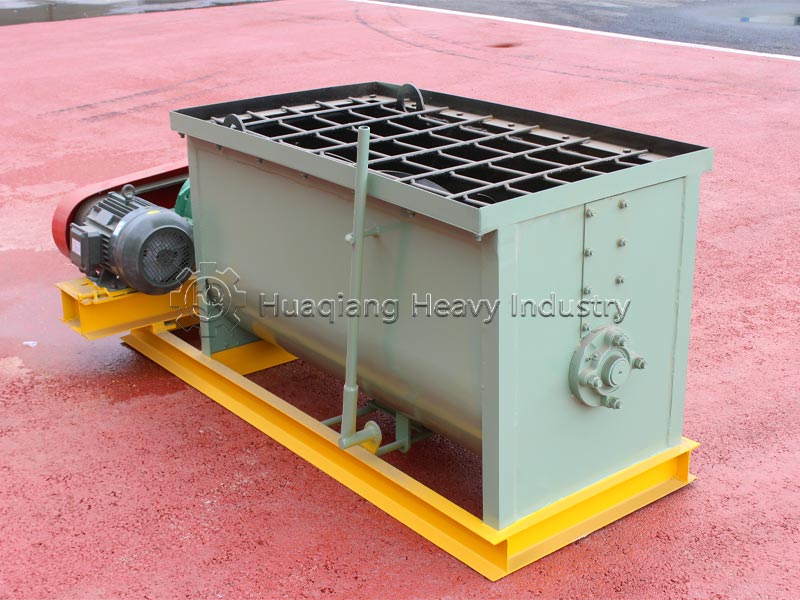 2.Organic/Compound Fertilizer Mixers: Aiming for "Integration into a Unified Whole"
Mixers for organic or compound fertilizers handle raw materials requiring processing—such as wet, sticky manure, powdered fertilizers, or mixtures needing added water or steam. The mixing process is one of "transformation," involving intense shearing, the breaking up of clumps, humidification, conditioning, and sometimes even chemical reactions. These machines typically utilize high-speed rotating paddles or blades; they operate at high speeds and high torque, requiring wear- and corrosion-resistant materials. They do not aim to preserve the material's original form; in fact, breaking up clumps is essential to achieving a uniform mix. The process involves physicochemical transformation—breaking down existing forms to create a new material.
3.The Key Difference
NPK blenders act as "guardians of the granules," with a core mission of achieving uniform distribution without damaging the particles. In contrast, organic or compound fertilizer mixers act as "material transformers," with a core mission of achieving intense homogenization while allowing for changes in physical form.
2.Organic/Compound Fertilizer Mixers: Aiming for "Integration into a Unified Whole"
Mixers for organic or compound fertilizers handle raw materials requiring processing—such as wet, sticky manure, powdered fertilizers, or mixtures needing added water or steam. The mixing process is one of "transformation," involving intense shearing, the breaking up of clumps, humidification, conditioning, and sometimes even chemical reactions. These machines typically utilize high-speed rotating paddles or blades; they operate at high speeds and high torque, requiring wear- and corrosion-resistant materials. They do not aim to preserve the material's original form; in fact, breaking up clumps is essential to achieving a uniform mix. The process involves physicochemical transformation—breaking down existing forms to create a new material.
3.The Key Difference
NPK blenders act as "guardians of the granules," with a core mission of achieving uniform distribution without damaging the particles. In contrast, organic or compound fertilizer mixers act as "material transformers," with a core mission of achieving intense homogenization while allowing for changes in physical form. 