Scientific Formulation of Three Major Nutrients: The Precise Synergy of N-P-K
Common NPK Formulations and Applications
General-Purpose Balanced Formulations
15-15-15: Balanced nutrition suitable for most field crops
17-17-17: High-concentration balanced fertilizer suitable for cash crops
20-20-20: Fully water-soluble formulation suitable for drip and spray irrigation
Specialized Crop Formulations
Corn-specific fertilizer: 28-6-6, high nitrogen for growth promotion
Fruit tree-specific fertilizer: 15-15-20, high potassium for quality improvement
Vegetable-specific fertilizer: 20-10-20, balanced for high yield
Functional Specialty Formulations
Slow-release fertilizers: Added controlled-release materials to extend fertilizer efficiency
Bio-fertilizers: Compound microbial agents to improve soil
Medium/trace element fertilizers: Added calcium, magnesium, sulfur, zinc, boron, etc.
NPK Production Line Technical Parameters
Parameter Category
Small Production Line
Medium Production Line
Large Production Line
Design Capacity
3-5 tons/hour
5-15 tons/hour
15-30 tons/hour
Annual Production Capacity
10,000-20,000 tons
30,000-50,000 tons
50,000-100,000 tons
Total Installed Power
150-300kW
300-600kW
600-1200kW
Floor Space
800-1500m²
1500-3000m²
3000-6000m²
Operating Personnel
6-8 people/shift
8-12 people/shift
12-16 people/shift
Automation Level
80-85%
85-90%
90-95%
Core Advantages of Modern NPK Production Lines
Precise Nutrient Control
Efficient Resource Utilization
Flexible Production Capacity
Excellent Product Quality
Environmentally Friendly Process
Intelligent Control System
Quick Changeover Capability
Low Maintenance High Reliability
Precise Nutrient Control: Computer control systems ensure accurate proportioning of various nutrient elements with errors less than 1%. Online detection systems monitor product quality in real time, automatically adjusting process parameters.
Efficient Resource Utilization: Closed-loop circulation design achieves over 99% raw material utilization, with energy consumption 30-40% lower than traditional processes. Zero wastewater discharge, dust emissions below national standards.
Flexible Production Capacity: Quick changeover systems can complete formulation switching within 30 minutes, adapting to multi-variety, small-batch market demands. From general-purpose to specialized fertilizers, one machine serves multiple functions.
Excellent Product Quality: High granule uniformity (≥95%), moderate strength (15-30N), controllable dissolution characteristics. Nutrients release uniformly in soil, with lasting and stable fertilizer efficiency.
Intelligent Control System Configuration
Modern NPK fertilizer production lines are equipped with advanced intelligent control systems, achieving comprehensive automation of the production process:
Central Control Room: Integrates monitoring and control of all equipment, with rotary screener machine displaying real-time production data. Operators can manage the entire production line through touchscreens.
PLC Automatic Control: Programmable logic controllers achieve equipment linkage and automatic operation. Formula management systems can store hundreds of formulations for one-click calling.
Online Quality Detection: Near-infrared spectrometers detect product nutrient content in real time, while laser particle size analyzers monitor granule size distribution. Data is fed back to the control system in real time.
Data Collection and Traceability: Production data automatically recorded and stored, achieving full traceability from raw materials to finished products. Each batch of products has complete quality files.
Remote Monitoring and Maintenance: machinery and granulation technology enables remote equipment monitoring, with expert systems providing maintenance suggestions. Predictive maintenance reduces unplanned downtime.
Wide Application Fields
Products from NPK fertilizer production lines are widely used in various fields of modern agriculture:
Field Crop Production: Nutritional supply for main grain crops like wheat, rice, corn, and soybeans. Provides specialized formula fertilizers according to nutritional needs at different growth stages.
Cash Crop Cultivation: Precise fertilization for cash crops like fruit trees, vegetables, cotton, tobacco, and tea. High-potassium formulations improve fruit quality, high-nitrogen formulations promote vegetative growth.
Facility Agriculture Applications: Integrated water and fertilizer systems for facility agriculture like greenhouses and plastic tunnels. Fully water-soluble formulations suitable for drip and spray irrigation systems, improving fertilizer utilization.
Landscape Maintenance: Maintenance management for urban greening, golf courses, and sports field turf. Slow-release formulations reduce fertilization frequency, lowering maintenance costs.
Special Agricultural Needs: Special requirements for organic agriculture, ecological agriculture, and precision agriculture. Adding functional materials like biostimulants and soil amendments.
Future Development Trends
With the deepening of precision agriculture and sustainable development concepts, NPK fertilizer production lines are developing in the following directions:
Customized Services: Provide personalized formulations based on soil test data and crop needs. Full technical support from laboratory trials to industrial production. Produce on demand, reducing inventory pressure.
The NPK fertilizer production line is an important component of modern agricultural production systems. It transforms scientific nutritional formulations into industrialized products, providing solid guarantees for global food security and agricultural sustainable development. With continuous technological advancement, this production line will become more intelligent, efficient, and environmentally friendly, injecting new vitality into the development of precision agriculture and green agriculture.

 NPK Production Line Technical Parameters
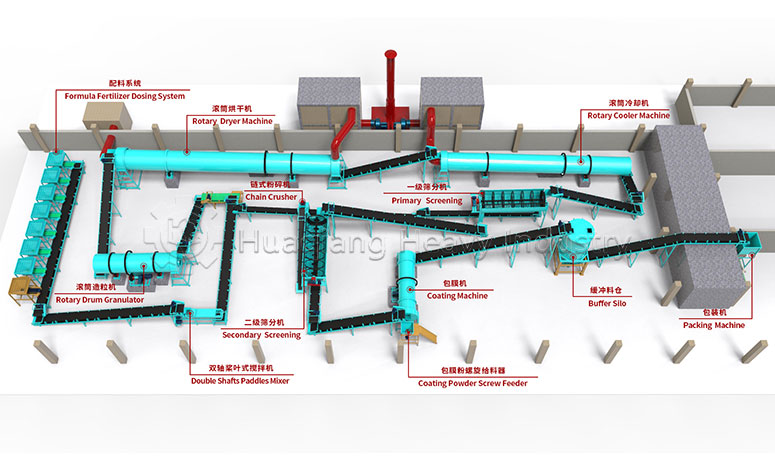 NPK Production Line Technical Parameters
