
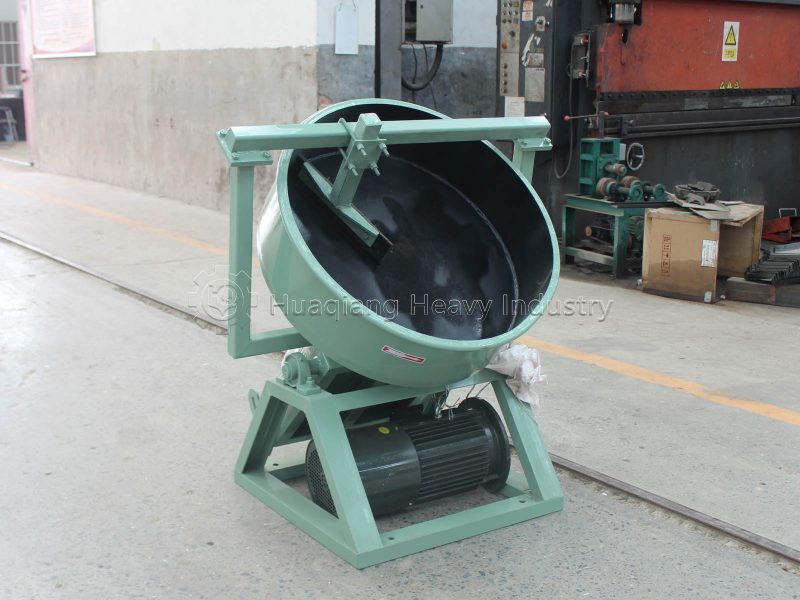
Although the structure of a disc granulator is simple, achieving a consistent output of well-rounded granules depends on proper feed preparation and the fine-tuning of operational parameters.
1.Feed Preparation
Ensure the material fineness is below 1mm; overly coarse material results in weak granules and a high volume of recycled fines. Moisture content is critical—aim for 25%–35% before feeding. The material should hold its shape when squeezed by hand, show moisture between the fingers without dripping, and remain intact when the hand is opened. If the raw material contains high levels of sand or fiber, increasing the proportion of fine powder can improve granulation (pelletizing) performance.
2.Adjusting Disc Parameters
The tilt angle is typically set between 45° and 55°. A smaller angle increases the material's residence time, resulting in larger, rounder granules, while a larger angle accelerates discharge, leading to smaller granules. The rotation speed must be coordinated with the tilt angle to ensure the material forms a stable "rolling zone" within the disc, rather than simply rotating along with it. A retaining ring can be added to the disc edge to adjust the thickness of the material layer.
 3.Water Spraying and Granule Formation
Use an atomizing nozzle to spray water in small, frequent increments to prevent localized over-wetting and sticking to the disc. Start by adding a small amount of powder to form "seed granules" (nuclei) before beginning continuous feeding. Once the granules reach the target size, centrifugal force causes them to spill over the edge of the disc. If the granule sizes are inconsistent, increasing the rotation speed or decreasing the tilt angle can help accelerate the classification process.
4.Troubleshooting Common Issues
Sticking or caking: Often caused by excessive moisture or concentrated water spraying; reduce water input and improve atomization. Failure to form granules: The material may be too dry or lack sufficient fineness; add water and increase the proportion of fine powder. Loose or fragile granules: Insufficient adhesion; increase moisture content slightly or add a small amount of binding agent. Excessive recycled material: Check whether the screen mesh size is properly matched with the feed rate.
5.Post-Processing
Wet granules should be dried at low temperatures (≤50°C for bio-fertilizers) or air-dried naturally, then screened and packaged. Fine material that passes through the screen is returned to the process, creating a closed-loop system. By keeping the feed rate, water spray, and rotational speed stable, the organic fertilizer disc granulator can continuously produce high-quality granules.
 3.Water Spraying and Granule Formation
Use an atomizing nozzle to spray water in small, frequent increments to prevent localized over-wetting and sticking to the disc. Start by adding a small amount of powder to form "seed granules" (nuclei) before beginning continuous feeding. Once the granules reach the target size, centrifugal force causes them to spill over the edge of the disc. If the granule sizes are inconsistent, increasing the rotation speed or decreasing the tilt angle can help accelerate the classification process.
4.Troubleshooting Common Issues
Sticking or caking: Often caused by excessive moisture or concentrated water spraying; reduce water input and improve atomization. Failure to form granules: The material may be too dry or lack sufficient fineness; add water and increase the proportion of fine powder. Loose or fragile granules: Insufficient adhesion; increase moisture content slightly or add a small amount of binding agent. Excessive recycled material: Check whether the screen mesh size is properly matched with the feed rate.
5.Post-Processing
Wet granules should be dried at low temperatures (≤50°C for bio-fertilizers) or air-dried naturally, then screened and packaged. Fine material that passes through the screen is returned to the process, creating a closed-loop system. By keeping the feed rate, water spray, and rotational speed stable, the organic fertilizer disc granulator can continuously produce high-quality granules.
