
In every journey of bulk materials—from mines to ports, from factories to power plants—there is a silent yet powerful force at work: the Belt Conveyor. It is not merely a "bridge" connecting production stages; it is the "perpetual artery" driving the efficient operation of the entire industrial system. With its unparalleled continuous handling capacity, minimalist reliability, and exceptional economy, it has rightfully become the cornerstone of global bulk material handling.
Core Advantages: Continuous, Efficient, Reliable
The success of the belt conveyor stems from its simple yet supremely effective principle, setting it apart from numerous alternatives:
 Unmatched Conveying Capacity & Continuity: Belt conveyors enable true 24/7 continuous transport, with capacities ranging from a few tons to over ten thousand tons per hour. They are the most efficient method for handling large volumes of bulk materials like coal, ore, grain, and aggregates, perfectly matching the demands of modern large-scale continuous production.
Exceptional Conveying Distance & Flexible Routing: A single conveyor can span several kilometers, even over ten kilometers, easily traversing terrain and plants to connect distant loading and unloading points. Through combinations of horizontal, inclined (within specific angles), and curved (convex/concave) sections, it can flexibly adapt to complex layouts and topography, with almost no spatial limitations.
Very Low Specific Energy Consumption & Operating Costs: Material is carried on a nearly stationary belt, with frictional resistance primarily coming from rotating parts. This results in the lowest energy consumption per ton-kilometer among all continuous conveying equipment. Its simple structure allows for easy maintenance, with highly general-purpose spare parts, making its whole-lifecycle operational cost highly competitive.
Superior Reliability & Safety: Mature technologies for drive, tensioning, and alignment ensure super-strong stability. Fully enclosed designs effectively prevent dust emission and material spillage, protecting the environment and personnel safety. Additionally, it causes minimal damage to materials, making it ideal for handling fragile goods.
High Degree of Automation & Smart Integration: As the core of automated logistics systems, it integrates easily with PLC and DCS systems for remote start/stop, speed control, fault diagnosis, and flow metering. Modern sensing technologies (e.g., for misalignment, slippage, rip detection) make it smarter and safer.
Working Principle: The Linear Art of Friction Drive
The core of a belt conveyor is an endless loop of belting revolving around drive, bend, and take-up pulleys. Its workflow is a paradigm of applied mechanics:
Drive & Traction: The Drive Unit (motor, reducer, drive pulley) provides power, moving the belt via friction.
Carrying & Transport: Material is evenly loaded onto the carrying side of the belt via a Feed Chute or Feeder and travels with it. The Carrying Idlers (typically troughed) support the belt and load.
Guidance & Tensioning: Return Idlers support the empty belt on its return journey. The Take-up Unit (screw, gravity, or hydraulic) maintains adequate initial belt tension, providing necessary traction and preventing slippage.
Discharge & Cleaning: Material is discharged at the head pulley by gravity or by a Plow Tripper. Belt Cleaners (scrapers, brushes) remove residual material adhering to the belt, keeping it clean.
Comparison with Other Conveying Equipment
In the family of material handling, the belt conveyor is the undisputed "long-distance champion":
VS Screw Conveyor: Screw conveyors are suitable for short-distance, low-capacity, enclosed handling of powders or granules but have higher energy consumption, significant wear, and limited distance/capacity. Belt conveyors are the first choice for long-distance, high-volume economical transport.
VS Bucket Elevator: Elevators specialize in vertical or steep-incline lifting but typically have medium capacity and an empty return leg. Belt conveyors excel at horizontal and shallow-incline, very high-volume conveying with greater efficiency.
Core Role in Production Lines
The belt conveyor is the "lifeline" of almost all bulk material processing lines:
In Mining: It continuously transports ore from crushers to processing plants or stockpiles.
In Thermal Power Plants: It conveys coal from storage yards to the boiler bunkers—the "wings of coal firing."
In Cement Plants: It connects the raw mill, rotary kiln, and cement mill, running through the entire process.
In Ports & Terminals: It is used for ship loading and unloading, enabling rapid cargo turnover.
In the Fertilizer Production Lines discussed: It transports raw materials from storage to crushers, feeds mixed materials into granulators, and moves finished pellets to packaging—the "link" that connects in series all individual equipment.
Unmatched Conveying Capacity & Continuity: Belt conveyors enable true 24/7 continuous transport, with capacities ranging from a few tons to over ten thousand tons per hour. They are the most efficient method for handling large volumes of bulk materials like coal, ore, grain, and aggregates, perfectly matching the demands of modern large-scale continuous production.
Exceptional Conveying Distance & Flexible Routing: A single conveyor can span several kilometers, even over ten kilometers, easily traversing terrain and plants to connect distant loading and unloading points. Through combinations of horizontal, inclined (within specific angles), and curved (convex/concave) sections, it can flexibly adapt to complex layouts and topography, with almost no spatial limitations.
Very Low Specific Energy Consumption & Operating Costs: Material is carried on a nearly stationary belt, with frictional resistance primarily coming from rotating parts. This results in the lowest energy consumption per ton-kilometer among all continuous conveying equipment. Its simple structure allows for easy maintenance, with highly general-purpose spare parts, making its whole-lifecycle operational cost highly competitive.
Superior Reliability & Safety: Mature technologies for drive, tensioning, and alignment ensure super-strong stability. Fully enclosed designs effectively prevent dust emission and material spillage, protecting the environment and personnel safety. Additionally, it causes minimal damage to materials, making it ideal for handling fragile goods.
High Degree of Automation & Smart Integration: As the core of automated logistics systems, it integrates easily with PLC and DCS systems for remote start/stop, speed control, fault diagnosis, and flow metering. Modern sensing technologies (e.g., for misalignment, slippage, rip detection) make it smarter and safer.
Working Principle: The Linear Art of Friction Drive
The core of a belt conveyor is an endless loop of belting revolving around drive, bend, and take-up pulleys. Its workflow is a paradigm of applied mechanics:
Drive & Traction: The Drive Unit (motor, reducer, drive pulley) provides power, moving the belt via friction.
Carrying & Transport: Material is evenly loaded onto the carrying side of the belt via a Feed Chute or Feeder and travels with it. The Carrying Idlers (typically troughed) support the belt and load.
Guidance & Tensioning: Return Idlers support the empty belt on its return journey. The Take-up Unit (screw, gravity, or hydraulic) maintains adequate initial belt tension, providing necessary traction and preventing slippage.
Discharge & Cleaning: Material is discharged at the head pulley by gravity or by a Plow Tripper. Belt Cleaners (scrapers, brushes) remove residual material adhering to the belt, keeping it clean.
Comparison with Other Conveying Equipment
In the family of material handling, the belt conveyor is the undisputed "long-distance champion":
VS Screw Conveyor: Screw conveyors are suitable for short-distance, low-capacity, enclosed handling of powders or granules but have higher energy consumption, significant wear, and limited distance/capacity. Belt conveyors are the first choice for long-distance, high-volume economical transport.
VS Bucket Elevator: Elevators specialize in vertical or steep-incline lifting but typically have medium capacity and an empty return leg. Belt conveyors excel at horizontal and shallow-incline, very high-volume conveying with greater efficiency.
Core Role in Production Lines
The belt conveyor is the "lifeline" of almost all bulk material processing lines:
In Mining: It continuously transports ore from crushers to processing plants or stockpiles.
In Thermal Power Plants: It conveys coal from storage yards to the boiler bunkers—the "wings of coal firing."
In Cement Plants: It connects the raw mill, rotary kiln, and cement mill, running through the entire process.
In Ports & Terminals: It is used for ship loading and unloading, enabling rapid cargo turnover.
In the Fertilizer Production Lines discussed: It transports raw materials from storage to crushers, feeds mixed materials into granulators, and moves finished pellets to packaging—the "link" that connects in series all individual equipment.
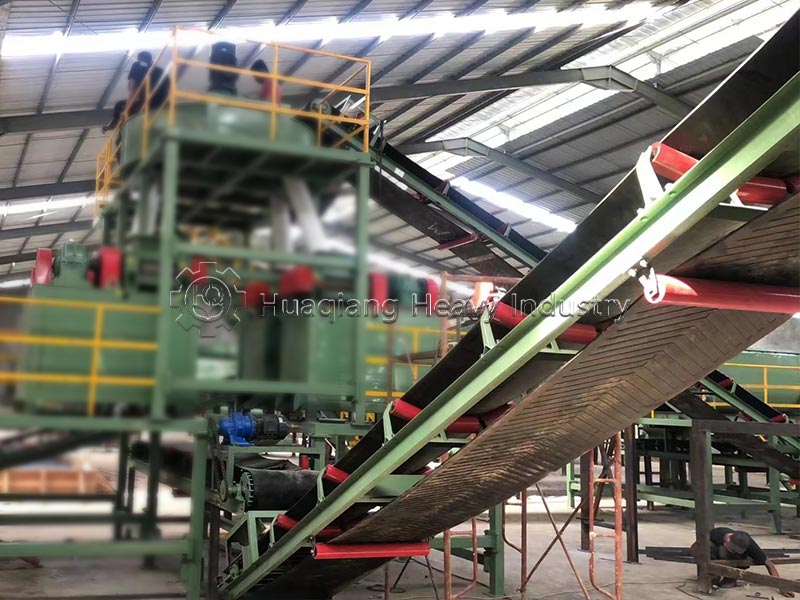 Unmatched Conveying Capacity & Continuity: Belt conveyors enable true 24/7 continuous transport, with capacities ranging from a few tons to over ten thousand tons per hour. They are the most efficient method for handling large volumes of bulk materials like coal, ore, grain, and aggregates, perfectly matching the demands of modern large-scale continuous production.
Exceptional Conveying Distance & Flexible Routing: A single conveyor can span several kilometers, even over ten kilometers, easily traversing terrain and plants to connect distant loading and unloading points. Through combinations of horizontal, inclined (within specific angles), and curved (convex/concave) sections, it can flexibly adapt to complex layouts and topography, with almost no spatial limitations.
Very Low Specific Energy Consumption & Operating Costs: Material is carried on a nearly stationary belt, with frictional resistance primarily coming from rotating parts. This results in the lowest energy consumption per ton-kilometer among all continuous conveying equipment. Its simple structure allows for easy maintenance, with highly general-purpose spare parts, making its whole-lifecycle operational cost highly competitive.
Superior Reliability & Safety: Mature technologies for drive, tensioning, and alignment ensure super-strong stability. Fully enclosed designs effectively prevent dust emission and material spillage, protecting the environment and personnel safety. Additionally, it causes minimal damage to materials, making it ideal for handling fragile goods.
High Degree of Automation & Smart Integration: As the core of automated logistics systems, it integrates easily with PLC and DCS systems for remote start/stop, speed control, fault diagnosis, and flow metering. Modern sensing technologies (e.g., for misalignment, slippage, rip detection) make it smarter and safer.
Working Principle: The Linear Art of Friction Drive
The core of a belt conveyor is an endless loop of belting revolving around drive, bend, and take-up pulleys. Its workflow is a paradigm of applied mechanics:
Drive & Traction: The Drive Unit (motor, reducer, drive pulley) provides power, moving the belt via friction.
Carrying & Transport: Material is evenly loaded onto the carrying side of the belt via a Feed Chute or Feeder and travels with it. The Carrying Idlers (typically troughed) support the belt and load.
Guidance & Tensioning: Return Idlers support the empty belt on its return journey. The Take-up Unit (screw, gravity, or hydraulic) maintains adequate initial belt tension, providing necessary traction and preventing slippage.
Discharge & Cleaning: Material is discharged at the head pulley by gravity or by a Plow Tripper. Belt Cleaners (scrapers, brushes) remove residual material adhering to the belt, keeping it clean.
Comparison with Other Conveying Equipment
In the family of material handling, the belt conveyor is the undisputed "long-distance champion":
VS Screw Conveyor: Screw conveyors are suitable for short-distance, low-capacity, enclosed handling of powders or granules but have higher energy consumption, significant wear, and limited distance/capacity. Belt conveyors are the first choice for long-distance, high-volume economical transport.
VS Bucket Elevator: Elevators specialize in vertical or steep-incline lifting but typically have medium capacity and an empty return leg. Belt conveyors excel at horizontal and shallow-incline, very high-volume conveying with greater efficiency.
Core Role in Production Lines
The belt conveyor is the "lifeline" of almost all bulk material processing lines:
In Mining: It continuously transports ore from crushers to processing plants or stockpiles.
In Thermal Power Plants: It conveys coal from storage yards to the boiler bunkers—the "wings of coal firing."
In Cement Plants: It connects the raw mill, rotary kiln, and cement mill, running through the entire process.
In Ports & Terminals: It is used for ship loading and unloading, enabling rapid cargo turnover.
In the Fertilizer Production Lines discussed: It transports raw materials from storage to crushers, feeds mixed materials into granulators, and moves finished pellets to packaging—the "link" that connects in series all individual equipment.
Unmatched Conveying Capacity & Continuity: Belt conveyors enable true 24/7 continuous transport, with capacities ranging from a few tons to over ten thousand tons per hour. They are the most efficient method for handling large volumes of bulk materials like coal, ore, grain, and aggregates, perfectly matching the demands of modern large-scale continuous production.
Exceptional Conveying Distance & Flexible Routing: A single conveyor can span several kilometers, even over ten kilometers, easily traversing terrain and plants to connect distant loading and unloading points. Through combinations of horizontal, inclined (within specific angles), and curved (convex/concave) sections, it can flexibly adapt to complex layouts and topography, with almost no spatial limitations.
Very Low Specific Energy Consumption & Operating Costs: Material is carried on a nearly stationary belt, with frictional resistance primarily coming from rotating parts. This results in the lowest energy consumption per ton-kilometer among all continuous conveying equipment. Its simple structure allows for easy maintenance, with highly general-purpose spare parts, making its whole-lifecycle operational cost highly competitive.
Superior Reliability & Safety: Mature technologies for drive, tensioning, and alignment ensure super-strong stability. Fully enclosed designs effectively prevent dust emission and material spillage, protecting the environment and personnel safety. Additionally, it causes minimal damage to materials, making it ideal for handling fragile goods.
High Degree of Automation & Smart Integration: As the core of automated logistics systems, it integrates easily with PLC and DCS systems for remote start/stop, speed control, fault diagnosis, and flow metering. Modern sensing technologies (e.g., for misalignment, slippage, rip detection) make it smarter and safer.
Working Principle: The Linear Art of Friction Drive
The core of a belt conveyor is an endless loop of belting revolving around drive, bend, and take-up pulleys. Its workflow is a paradigm of applied mechanics:
Drive & Traction: The Drive Unit (motor, reducer, drive pulley) provides power, moving the belt via friction.
Carrying & Transport: Material is evenly loaded onto the carrying side of the belt via a Feed Chute or Feeder and travels with it. The Carrying Idlers (typically troughed) support the belt and load.
Guidance & Tensioning: Return Idlers support the empty belt on its return journey. The Take-up Unit (screw, gravity, or hydraulic) maintains adequate initial belt tension, providing necessary traction and preventing slippage.
Discharge & Cleaning: Material is discharged at the head pulley by gravity or by a Plow Tripper. Belt Cleaners (scrapers, brushes) remove residual material adhering to the belt, keeping it clean.
Comparison with Other Conveying Equipment
In the family of material handling, the belt conveyor is the undisputed "long-distance champion":
VS Screw Conveyor: Screw conveyors are suitable for short-distance, low-capacity, enclosed handling of powders or granules but have higher energy consumption, significant wear, and limited distance/capacity. Belt conveyors are the first choice for long-distance, high-volume economical transport.
VS Bucket Elevator: Elevators specialize in vertical or steep-incline lifting but typically have medium capacity and an empty return leg. Belt conveyors excel at horizontal and shallow-incline, very high-volume conveying with greater efficiency.
Core Role in Production Lines
The belt conveyor is the "lifeline" of almost all bulk material processing lines:
In Mining: It continuously transports ore from crushers to processing plants or stockpiles.
In Thermal Power Plants: It conveys coal from storage yards to the boiler bunkers—the "wings of coal firing."
In Cement Plants: It connects the raw mill, rotary kiln, and cement mill, running through the entire process.
In Ports & Terminals: It is used for ship loading and unloading, enabling rapid cargo turnover.
In the Fertilizer Production Lines discussed: It transports raw materials from storage to crushers, feeds mixed materials into granulators, and moves finished pellets to packaging—the "link" that connects in series all individual equipment. 