
Have you ever seen a giant disc that doesn’t lie flat but stands upright and spins? That’s the vertical disc mixer – the “dough master” on a fertilizer production line. It doesn’t granulate, doesn’t crush – it does only one thing: blends all kinds of raw materials until they’re closer than family. Today, let’s walk into its installation site and see what this “vertical spinner” is really capable of.
At the installation site, the vertical disc mixer sits solidly on a reinforced base, its disc perpendicular to the ground – like a slice taken out of a giant Ferris wheel. Workers are busy aligning the inlet and outlet with the upstream and downstream belt conveyors. An old hand lies across the disc housing, checking verticality again and again with a spirit level: “If this thing is even a little tilted, all the material will pile up on one side, and the bottom half won’t get mixed at all.” His voice comes out muffled from behind the disc. A young worker nearby is pouring gear oil into the gearbox – the oil glows amber in the sunlight.
 Inside this machine sits a set of high speed mixing blades that hug the inner wall and bottom of the disc. They act like iron hands, scooping material up, throwing it outward, and scooping again. Material falls from the top inlet onto the disc bottom, is forced by the blades to climb up along the wall, then falls back down by gravity – over and over, creating a three dimensional “tumbling vortex.” How even is the mix? Even if only one percent of a trace element is in the batch, after two or three minutes of spinning, a sample test will show nearly zero deviation.
But the vertical mixer never works alone. Upstream, you’ll find a batching scale and a crusher – the scale weighs out N, P, K, and various organics according to the formula, and the crusher breaks up any lumps into fine powder. Once the mixer is fed with these powders, it spins for a few minutes and then discharges a batch of uniformly gray blended material. From there, a belt conveyor sends it to a horizontal mixer for secondary moisture adjustment, or directly to a disc granulator or ring die pellet mill. After granulation come the ball shaping machine, dryer, cooler, screener, and packaging scale – all escorting the product to the finish line. Without the vertical mixer acting as the “dough maker” up front, the downstream granulator would be like a chef handed an unkneaded lump of dough – no matter how hard he tries, it will never hold together.
Finally, it’s time for the test run. Empty, the disc spins quietly and smoothly – just the low murmur of the motor. Workers dump several shovel loads of raw material into the hopper and start the machine. Inside the disc, the material tumbles like a tornado, blades whipping up a gray wave. In less than three minutes, the discharge port begins spitting out perfectly blended powder – uniform in color, like a layer of cocoa powder. The old hand grabs a handful, rubs it between his fingers, and brings it to his nose: “Yep – the sour stuff and the alkaline stuff have all become one family.” He pats the housing and adds, “No other machine could get this job done so cleanly.”
So here’s the thing: the vertical disc mixer isn’t the star of the show, but it’s the glue that holds the whole production line together. Without it, all the granulating, shaping, and drying downstream would be wasted effort. Next time you see those uniform, plump fertilizer pellets, remember their former selves once tumbled hundreds of times inside this upright spinning disc, just to become one family.
Inside this machine sits a set of high speed mixing blades that hug the inner wall and bottom of the disc. They act like iron hands, scooping material up, throwing it outward, and scooping again. Material falls from the top inlet onto the disc bottom, is forced by the blades to climb up along the wall, then falls back down by gravity – over and over, creating a three dimensional “tumbling vortex.” How even is the mix? Even if only one percent of a trace element is in the batch, after two or three minutes of spinning, a sample test will show nearly zero deviation.
But the vertical mixer never works alone. Upstream, you’ll find a batching scale and a crusher – the scale weighs out N, P, K, and various organics according to the formula, and the crusher breaks up any lumps into fine powder. Once the mixer is fed with these powders, it spins for a few minutes and then discharges a batch of uniformly gray blended material. From there, a belt conveyor sends it to a horizontal mixer for secondary moisture adjustment, or directly to a disc granulator or ring die pellet mill. After granulation come the ball shaping machine, dryer, cooler, screener, and packaging scale – all escorting the product to the finish line. Without the vertical mixer acting as the “dough maker” up front, the downstream granulator would be like a chef handed an unkneaded lump of dough – no matter how hard he tries, it will never hold together.
Finally, it’s time for the test run. Empty, the disc spins quietly and smoothly – just the low murmur of the motor. Workers dump several shovel loads of raw material into the hopper and start the machine. Inside the disc, the material tumbles like a tornado, blades whipping up a gray wave. In less than three minutes, the discharge port begins spitting out perfectly blended powder – uniform in color, like a layer of cocoa powder. The old hand grabs a handful, rubs it between his fingers, and brings it to his nose: “Yep – the sour stuff and the alkaline stuff have all become one family.” He pats the housing and adds, “No other machine could get this job done so cleanly.”
So here’s the thing: the vertical disc mixer isn’t the star of the show, but it’s the glue that holds the whole production line together. Without it, all the granulating, shaping, and drying downstream would be wasted effort. Next time you see those uniform, plump fertilizer pellets, remember their former selves once tumbled hundreds of times inside this upright spinning disc, just to become one family.
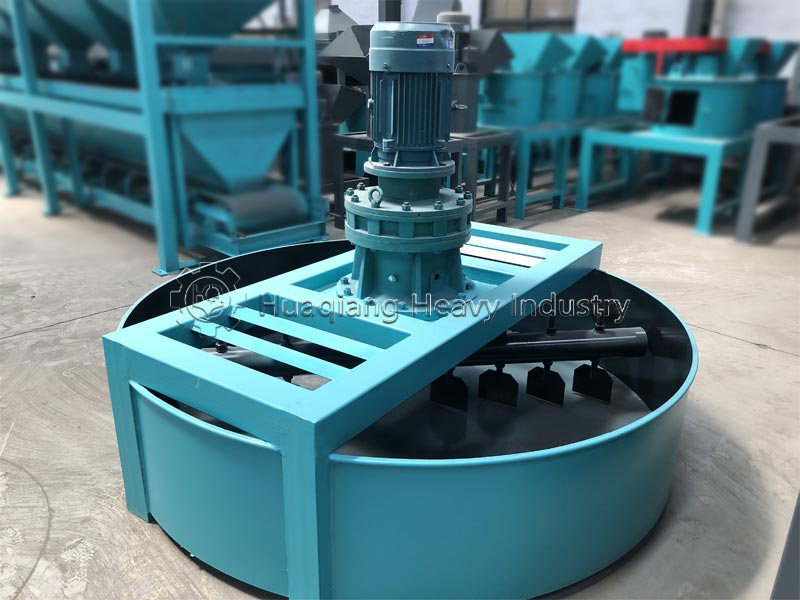 Inside this machine sits a set of high speed mixing blades that hug the inner wall and bottom of the disc. They act like iron hands, scooping material up, throwing it outward, and scooping again. Material falls from the top inlet onto the disc bottom, is forced by the blades to climb up along the wall, then falls back down by gravity – over and over, creating a three dimensional “tumbling vortex.” How even is the mix? Even if only one percent of a trace element is in the batch, after two or three minutes of spinning, a sample test will show nearly zero deviation.
But the vertical mixer never works alone. Upstream, you’ll find a batching scale and a crusher – the scale weighs out N, P, K, and various organics according to the formula, and the crusher breaks up any lumps into fine powder. Once the mixer is fed with these powders, it spins for a few minutes and then discharges a batch of uniformly gray blended material. From there, a belt conveyor sends it to a horizontal mixer for secondary moisture adjustment, or directly to a disc granulator or ring die pellet mill. After granulation come the ball shaping machine, dryer, cooler, screener, and packaging scale – all escorting the product to the finish line. Without the vertical mixer acting as the “dough maker” up front, the downstream granulator would be like a chef handed an unkneaded lump of dough – no matter how hard he tries, it will never hold together.
Finally, it’s time for the test run. Empty, the disc spins quietly and smoothly – just the low murmur of the motor. Workers dump several shovel loads of raw material into the hopper and start the machine. Inside the disc, the material tumbles like a tornado, blades whipping up a gray wave. In less than three minutes, the discharge port begins spitting out perfectly blended powder – uniform in color, like a layer of cocoa powder. The old hand grabs a handful, rubs it between his fingers, and brings it to his nose: “Yep – the sour stuff and the alkaline stuff have all become one family.” He pats the housing and adds, “No other machine could get this job done so cleanly.”
So here’s the thing: the vertical disc mixer isn’t the star of the show, but it’s the glue that holds the whole production line together. Without it, all the granulating, shaping, and drying downstream would be wasted effort. Next time you see those uniform, plump fertilizer pellets, remember their former selves once tumbled hundreds of times inside this upright spinning disc, just to become one family.
Inside this machine sits a set of high speed mixing blades that hug the inner wall and bottom of the disc. They act like iron hands, scooping material up, throwing it outward, and scooping again. Material falls from the top inlet onto the disc bottom, is forced by the blades to climb up along the wall, then falls back down by gravity – over and over, creating a three dimensional “tumbling vortex.” How even is the mix? Even if only one percent of a trace element is in the batch, after two or three minutes of spinning, a sample test will show nearly zero deviation.
But the vertical mixer never works alone. Upstream, you’ll find a batching scale and a crusher – the scale weighs out N, P, K, and various organics according to the formula, and the crusher breaks up any lumps into fine powder. Once the mixer is fed with these powders, it spins for a few minutes and then discharges a batch of uniformly gray blended material. From there, a belt conveyor sends it to a horizontal mixer for secondary moisture adjustment, or directly to a disc granulator or ring die pellet mill. After granulation come the ball shaping machine, dryer, cooler, screener, and packaging scale – all escorting the product to the finish line. Without the vertical mixer acting as the “dough maker” up front, the downstream granulator would be like a chef handed an unkneaded lump of dough – no matter how hard he tries, it will never hold together.
Finally, it’s time for the test run. Empty, the disc spins quietly and smoothly – just the low murmur of the motor. Workers dump several shovel loads of raw material into the hopper and start the machine. Inside the disc, the material tumbles like a tornado, blades whipping up a gray wave. In less than three minutes, the discharge port begins spitting out perfectly blended powder – uniform in color, like a layer of cocoa powder. The old hand grabs a handful, rubs it between his fingers, and brings it to his nose: “Yep – the sour stuff and the alkaline stuff have all become one family.” He pats the housing and adds, “No other machine could get this job done so cleanly.”
So here’s the thing: the vertical disc mixer isn’t the star of the show, but it’s the glue that holds the whole production line together. Without it, all the granulating, shaping, and drying downstream would be wasted effort. Next time you see those uniform, plump fertilizer pellets, remember their former selves once tumbled hundreds of times inside this upright spinning disc, just to become one family. 