
Walk into the installation site of a fertilizer production line, and your eyes are likely drawn to the towering granulation tower or the roaring mixers. But look down—crisscrossing every corner like silent blood vessels are the belt conveyors. Without them, even the best equipment would fight alone. Believe it or not, the true “lifeline” of the entire factory lies in these seemingly ordinary belts.
On site, workers are making the final splice on a main conveyor belt. Eighty meters long and 1.2 meters wide, it stretches from the raw material storage all the way to the chain fertilizer crusher inlet. Unlike standard belt conveyor, this one uses an anti-tear steel cord carcass, with spill-proof skirt boards along the edges. A fitter kneels at the splice, heating both ends with a vulcanizer, his focus as intense as a surgeon’s. “If the splice fails—belt misalignment, material spillage, shutdowns… you name it,” he says without looking up.
 The belt conveyor’s strengths reveal themselves one by one during installation. First, its soft-start capability: the variable-frequency drive is being tuned so that the heavy belt starts as gently as a cat’s step, avoiding material impact. Second, the sealed idler design keeps even dust from escaping. Most impressive is the walkway with emergency pull cords—a pull cord switch every twenty meters gives workers safe, immediate control.
Flanking this main belt, other fertilizer equipment waits to be “fed”: a vertical disc mixer has just had its base grouted, a rotary drum granulator is being aligned, and a cooling tower stands in the distance. All these machines are linked through the conveyors—raw material belts, return belts, finished product belts—each doing its part yet working in harmony.
You might wonder: with so many belts, what if one breaks down? The answer lies in the parallel “one active, one standby” design. On site, two finished-product belts run side by side: one fully installed, the other still being laid. The engineer points to the control cabinet: “Switching takes just a button push. The line never stops.”
When the last set of idlers is tightened and the motor test-run begins, the belt glides smoothly without a hint of deviation. Sunlight pours through the high workshop windows, illuminating the belt like a silver river, quietly waiting to deliver “nutrients” to the entire factory. Who says belt conveyors are just sidekicks? In the world of fertilizer, they are the most reliable lifelines of all.
The belt conveyor’s strengths reveal themselves one by one during installation. First, its soft-start capability: the variable-frequency drive is being tuned so that the heavy belt starts as gently as a cat’s step, avoiding material impact. Second, the sealed idler design keeps even dust from escaping. Most impressive is the walkway with emergency pull cords—a pull cord switch every twenty meters gives workers safe, immediate control.
Flanking this main belt, other fertilizer equipment waits to be “fed”: a vertical disc mixer has just had its base grouted, a rotary drum granulator is being aligned, and a cooling tower stands in the distance. All these machines are linked through the conveyors—raw material belts, return belts, finished product belts—each doing its part yet working in harmony.
You might wonder: with so many belts, what if one breaks down? The answer lies in the parallel “one active, one standby” design. On site, two finished-product belts run side by side: one fully installed, the other still being laid. The engineer points to the control cabinet: “Switching takes just a button push. The line never stops.”
When the last set of idlers is tightened and the motor test-run begins, the belt glides smoothly without a hint of deviation. Sunlight pours through the high workshop windows, illuminating the belt like a silver river, quietly waiting to deliver “nutrients” to the entire factory. Who says belt conveyors are just sidekicks? In the world of fertilizer, they are the most reliable lifelines of all.
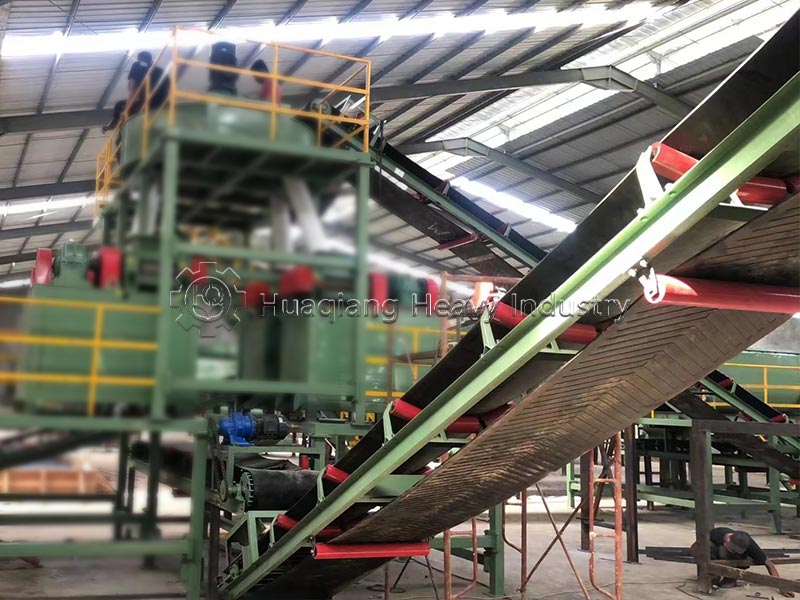 The belt conveyor’s strengths reveal themselves one by one during installation. First, its soft-start capability: the variable-frequency drive is being tuned so that the heavy belt starts as gently as a cat’s step, avoiding material impact. Second, the sealed idler design keeps even dust from escaping. Most impressive is the walkway with emergency pull cords—a pull cord switch every twenty meters gives workers safe, immediate control.
Flanking this main belt, other fertilizer equipment waits to be “fed”: a vertical disc mixer has just had its base grouted, a rotary drum granulator is being aligned, and a cooling tower stands in the distance. All these machines are linked through the conveyors—raw material belts, return belts, finished product belts—each doing its part yet working in harmony.
You might wonder: with so many belts, what if one breaks down? The answer lies in the parallel “one active, one standby” design. On site, two finished-product belts run side by side: one fully installed, the other still being laid. The engineer points to the control cabinet: “Switching takes just a button push. The line never stops.”
When the last set of idlers is tightened and the motor test-run begins, the belt glides smoothly without a hint of deviation. Sunlight pours through the high workshop windows, illuminating the belt like a silver river, quietly waiting to deliver “nutrients” to the entire factory. Who says belt conveyors are just sidekicks? In the world of fertilizer, they are the most reliable lifelines of all.
The belt conveyor’s strengths reveal themselves one by one during installation. First, its soft-start capability: the variable-frequency drive is being tuned so that the heavy belt starts as gently as a cat’s step, avoiding material impact. Second, the sealed idler design keeps even dust from escaping. Most impressive is the walkway with emergency pull cords—a pull cord switch every twenty meters gives workers safe, immediate control.
Flanking this main belt, other fertilizer equipment waits to be “fed”: a vertical disc mixer has just had its base grouted, a rotary drum granulator is being aligned, and a cooling tower stands in the distance. All these machines are linked through the conveyors—raw material belts, return belts, finished product belts—each doing its part yet working in harmony.
You might wonder: with so many belts, what if one breaks down? The answer lies in the parallel “one active, one standby” design. On site, two finished-product belts run side by side: one fully installed, the other still being laid. The engineer points to the control cabinet: “Switching takes just a button push. The line never stops.”
When the last set of idlers is tightened and the motor test-run begins, the belt glides smoothly without a hint of deviation. Sunlight pours through the high workshop windows, illuminating the belt like a silver river, quietly waiting to deliver “nutrients” to the entire factory. Who says belt conveyors are just sidekicks? In the world of fertilizer, they are the most reliable lifelines of all. 