
Equipment Configuration and Key Processes of a Bio-Organic Fertilizer Production Line

Bio-organic fertilizer, due to its dual functions of improving soil with organic matter and promoting the growth and disease resistance of functional bacteria, is becoming the fastest-growing sub-category in the fertilizer industry. The equipment configuration required for its production differs significantly from that of traditional organic fertilizer production lines. These differences are mainly reflected in key aspects such as sterilization, cooling, and the addition of microbial agents. The raw materials for bio-organic fertilizer must first undergo thorough aerobic fermentation using a compost turner, maintaining the compost temperature above 60℃ for at least 7 days to ensure the complete elimination of pathogens and weed seeds. After fermentation and maturation, the material enters the crushing and sieving process. At this stage, it is crucial that the sieving equipment adopts a closed design to prevent contamination by exogenous bacteria.
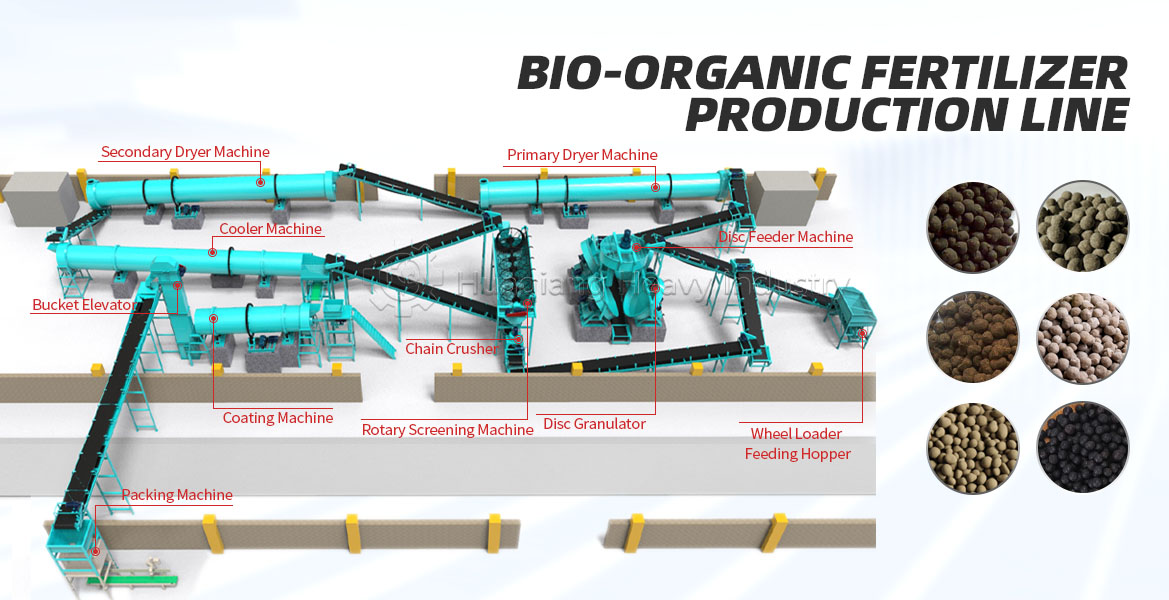
The granulation stage is a watershed moment in the bio-organic fertilizer production line. Because the functional bacteria are extremely sensitive to high temperatures, environments exceeding 50℃ will cause a large number of bacteria to become inactive. Therefore, the conventional process of high-temperature drying after wet drum granulation is completely unsuitable. There are two feasible alternatives: First, dry cold granulation using a roller extrusion granulator, without adding water or heating throughout the process. The granules are then directly cooled to below 30°C in a low-temperature fluidized bed to maximize the preservation of microbial activity. Second, wet granules are prepared using a disc granulator and then slowly dehydrated at below 40°C using a low-temperature dehumidifying dryer. However, this method is time-consuming and requires higher equipment investment. The microbial agent addition process is a core feature of the bio-organic fertilizer production line. It typically involves a dedicated liquid microbial spraying system or a powdered microbial powder mixer to evenly attach high concentrations of functional bacteria (such as Bacillus subtilis, phosphorus- and potassium-solubilizing bacteria, etc.) to the surface or interior of the granules. For the post-coating process, a coating machine with heating function is required to spray a protective agent (such as sodium alginate or starch paste) along with the microbial suspension onto the granule surface, forming a protective film to extend shelf life and improve microbial survival rate. After cooling and coating, the granules must immediately enter an automatic packaging machine for vacuum or nitrogen-filled packaging to prevent secondary contamination from airborne microorganisms. Therefore, the packaging machine must be equipped with dust removal and ultraviolet sterilization devices. The conveying system of the entire bio-organic fertilizer production line should, as far as possible, use closed-loop tubular chain conveyors instead of open belt conveyors to control dust and microbial cross-contamination in the environment. From actual production projects, the investment per ton of product for a bio-organic fertilizer production line is 15% to 25% higher than that of a conventional organic fertilizer line, but the premium for the final selling price can reach 30% to 50%. This strong economic benefit drives many traditional fertilizer companies to upgrade their production lines. It is worth emphasizing that the quality of bio-organic fertilizer depends not only on equipment performance but also on the degree of fermentation and decomposition, strain selection, and storage conditions. Therefore, the production line configuration must be precisely aligned with biotechnology parameters to ensure that the final product meets the Ministry of Agriculture's standard of ≥0.2 billion viable bacteria per gram.