
In the field of organic fertilizer production, "reducing costs and increasing efficiency" is no longer merely a slogan; it is tangibly reflected in the operational parameters of every piece of equipment. Modern automated control systems for organic fertilizer production lines are fundamentally restructuring traditional, experience-based production models into a precisely coordinated industrial system through the deep integration of PLCs (Programmable Logic Controllers), DCS (Distributed Control Systems), and SCADA (Supervisory Control and Data Acquisition) systems.
 Within this system, the equipment itself serves as the core vehicle for cost reduction and efficiency gains. Take the trough-type compost turner, for example: it is no longer just a machine for turning material but an "intelligent fermentation engine" equipped with multiple sensors for temperature, humidity, and oxygen levels. When sensors detect that the compost pile temperature has dropped below 55°C, the turner automatically activates, penetrating the material layer to break up clumps and replenish oxygen; if humidity exceeds set limits, the system automatically increases the turning frequency to accelerate moisture evaporation. This real-time, data-driven closed-loop control slashes the fermentation cycle from the traditional 45 days to under 25 days while boosting the pathogen elimination rate during decomposition to over 99%. Such a leap in efficiency—driven by autonomous equipment decision-making—is beyond the reach of any manual operation.
Extending from the fermentation stage to the entire production process, the cost-saving impact of automated control equipment is amplified exponentially. In the batching section, DCS systems utilize high-precision metering equipment—such as dual-belt scales and loss-in-weight scales—to precisely control trace element dosing errors, eliminating raw material waste at the source. During the drying phase, intelligent temperature control systems automatically adjust hot air temperatures and conveyor speeds based on the material's initial moisture content; combined with waste heat recovery units, this reduces energy consumption by 15% to 20%. Finally, in the packaging and palletizing section, robotic arms integrated with intelligent recognition and control systems autonomously handle the entire process, from positioning and gripping to precise stacking. From the intelligent fermentation enabled by trough-type turners to the precision batching managed by DCS systems, and from adaptive temperature control in drying equipment to automated palletizing by robotic arms—every piece of equipment, empowered by automated control systems, transforms the promise of cost reduction and efficiency gains into a quantifiable, replicable production reality. This represents not merely an evolution of machinery, but an inevitable path for the entire organic fertilizer industry toward refined, standardized operations.
Within this system, the equipment itself serves as the core vehicle for cost reduction and efficiency gains. Take the trough-type compost turner, for example: it is no longer just a machine for turning material but an "intelligent fermentation engine" equipped with multiple sensors for temperature, humidity, and oxygen levels. When sensors detect that the compost pile temperature has dropped below 55°C, the turner automatically activates, penetrating the material layer to break up clumps and replenish oxygen; if humidity exceeds set limits, the system automatically increases the turning frequency to accelerate moisture evaporation. This real-time, data-driven closed-loop control slashes the fermentation cycle from the traditional 45 days to under 25 days while boosting the pathogen elimination rate during decomposition to over 99%. Such a leap in efficiency—driven by autonomous equipment decision-making—is beyond the reach of any manual operation.
Extending from the fermentation stage to the entire production process, the cost-saving impact of automated control equipment is amplified exponentially. In the batching section, DCS systems utilize high-precision metering equipment—such as dual-belt scales and loss-in-weight scales—to precisely control trace element dosing errors, eliminating raw material waste at the source. During the drying phase, intelligent temperature control systems automatically adjust hot air temperatures and conveyor speeds based on the material's initial moisture content; combined with waste heat recovery units, this reduces energy consumption by 15% to 20%. Finally, in the packaging and palletizing section, robotic arms integrated with intelligent recognition and control systems autonomously handle the entire process, from positioning and gripping to precise stacking. From the intelligent fermentation enabled by trough-type turners to the precision batching managed by DCS systems, and from adaptive temperature control in drying equipment to automated palletizing by robotic arms—every piece of equipment, empowered by automated control systems, transforms the promise of cost reduction and efficiency gains into a quantifiable, replicable production reality. This represents not merely an evolution of machinery, but an inevitable path for the entire organic fertilizer industry toward refined, standardized operations.
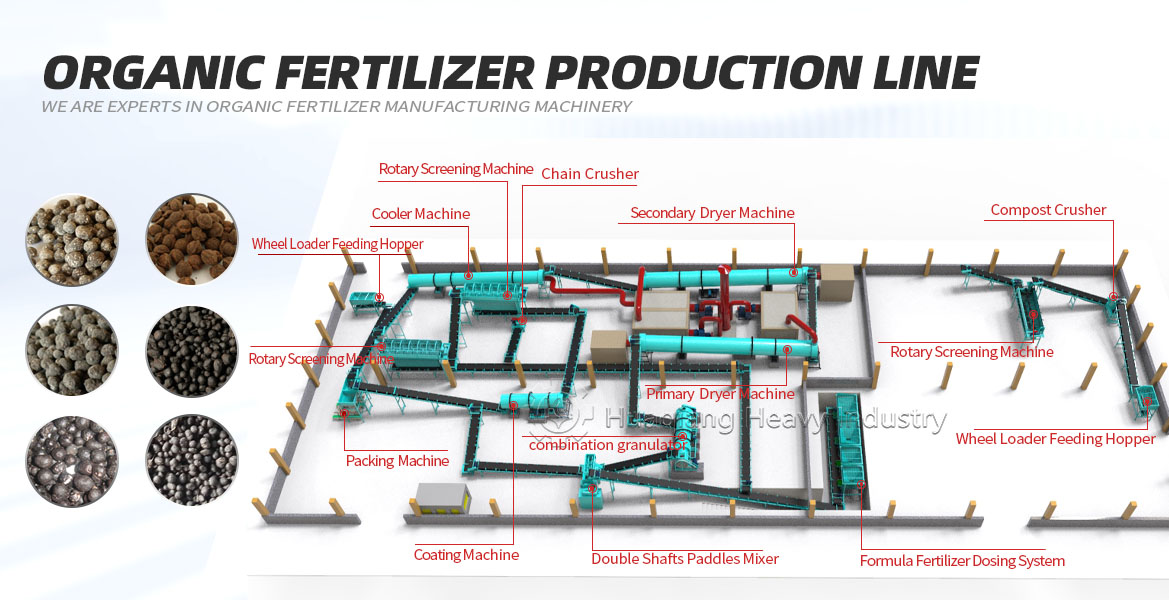 Within this system, the equipment itself serves as the core vehicle for cost reduction and efficiency gains. Take the trough-type compost turner, for example: it is no longer just a machine for turning material but an "intelligent fermentation engine" equipped with multiple sensors for temperature, humidity, and oxygen levels. When sensors detect that the compost pile temperature has dropped below 55°C, the turner automatically activates, penetrating the material layer to break up clumps and replenish oxygen; if humidity exceeds set limits, the system automatically increases the turning frequency to accelerate moisture evaporation. This real-time, data-driven closed-loop control slashes the fermentation cycle from the traditional 45 days to under 25 days while boosting the pathogen elimination rate during decomposition to over 99%. Such a leap in efficiency—driven by autonomous equipment decision-making—is beyond the reach of any manual operation.
Extending from the fermentation stage to the entire production process, the cost-saving impact of automated control equipment is amplified exponentially. In the batching section, DCS systems utilize high-precision metering equipment—such as dual-belt scales and loss-in-weight scales—to precisely control trace element dosing errors, eliminating raw material waste at the source. During the drying phase, intelligent temperature control systems automatically adjust hot air temperatures and conveyor speeds based on the material's initial moisture content; combined with waste heat recovery units, this reduces energy consumption by 15% to 20%. Finally, in the packaging and palletizing section, robotic arms integrated with intelligent recognition and control systems autonomously handle the entire process, from positioning and gripping to precise stacking. From the intelligent fermentation enabled by trough-type turners to the precision batching managed by DCS systems, and from adaptive temperature control in drying equipment to automated palletizing by robotic arms—every piece of equipment, empowered by automated control systems, transforms the promise of cost reduction and efficiency gains into a quantifiable, replicable production reality. This represents not merely an evolution of machinery, but an inevitable path for the entire organic fertilizer industry toward refined, standardized operations.
Within this system, the equipment itself serves as the core vehicle for cost reduction and efficiency gains. Take the trough-type compost turner, for example: it is no longer just a machine for turning material but an "intelligent fermentation engine" equipped with multiple sensors for temperature, humidity, and oxygen levels. When sensors detect that the compost pile temperature has dropped below 55°C, the turner automatically activates, penetrating the material layer to break up clumps and replenish oxygen; if humidity exceeds set limits, the system automatically increases the turning frequency to accelerate moisture evaporation. This real-time, data-driven closed-loop control slashes the fermentation cycle from the traditional 45 days to under 25 days while boosting the pathogen elimination rate during decomposition to over 99%. Such a leap in efficiency—driven by autonomous equipment decision-making—is beyond the reach of any manual operation.
Extending from the fermentation stage to the entire production process, the cost-saving impact of automated control equipment is amplified exponentially. In the batching section, DCS systems utilize high-precision metering equipment—such as dual-belt scales and loss-in-weight scales—to precisely control trace element dosing errors, eliminating raw material waste at the source. During the drying phase, intelligent temperature control systems automatically adjust hot air temperatures and conveyor speeds based on the material's initial moisture content; combined with waste heat recovery units, this reduces energy consumption by 15% to 20%. Finally, in the packaging and palletizing section, robotic arms integrated with intelligent recognition and control systems autonomously handle the entire process, from positioning and gripping to precise stacking. From the intelligent fermentation enabled by trough-type turners to the precision batching managed by DCS systems, and from adaptive temperature control in drying equipment to automated palletizing by robotic arms—every piece of equipment, empowered by automated control systems, transforms the promise of cost reduction and efficiency gains into a quantifiable, replicable production reality. This represents not merely an evolution of machinery, but an inevitable path for the entire organic fertilizer industry toward refined, standardized operations.
