
In the production of organic fertilizer, wall adhesion and material clogging during the granulation stage are major hurdles that almost every processor encounters. Materials may stick stubbornly to the inner walls of the equipment or completely block the die holes, causing shutdowns; at best, this hampers production efficiency, while at worst, it damages critical components. Many practitioners’ first instinct is to switch to more expensive equipment, only to find that the underlying problem persists. In reality, the root cause of these issues lies not in the price of the machinery, but in whether the equipment is truly designed to handle the specific characteristics—or "temperament"—of organic fertilizer raw materials.
 So, what exactly do specialized machines that effectively solve the wall-adhesion and clogging problem do differently? Take the new "two-in-one" organic fertilizer granulator as an example; its design philosophy completely breaks away from the mindset of traditional equipment. Traditional disc granulators rely on material rolling across the disc surface, where small particles adhere to larger ones to form granules; if the material is too sticky to roll properly, wall adhesion becomes inevitable. In contrast, the new two-in-one granulator employs a vertical, high-speed stirring-tooth structure. A main shaft drives multiple layers of staggered, high-strength, wear-resistant teeth at high speeds, subjecting the material entering the chamber to repeated shearing, impact, mixing, and agglomeration. This method of "forced granulation" does not rely on material rolling against the inner walls; instead, it utilizes the mechanical force of the stirring teeth to bond and shape the material directly within the enclosed chamber.
Ultimately, the issue of wall adhesion and clogging in organic fertilizer granulation is not a question of whether granulation is possible, but rather a question of the underlying granulation principle employed. Instead of constantly tweaking moisture levels, adjusting rotation speeds, or installing scrapers on traditional equipment, it is better to adopt a new approach: selecting specialized equipment truly "tailor-made" for organic fertilizer. Shifting from "passive anti-adhesion" to "active granulation" represents not merely a technological upgrade, but a fundamental rethinking of the logic behind organic fertilizer production.
So, what exactly do specialized machines that effectively solve the wall-adhesion and clogging problem do differently? Take the new "two-in-one" organic fertilizer granulator as an example; its design philosophy completely breaks away from the mindset of traditional equipment. Traditional disc granulators rely on material rolling across the disc surface, where small particles adhere to larger ones to form granules; if the material is too sticky to roll properly, wall adhesion becomes inevitable. In contrast, the new two-in-one granulator employs a vertical, high-speed stirring-tooth structure. A main shaft drives multiple layers of staggered, high-strength, wear-resistant teeth at high speeds, subjecting the material entering the chamber to repeated shearing, impact, mixing, and agglomeration. This method of "forced granulation" does not rely on material rolling against the inner walls; instead, it utilizes the mechanical force of the stirring teeth to bond and shape the material directly within the enclosed chamber.
Ultimately, the issue of wall adhesion and clogging in organic fertilizer granulation is not a question of whether granulation is possible, but rather a question of the underlying granulation principle employed. Instead of constantly tweaking moisture levels, adjusting rotation speeds, or installing scrapers on traditional equipment, it is better to adopt a new approach: selecting specialized equipment truly "tailor-made" for organic fertilizer. Shifting from "passive anti-adhesion" to "active granulation" represents not merely a technological upgrade, but a fundamental rethinking of the logic behind organic fertilizer production.
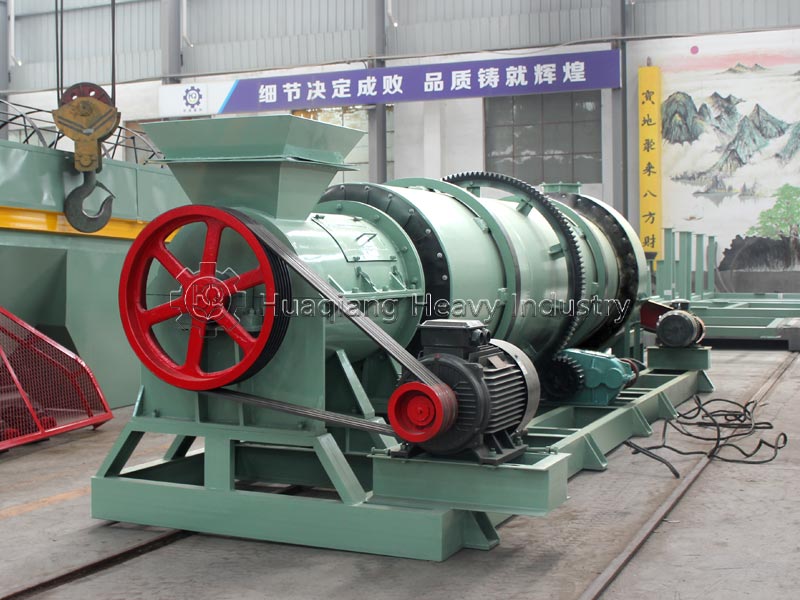 So, what exactly do specialized machines that effectively solve the wall-adhesion and clogging problem do differently? Take the new "two-in-one" organic fertilizer granulator as an example; its design philosophy completely breaks away from the mindset of traditional equipment. Traditional disc granulators rely on material rolling across the disc surface, where small particles adhere to larger ones to form granules; if the material is too sticky to roll properly, wall adhesion becomes inevitable. In contrast, the new two-in-one granulator employs a vertical, high-speed stirring-tooth structure. A main shaft drives multiple layers of staggered, high-strength, wear-resistant teeth at high speeds, subjecting the material entering the chamber to repeated shearing, impact, mixing, and agglomeration. This method of "forced granulation" does not rely on material rolling against the inner walls; instead, it utilizes the mechanical force of the stirring teeth to bond and shape the material directly within the enclosed chamber.
Ultimately, the issue of wall adhesion and clogging in organic fertilizer granulation is not a question of whether granulation is possible, but rather a question of the underlying granulation principle employed. Instead of constantly tweaking moisture levels, adjusting rotation speeds, or installing scrapers on traditional equipment, it is better to adopt a new approach: selecting specialized equipment truly "tailor-made" for organic fertilizer. Shifting from "passive anti-adhesion" to "active granulation" represents not merely a technological upgrade, but a fundamental rethinking of the logic behind organic fertilizer production.
So, what exactly do specialized machines that effectively solve the wall-adhesion and clogging problem do differently? Take the new "two-in-one" organic fertilizer granulator as an example; its design philosophy completely breaks away from the mindset of traditional equipment. Traditional disc granulators rely on material rolling across the disc surface, where small particles adhere to larger ones to form granules; if the material is too sticky to roll properly, wall adhesion becomes inevitable. In contrast, the new two-in-one granulator employs a vertical, high-speed stirring-tooth structure. A main shaft drives multiple layers of staggered, high-strength, wear-resistant teeth at high speeds, subjecting the material entering the chamber to repeated shearing, impact, mixing, and agglomeration. This method of "forced granulation" does not rely on material rolling against the inner walls; instead, it utilizes the mechanical force of the stirring teeth to bond and shape the material directly within the enclosed chamber.
Ultimately, the issue of wall adhesion and clogging in organic fertilizer granulation is not a question of whether granulation is possible, but rather a question of the underlying granulation principle employed. Instead of constantly tweaking moisture levels, adjusting rotation speeds, or installing scrapers on traditional equipment, it is better to adopt a new approach: selecting specialized equipment truly "tailor-made" for organic fertilizer. Shifting from "passive anti-adhesion" to "active granulation" represents not merely a technological upgrade, but a fundamental rethinking of the logic behind organic fertilizer production. 