
Have you ever seen waste turn into "black gold"? If not, step into the installation site of a bio organic fertilizer production line. There's no blazing furnace glow, no pungent chemical smoke – just quietly arranged equipment, busy workers, and a faint hint of fermentation in the air. This soon to be born line is about to transform straw, manure, and lees – those "wastes" – into dark granules that bring tired soil back to life.
The entire line starts at the raw material pre treatment area. A twin screw compost turner straddles the fermentation trough, its two thick screws like the spine of a giant dragon, undergoing final hydraulic lift tests. Workers crouch beside the trough, checking the spacing of aeration holes – because fermentation needs oxygen, and oxygen needs even penetration. Nearby, a mobile belt conveyor is pushed to the feed inlet, its tires still stained with fresh soil. "This guy comes whenever you call," an installer says with a smile. "Wherever material is short, it goes there."
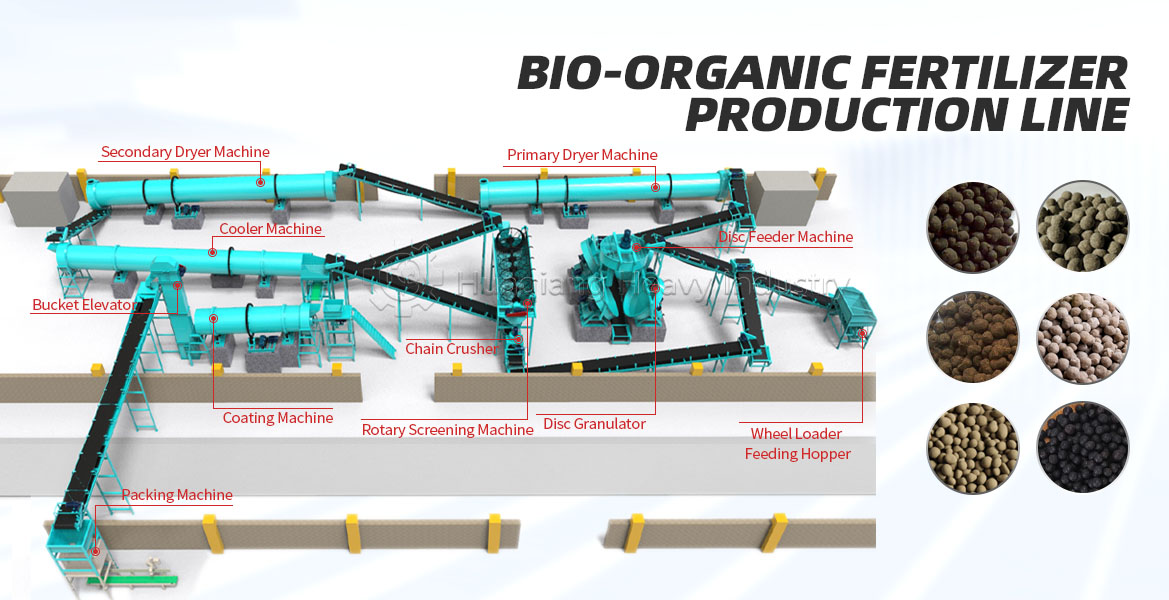 After full decomposition, the material is lifted vertically by a bucket elevator. Look at that elevator – standing straight in a corner of the building, steel buckets cycling up one after another like tireless porters. At the top, centrifugal force flings the material into a chain fertilizer crusher. The crusher's rotor spins at high speed, smashing clumps into fine powder – amid the roar, roughness and refinement shake hands for the first time.
Next comes screening. A drum screener rotates slowly. Fine powder falls through the mesh into a hopper below, while coarse rejects exit at the tail and are sent back to the turning area for further fermentation by another belt. Beside the screener, a granulator waits to be fed. This is a rotary drum granulator, and the workers have just aligned its shell. The polished drum gleams softly under the lights. When fine powder and a little binder tumble and squeeze inside the drum, round, beautiful granules are born like magic.
But the story isn't over. The moist granules need drying and cooling before storage and packaging. The drying drum tilts on its supports, internal lifters tossing the granules up again and again as hot air carries moisture away. Then a cooler rapidly brings down the temperature with ambient air. Finally, an automatic packing scale stands firmly at the end of the line – its sensors so sensitive that each bag of fertilizer is accurate to within tens of grams. A young technician pats it gently and says with a smile, "You're the last gatekeeper – don't make any mistakes."
From turning to packing, this production line includes about a dozen pieces of equipment. They have very different personalities: some are fierce like the crusher, some silent like the bucket elevator, some agile like the mobile belt conveyor, some precise like the packing scale. But when linked by belts, pipes, and cables, they play a complete symphony. You might ask: with so many machines crowded together, won't they clash during installation? The answer lies in the workers' spirit levels, torque wrenches, and the flowchart covered with arrows – every bolt position, every belt tension, is the result of careful deliberation.
On the day of the trial run, the entire line ran empty. The hum of motors, the clink of chains, the slide of belts – all intertwined without a single abnormal noise. When the first batch of raw material entered the turner, traveled the long journey, and emerged at the packing station as bags of black organic fertilizer, everyone applauded. An old engineer took off his hard hat, wiped his sweat, and said, "See? Waste really has become 'black gold.'"
Who says green can't create wealth? This production line is the answer. Quiet and resilient, it turns waste into hope every single day. And you – don't you also want to do something for the soil?
After full decomposition, the material is lifted vertically by a bucket elevator. Look at that elevator – standing straight in a corner of the building, steel buckets cycling up one after another like tireless porters. At the top, centrifugal force flings the material into a chain fertilizer crusher. The crusher's rotor spins at high speed, smashing clumps into fine powder – amid the roar, roughness and refinement shake hands for the first time.
Next comes screening. A drum screener rotates slowly. Fine powder falls through the mesh into a hopper below, while coarse rejects exit at the tail and are sent back to the turning area for further fermentation by another belt. Beside the screener, a granulator waits to be fed. This is a rotary drum granulator, and the workers have just aligned its shell. The polished drum gleams softly under the lights. When fine powder and a little binder tumble and squeeze inside the drum, round, beautiful granules are born like magic.
But the story isn't over. The moist granules need drying and cooling before storage and packaging. The drying drum tilts on its supports, internal lifters tossing the granules up again and again as hot air carries moisture away. Then a cooler rapidly brings down the temperature with ambient air. Finally, an automatic packing scale stands firmly at the end of the line – its sensors so sensitive that each bag of fertilizer is accurate to within tens of grams. A young technician pats it gently and says with a smile, "You're the last gatekeeper – don't make any mistakes."
From turning to packing, this production line includes about a dozen pieces of equipment. They have very different personalities: some are fierce like the crusher, some silent like the bucket elevator, some agile like the mobile belt conveyor, some precise like the packing scale. But when linked by belts, pipes, and cables, they play a complete symphony. You might ask: with so many machines crowded together, won't they clash during installation? The answer lies in the workers' spirit levels, torque wrenches, and the flowchart covered with arrows – every bolt position, every belt tension, is the result of careful deliberation.
On the day of the trial run, the entire line ran empty. The hum of motors, the clink of chains, the slide of belts – all intertwined without a single abnormal noise. When the first batch of raw material entered the turner, traveled the long journey, and emerged at the packing station as bags of black organic fertilizer, everyone applauded. An old engineer took off his hard hat, wiped his sweat, and said, "See? Waste really has become 'black gold.'"
Who says green can't create wealth? This production line is the answer. Quiet and resilient, it turns waste into hope every single day. And you – don't you also want to do something for the soil?
After full decomposition, the material is lifted vertically by a bucket elevator. Look at that elevator – standing straight in a corner of the building, steel buckets cycling up one after another like tireless porters. At the top, centrifugal force flings the material into a chain fertilizer crusher. The crusher's rotor spins at high speed, smashing clumps into fine powder – amid the roar, roughness and refinement shake hands for the first time.
Next comes screening. A drum screener rotates slowly. Fine powder falls through the mesh into a hopper below, while coarse rejects exit at the tail and are sent back to the turning area for further fermentation by another belt. Beside the screener, a granulator waits to be fed. This is a rotary drum granulator, and the workers have just aligned its shell. The polished drum gleams softly under the lights. When fine powder and a little binder tumble and squeeze inside the drum, round, beautiful granules are born like magic.
But the story isn't over. The moist granules need drying and cooling before storage and packaging. The drying drum tilts on its supports, internal lifters tossing the granules up again and again as hot air carries moisture away. Then a cooler rapidly brings down the temperature with ambient air. Finally, an automatic packing scale stands firmly at the end of the line – its sensors so sensitive that each bag of fertilizer is accurate to within tens of grams. A young technician pats it gently and says with a smile, "You're the last gatekeeper – don't make any mistakes."
From turning to packing, this production line includes about a dozen pieces of equipment. They have very different personalities: some are fierce like the crusher, some silent like the bucket elevator, some agile like the mobile belt conveyor, some precise like the packing scale. But when linked by belts, pipes, and cables, they play a complete symphony. You might ask: with so many machines crowded together, won't they clash during installation? The answer lies in the workers' spirit levels, torque wrenches, and the flowchart covered with arrows – every bolt position, every belt tension, is the result of careful deliberation.
On the day of the trial run, the entire line ran empty. The hum of motors, the clink of chains, the slide of belts – all intertwined without a single abnormal noise. When the first batch of raw material entered the turner, traveled the long journey, and emerged at the packing station as bags of black organic fertilizer, everyone applauded. An old engineer took off his hard hat, wiped his sweat, and said, "See? Waste really has become 'black gold.'"
Who says green can't create wealth? This production line is the answer. Quiet and resilient, it turns waste into hope every single day. And you – don't you also want to do something for the soil? 