
Walk into any modern fertilizer plant, and you'll likely hear the gentle rumble of rotating pans. That's the sound of a disc granulation production line in action—one of the most elegant, efficient, and widely adopted methods for transforming powdery raw materials into uniform, round granules. But what makes this technology so special? And how does it work alongside other fertilizer equipment to create a truly versatile production hub?
At the heart of the line sits the disc granulator itself—a shallow, inclined pan that rotates slowly. As fine powders are fed into the pan, a fine mist of water or binder solution is sprayed. Through a combination of rolling motion and capillary forces, tiny particles gradually coalesce into perfect spheres. The operator can adjust the pan's angle and rotation speed to control granule size, producing anything from 1mm micro-granules to 5mm coarse pellets with astonishing consistency.
 But a disc granulator never works alone. It's the centerpiece of a fully integrated system. Upstream, you'll find the crusher and mixer—heavy-duty machines that pulverize raw materials like ammonium sulfate, potassium chloride, or organic compost, then blend them with precise ratios of nitrogen, phosphorus, and potassium. Downstream, a rotary dryer removes excess moisture, followed by a cooler that stabilizes the granules and prevents caking. A vibrating screener then separates oversize and undersize particles, sending them back to the crusher for re-processing, while the perfect granules move to the automatic packaging scale.
What truly sets a disc granulation line apart is its remarkable flexibility. Unlike steam rotary drum granulator that lock you into fixed formulas, disc systems thrive on variety. Want to produce an organic-inorganic compound fertilizer? Simply swap the feed to include fermented manure or humic acid alongside your NPK base. Need a batch of slow-release sulfur-coated urea? Add a coating drum downstream and integrate it with the same line. Many producers even combine disc granulation with a bulk blending unit nearby, allowing them to switch seamlessly between granulated products and custom-blended powders.
Take the example of a family-owned operation in Nebraska. They started with a single disc granulator to produce corn starter fertilizer. Within two years, they added a belt conveyor linking to an existing mixing tower, a coating drum, and a small bio-fertilizer inoculant station. Now, they produce seven different products on the same line: from conventional compound fertilizers to amino-acid-enriched granules and coated slow-release blends. "We can change formulas in under an hour," says the owner. "One day we're making 15-15-15, the next we're running an organic-based product for the vegetable growers. The disc line gives us that freedom."
Environmental stewardship is built in as well. A high-efficiency cyclone or baghouse dust collector captures fine particles at every transfer point, returning them to the process. The drying system can be fitted with a wet scrubber to neutralize any exhaust gases. And because disc granulation operates at relatively low temperatures compared to extrusion or compaction, it consumes less energy—a win for both the bottom line and the planet.
So, is a disc granulation production line the right choice for your operation? If you value versatility, simplicity, and the ability to pivot quickly as market demands shift, the answer is almost certainly yes. It's a technology that respects the art of granulation while embracing the power of integrated equipment—giving you the freedom to create, adapt, and grow.
But a disc granulator never works alone. It's the centerpiece of a fully integrated system. Upstream, you'll find the crusher and mixer—heavy-duty machines that pulverize raw materials like ammonium sulfate, potassium chloride, or organic compost, then blend them with precise ratios of nitrogen, phosphorus, and potassium. Downstream, a rotary dryer removes excess moisture, followed by a cooler that stabilizes the granules and prevents caking. A vibrating screener then separates oversize and undersize particles, sending them back to the crusher for re-processing, while the perfect granules move to the automatic packaging scale.
What truly sets a disc granulation line apart is its remarkable flexibility. Unlike steam rotary drum granulator that lock you into fixed formulas, disc systems thrive on variety. Want to produce an organic-inorganic compound fertilizer? Simply swap the feed to include fermented manure or humic acid alongside your NPK base. Need a batch of slow-release sulfur-coated urea? Add a coating drum downstream and integrate it with the same line. Many producers even combine disc granulation with a bulk blending unit nearby, allowing them to switch seamlessly between granulated products and custom-blended powders.
Take the example of a family-owned operation in Nebraska. They started with a single disc granulator to produce corn starter fertilizer. Within two years, they added a belt conveyor linking to an existing mixing tower, a coating drum, and a small bio-fertilizer inoculant station. Now, they produce seven different products on the same line: from conventional compound fertilizers to amino-acid-enriched granules and coated slow-release blends. "We can change formulas in under an hour," says the owner. "One day we're making 15-15-15, the next we're running an organic-based product for the vegetable growers. The disc line gives us that freedom."
Environmental stewardship is built in as well. A high-efficiency cyclone or baghouse dust collector captures fine particles at every transfer point, returning them to the process. The drying system can be fitted with a wet scrubber to neutralize any exhaust gases. And because disc granulation operates at relatively low temperatures compared to extrusion or compaction, it consumes less energy—a win for both the bottom line and the planet.
So, is a disc granulation production line the right choice for your operation? If you value versatility, simplicity, and the ability to pivot quickly as market demands shift, the answer is almost certainly yes. It's a technology that respects the art of granulation while embracing the power of integrated equipment—giving you the freedom to create, adapt, and grow.
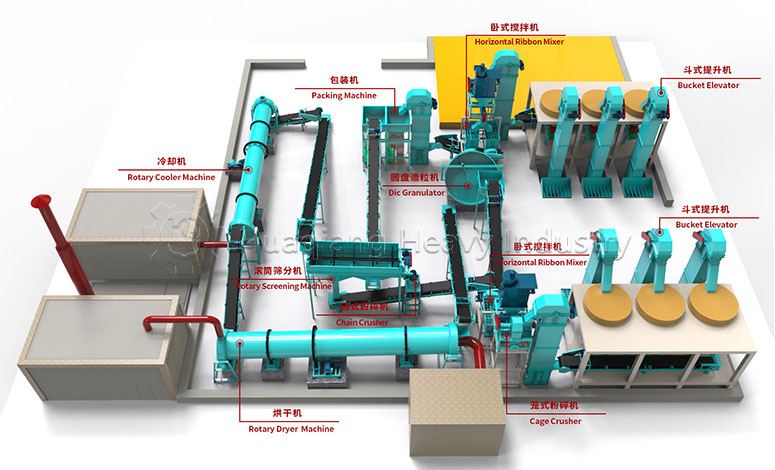 But a disc granulator never works alone. It's the centerpiece of a fully integrated system. Upstream, you'll find the crusher and mixer—heavy-duty machines that pulverize raw materials like ammonium sulfate, potassium chloride, or organic compost, then blend them with precise ratios of nitrogen, phosphorus, and potassium. Downstream, a rotary dryer removes excess moisture, followed by a cooler that stabilizes the granules and prevents caking. A vibrating screener then separates oversize and undersize particles, sending them back to the crusher for re-processing, while the perfect granules move to the automatic packaging scale.
What truly sets a disc granulation line apart is its remarkable flexibility. Unlike steam rotary drum granulator that lock you into fixed formulas, disc systems thrive on variety. Want to produce an organic-inorganic compound fertilizer? Simply swap the feed to include fermented manure or humic acid alongside your NPK base. Need a batch of slow-release sulfur-coated urea? Add a coating drum downstream and integrate it with the same line. Many producers even combine disc granulation with a bulk blending unit nearby, allowing them to switch seamlessly between granulated products and custom-blended powders.
Take the example of a family-owned operation in Nebraska. They started with a single disc granulator to produce corn starter fertilizer. Within two years, they added a belt conveyor linking to an existing mixing tower, a coating drum, and a small bio-fertilizer inoculant station. Now, they produce seven different products on the same line: from conventional compound fertilizers to amino-acid-enriched granules and coated slow-release blends. "We can change formulas in under an hour," says the owner. "One day we're making 15-15-15, the next we're running an organic-based product for the vegetable growers. The disc line gives us that freedom."
Environmental stewardship is built in as well. A high-efficiency cyclone or baghouse dust collector captures fine particles at every transfer point, returning them to the process. The drying system can be fitted with a wet scrubber to neutralize any exhaust gases. And because disc granulation operates at relatively low temperatures compared to extrusion or compaction, it consumes less energy—a win for both the bottom line and the planet.
So, is a disc granulation production line the right choice for your operation? If you value versatility, simplicity, and the ability to pivot quickly as market demands shift, the answer is almost certainly yes. It's a technology that respects the art of granulation while embracing the power of integrated equipment—giving you the freedom to create, adapt, and grow.
But a disc granulator never works alone. It's the centerpiece of a fully integrated system. Upstream, you'll find the crusher and mixer—heavy-duty machines that pulverize raw materials like ammonium sulfate, potassium chloride, or organic compost, then blend them with precise ratios of nitrogen, phosphorus, and potassium. Downstream, a rotary dryer removes excess moisture, followed by a cooler that stabilizes the granules and prevents caking. A vibrating screener then separates oversize and undersize particles, sending them back to the crusher for re-processing, while the perfect granules move to the automatic packaging scale.
What truly sets a disc granulation line apart is its remarkable flexibility. Unlike steam rotary drum granulator that lock you into fixed formulas, disc systems thrive on variety. Want to produce an organic-inorganic compound fertilizer? Simply swap the feed to include fermented manure or humic acid alongside your NPK base. Need a batch of slow-release sulfur-coated urea? Add a coating drum downstream and integrate it with the same line. Many producers even combine disc granulation with a bulk blending unit nearby, allowing them to switch seamlessly between granulated products and custom-blended powders.
Take the example of a family-owned operation in Nebraska. They started with a single disc granulator to produce corn starter fertilizer. Within two years, they added a belt conveyor linking to an existing mixing tower, a coating drum, and a small bio-fertilizer inoculant station. Now, they produce seven different products on the same line: from conventional compound fertilizers to amino-acid-enriched granules and coated slow-release blends. "We can change formulas in under an hour," says the owner. "One day we're making 15-15-15, the next we're running an organic-based product for the vegetable growers. The disc line gives us that freedom."
Environmental stewardship is built in as well. A high-efficiency cyclone or baghouse dust collector captures fine particles at every transfer point, returning them to the process. The drying system can be fitted with a wet scrubber to neutralize any exhaust gases. And because disc granulation operates at relatively low temperatures compared to extrusion or compaction, it consumes less energy—a win for both the bottom line and the planet.
So, is a disc granulation production line the right choice for your operation? If you value versatility, simplicity, and the ability to pivot quickly as market demands shift, the answer is almost certainly yes. It's a technology that respects the art of granulation while embracing the power of integrated equipment—giving you the freedom to create, adapt, and grow. 