
If you think an organic fertilizer production line is all about dirt and sweat, you've never seen the "debut" of a new type organic fertilizer granulator.
Inside the workshop, a brand-new ball shaping machine is being slowly hoisted into place. Sunlight streams in through the high windows, casting a soft glow across its silver-gray casing. Its drum hasn't yet begun to turn, but it stands like a dancer waiting for the music—poised, silent, ready. The crane operator holds his breath, fingers making micro-adjustments as the multi-ton machine is lowered precisely onto its foundation. Bolts and embedded plates align perfectly, as if by prior agreement.
 This granulator is the heart of the entire organic fertilizer line. Poultry manure, straw powder, mushroom residue—all those waste materials that once made people frown—will tumble and bond inside its drum, emerging as uniform, well-rounded organic fertilizer pellets. It doesn't fuss over raw materials, but it is demanding about process: rotation speed, drum angle, feed rate—every parameter determines whether the granules come out round and firm.
Yet it doesn't work alone. Beside it, a large wheel compost turner is having its tracks assembled; it will soon move tirelessly through the fermentation zone, like a tireless farmer turning piles to let them breathe. A screener has already been set up, its mesh stretched tight and flat, ready to send any imperfect granules back to the line. At the far end, an automatic packaging machine stands with its mechanical arm quietly lowered, waiting to open its "palm" for the finished product. Each piece of equipment has its role, yet all are connected—one production line, a silent orchestra.
The installation site isn't loud, but it has warmth. A technician leans over the control panel, fingertip tracing the screen as he sets granulation parameters. A welder crouches in a corner, focused eyes behind a mask; as the welding rod moves, bursts of blue spark flicker across the steel, like neat handwriting. An old master pats the granulator drum and grins: "It's quiet now, but once it starts—one ton, fifteen minutes." A few people laugh; the sound bounces between steel beams, landing on a pile of raw materials in the corner as if coaxing something to life.
When all the equipment is finally connected, the entire production line pulses like a circuit switched on—from turning to fermentation, from crushing to granulating, from screening to packaging—each step neatly interlocking. And at the very start of it all lies the quiet, powerful spin of that granulator.
So the next time you see dark, rich organic fertilizer being spread across a field, don't just think "waste." Have you ever wondered—who turned it into hope?
This granulator is the heart of the entire organic fertilizer line. Poultry manure, straw powder, mushroom residue—all those waste materials that once made people frown—will tumble and bond inside its drum, emerging as uniform, well-rounded organic fertilizer pellets. It doesn't fuss over raw materials, but it is demanding about process: rotation speed, drum angle, feed rate—every parameter determines whether the granules come out round and firm.
Yet it doesn't work alone. Beside it, a large wheel compost turner is having its tracks assembled; it will soon move tirelessly through the fermentation zone, like a tireless farmer turning piles to let them breathe. A screener has already been set up, its mesh stretched tight and flat, ready to send any imperfect granules back to the line. At the far end, an automatic packaging machine stands with its mechanical arm quietly lowered, waiting to open its "palm" for the finished product. Each piece of equipment has its role, yet all are connected—one production line, a silent orchestra.
The installation site isn't loud, but it has warmth. A technician leans over the control panel, fingertip tracing the screen as he sets granulation parameters. A welder crouches in a corner, focused eyes behind a mask; as the welding rod moves, bursts of blue spark flicker across the steel, like neat handwriting. An old master pats the granulator drum and grins: "It's quiet now, but once it starts—one ton, fifteen minutes." A few people laugh; the sound bounces between steel beams, landing on a pile of raw materials in the corner as if coaxing something to life.
When all the equipment is finally connected, the entire production line pulses like a circuit switched on—from turning to fermentation, from crushing to granulating, from screening to packaging—each step neatly interlocking. And at the very start of it all lies the quiet, powerful spin of that granulator.
So the next time you see dark, rich organic fertilizer being spread across a field, don't just think "waste." Have you ever wondered—who turned it into hope?
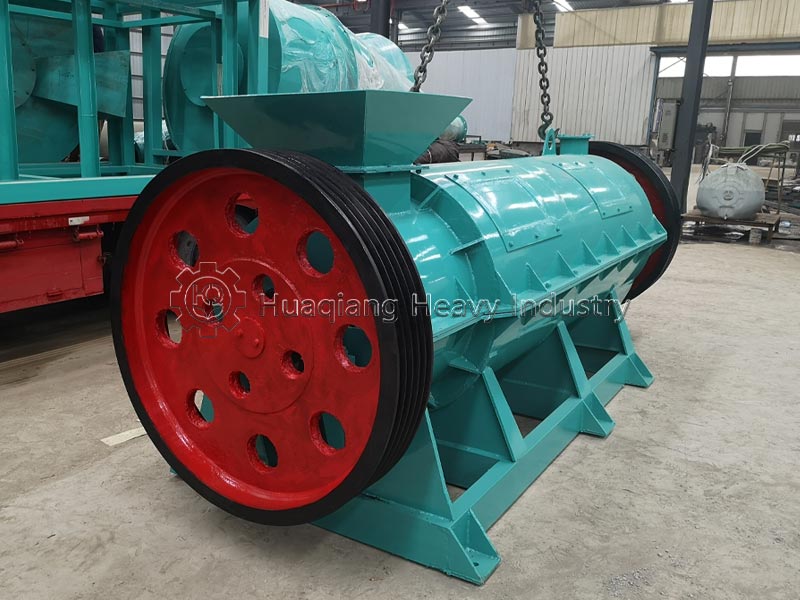 This granulator is the heart of the entire organic fertilizer line. Poultry manure, straw powder, mushroom residue—all those waste materials that once made people frown—will tumble and bond inside its drum, emerging as uniform, well-rounded organic fertilizer pellets. It doesn't fuss over raw materials, but it is demanding about process: rotation speed, drum angle, feed rate—every parameter determines whether the granules come out round and firm.
Yet it doesn't work alone. Beside it, a large wheel compost turner is having its tracks assembled; it will soon move tirelessly through the fermentation zone, like a tireless farmer turning piles to let them breathe. A screener has already been set up, its mesh stretched tight and flat, ready to send any imperfect granules back to the line. At the far end, an automatic packaging machine stands with its mechanical arm quietly lowered, waiting to open its "palm" for the finished product. Each piece of equipment has its role, yet all are connected—one production line, a silent orchestra.
The installation site isn't loud, but it has warmth. A technician leans over the control panel, fingertip tracing the screen as he sets granulation parameters. A welder crouches in a corner, focused eyes behind a mask; as the welding rod moves, bursts of blue spark flicker across the steel, like neat handwriting. An old master pats the granulator drum and grins: "It's quiet now, but once it starts—one ton, fifteen minutes." A few people laugh; the sound bounces between steel beams, landing on a pile of raw materials in the corner as if coaxing something to life.
When all the equipment is finally connected, the entire production line pulses like a circuit switched on—from turning to fermentation, from crushing to granulating, from screening to packaging—each step neatly interlocking. And at the very start of it all lies the quiet, powerful spin of that granulator.
So the next time you see dark, rich organic fertilizer being spread across a field, don't just think "waste." Have you ever wondered—who turned it into hope?
This granulator is the heart of the entire organic fertilizer line. Poultry manure, straw powder, mushroom residue—all those waste materials that once made people frown—will tumble and bond inside its drum, emerging as uniform, well-rounded organic fertilizer pellets. It doesn't fuss over raw materials, but it is demanding about process: rotation speed, drum angle, feed rate—every parameter determines whether the granules come out round and firm.
Yet it doesn't work alone. Beside it, a large wheel compost turner is having its tracks assembled; it will soon move tirelessly through the fermentation zone, like a tireless farmer turning piles to let them breathe. A screener has already been set up, its mesh stretched tight and flat, ready to send any imperfect granules back to the line. At the far end, an automatic packaging machine stands with its mechanical arm quietly lowered, waiting to open its "palm" for the finished product. Each piece of equipment has its role, yet all are connected—one production line, a silent orchestra.
The installation site isn't loud, but it has warmth. A technician leans over the control panel, fingertip tracing the screen as he sets granulation parameters. A welder crouches in a corner, focused eyes behind a mask; as the welding rod moves, bursts of blue spark flicker across the steel, like neat handwriting. An old master pats the granulator drum and grins: "It's quiet now, but once it starts—one ton, fifteen minutes." A few people laugh; the sound bounces between steel beams, landing on a pile of raw materials in the corner as if coaxing something to life.
When all the equipment is finally connected, the entire production line pulses like a circuit switched on—from turning to fermentation, from crushing to granulating, from screening to packaging—each step neatly interlocking. And at the very start of it all lies the quiet, powerful spin of that granulator.
So the next time you see dark, rich organic fertilizer being spread across a field, don't just think "waste." Have you ever wondered—who turned it into hope? 