
Have you ever watched a production line grind to a halt—not because something broke, but because material stuck? Stuck at the inlet. Stuck on the hammers. Stuck in the screen. Workers poke with iron bars, sweating. The production manager stares at the stopped clock, heart racing. And those half-wet chicken manures, fermented straws, dripping mushroom residues just sit there, laughing at your equipment.
Ordinary crushers see wet material and run. They can't handle it. But there's one machine that actually bites wet and sticky stuff—the half-wet material crusher.
 It's Not a Crusher. It's a Sticky-Stuff Specialist.
Others fear stickiness. This machine doesn't. Why?
Because it never gives material a chance to stick. Inside the crushing chamber, two rows of high-strength hammers spin at high speed. They don't grind slowly—they smash hard. Material gets torn apart the moment it enters. Before it can stick, the next hammer hits. The chamber has no dead corners, no flat surfaces for material to cling to. And even if something tries to stick, the high-speed airflow blows it away instantly.
Those hammers? Not ordinary iron. They're specially hardened alloy, with sharp edges designed for fibrous materials. Wet straw? Turns into strands. Wet manure? Becomes powder. Wet fruit residue? Turns into uniform fines. And those sticky clays and sludges that clog ordinary machines? Here, they get smashed into pieces and pass right through the screen.
The Screen? It's Clever.
What do half-wet materials fear most? Clogged screens. In ordinary crushers, rotary screener machine get wet, holes plug, output drops, and finally—stop.
This machine's screen is different. First, its position—wrapped around the lower half of the crushing chamber. Material doesn't trickle through by gravity; it's thrown out by centrifugal force from high-speed rotation. Second, cleaning—every time a hammer passes near the screen, it creates an air pulse that blows away any wet particles trying to stick. Third, material—stainless steel or special coatings mean wet stuff can't hold on.
Moisture? 50% and It Still Eats.
This is the number that surprises everyone. Ordinary hammer mills start frowning at 15% moisture. At 20%, they're basically done. The half-wet material crusher? 30% is routine. 40% is manageable.materials with 50% moisture—like fresh chicken manure mixed with rice hulls straight from the barn—it still swallows them and spits out uniform fines.
The secret is the perfect match between speed and clearance. High hammer speed generates enough kinetic energy to blast wet materials like cannonballs, not squeeze them slowly. And the gap between hammers and liner is precisely calculated—enough to crush effectively, but not so tight that wet material gets squeezed into cakes.
A Stomach That's Not Picky
What makes this machine most lovable? It's not picky:
Livestock manure—chicken, pig, cow, fresh or fermented
Crop straw—wet corn stalks, rice hulls, peanut shells (fibers don't scare it)
Kitchen waste—fruit and vegetable residues, food processing leftovers (high moisture? no problem)
Industrial organic waste—mushroom residue, pharmaceutical dregs, sugar mill sludge (the stickier, the happier)
Municipal sludge—wet sewage treatment leftovers (just adjust the mix with dry materials)
The Start of Every Line
In an organic fertilizer production line, the half-wet material crusher is often the first step. Fermented materials always have lumps and clumps—send them straight to the rotary drum granulator and you're asking for trouble. This machine goes first: breaks big chunks into fine powder, tears fibers into short pieces, evens out moisture. Then screening, mixing, granulating—everything runs smoothly.
It's Not a Crusher. It's a Sticky-Stuff Specialist.
Others fear stickiness. This machine doesn't. Why?
Because it never gives material a chance to stick. Inside the crushing chamber, two rows of high-strength hammers spin at high speed. They don't grind slowly—they smash hard. Material gets torn apart the moment it enters. Before it can stick, the next hammer hits. The chamber has no dead corners, no flat surfaces for material to cling to. And even if something tries to stick, the high-speed airflow blows it away instantly.
Those hammers? Not ordinary iron. They're specially hardened alloy, with sharp edges designed for fibrous materials. Wet straw? Turns into strands. Wet manure? Becomes powder. Wet fruit residue? Turns into uniform fines. And those sticky clays and sludges that clog ordinary machines? Here, they get smashed into pieces and pass right through the screen.
The Screen? It's Clever.
What do half-wet materials fear most? Clogged screens. In ordinary crushers, rotary screener machine get wet, holes plug, output drops, and finally—stop.
This machine's screen is different. First, its position—wrapped around the lower half of the crushing chamber. Material doesn't trickle through by gravity; it's thrown out by centrifugal force from high-speed rotation. Second, cleaning—every time a hammer passes near the screen, it creates an air pulse that blows away any wet particles trying to stick. Third, material—stainless steel or special coatings mean wet stuff can't hold on.
Moisture? 50% and It Still Eats.
This is the number that surprises everyone. Ordinary hammer mills start frowning at 15% moisture. At 20%, they're basically done. The half-wet material crusher? 30% is routine. 40% is manageable.materials with 50% moisture—like fresh chicken manure mixed with rice hulls straight from the barn—it still swallows them and spits out uniform fines.
The secret is the perfect match between speed and clearance. High hammer speed generates enough kinetic energy to blast wet materials like cannonballs, not squeeze them slowly. And the gap between hammers and liner is precisely calculated—enough to crush effectively, but not so tight that wet material gets squeezed into cakes.
A Stomach That's Not Picky
What makes this machine most lovable? It's not picky:
Livestock manure—chicken, pig, cow, fresh or fermented
Crop straw—wet corn stalks, rice hulls, peanut shells (fibers don't scare it)
Kitchen waste—fruit and vegetable residues, food processing leftovers (high moisture? no problem)
Industrial organic waste—mushroom residue, pharmaceutical dregs, sugar mill sludge (the stickier, the happier)
Municipal sludge—wet sewage treatment leftovers (just adjust the mix with dry materials)
The Start of Every Line
In an organic fertilizer production line, the half-wet material crusher is often the first step. Fermented materials always have lumps and clumps—send them straight to the rotary drum granulator and you're asking for trouble. This machine goes first: breaks big chunks into fine powder, tears fibers into short pieces, evens out moisture. Then screening, mixing, granulating—everything runs smoothly.
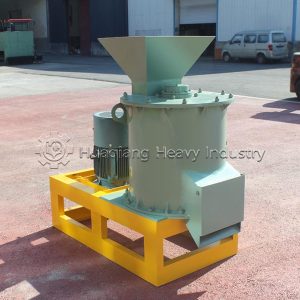 It's Not a Crusher. It's a Sticky-Stuff Specialist.
Others fear stickiness. This machine doesn't. Why?
Because it never gives material a chance to stick. Inside the crushing chamber, two rows of high-strength hammers spin at high speed. They don't grind slowly—they smash hard. Material gets torn apart the moment it enters. Before it can stick, the next hammer hits. The chamber has no dead corners, no flat surfaces for material to cling to. And even if something tries to stick, the high-speed airflow blows it away instantly.
Those hammers? Not ordinary iron. They're specially hardened alloy, with sharp edges designed for fibrous materials. Wet straw? Turns into strands. Wet manure? Becomes powder. Wet fruit residue? Turns into uniform fines. And those sticky clays and sludges that clog ordinary machines? Here, they get smashed into pieces and pass right through the screen.
The Screen? It's Clever.
What do half-wet materials fear most? Clogged screens. In ordinary crushers, rotary screener machine get wet, holes plug, output drops, and finally—stop.
This machine's screen is different. First, its position—wrapped around the lower half of the crushing chamber. Material doesn't trickle through by gravity; it's thrown out by centrifugal force from high-speed rotation. Second, cleaning—every time a hammer passes near the screen, it creates an air pulse that blows away any wet particles trying to stick. Third, material—stainless steel or special coatings mean wet stuff can't hold on.
Moisture? 50% and It Still Eats.
This is the number that surprises everyone. Ordinary hammer mills start frowning at 15% moisture. At 20%, they're basically done. The half-wet material crusher? 30% is routine. 40% is manageable.materials with 50% moisture—like fresh chicken manure mixed with rice hulls straight from the barn—it still swallows them and spits out uniform fines.
The secret is the perfect match between speed and clearance. High hammer speed generates enough kinetic energy to blast wet materials like cannonballs, not squeeze them slowly. And the gap between hammers and liner is precisely calculated—enough to crush effectively, but not so tight that wet material gets squeezed into cakes.
A Stomach That's Not Picky
What makes this machine most lovable? It's not picky:
Livestock manure—chicken, pig, cow, fresh or fermented
Crop straw—wet corn stalks, rice hulls, peanut shells (fibers don't scare it)
Kitchen waste—fruit and vegetable residues, food processing leftovers (high moisture? no problem)
Industrial organic waste—mushroom residue, pharmaceutical dregs, sugar mill sludge (the stickier, the happier)
Municipal sludge—wet sewage treatment leftovers (just adjust the mix with dry materials)
The Start of Every Line
In an organic fertilizer production line, the half-wet material crusher is often the first step. Fermented materials always have lumps and clumps—send them straight to the rotary drum granulator and you're asking for trouble. This machine goes first: breaks big chunks into fine powder, tears fibers into short pieces, evens out moisture. Then screening, mixing, granulating—everything runs smoothly.
It's Not a Crusher. It's a Sticky-Stuff Specialist.
Others fear stickiness. This machine doesn't. Why?
Because it never gives material a chance to stick. Inside the crushing chamber, two rows of high-strength hammers spin at high speed. They don't grind slowly—they smash hard. Material gets torn apart the moment it enters. Before it can stick, the next hammer hits. The chamber has no dead corners, no flat surfaces for material to cling to. And even if something tries to stick, the high-speed airflow blows it away instantly.
Those hammers? Not ordinary iron. They're specially hardened alloy, with sharp edges designed for fibrous materials. Wet straw? Turns into strands. Wet manure? Becomes powder. Wet fruit residue? Turns into uniform fines. And those sticky clays and sludges that clog ordinary machines? Here, they get smashed into pieces and pass right through the screen.
The Screen? It's Clever.
What do half-wet materials fear most? Clogged screens. In ordinary crushers, rotary screener machine get wet, holes plug, output drops, and finally—stop.
This machine's screen is different. First, its position—wrapped around the lower half of the crushing chamber. Material doesn't trickle through by gravity; it's thrown out by centrifugal force from high-speed rotation. Second, cleaning—every time a hammer passes near the screen, it creates an air pulse that blows away any wet particles trying to stick. Third, material—stainless steel or special coatings mean wet stuff can't hold on.
Moisture? 50% and It Still Eats.
This is the number that surprises everyone. Ordinary hammer mills start frowning at 15% moisture. At 20%, they're basically done. The half-wet material crusher? 30% is routine. 40% is manageable.materials with 50% moisture—like fresh chicken manure mixed with rice hulls straight from the barn—it still swallows them and spits out uniform fines.
The secret is the perfect match between speed and clearance. High hammer speed generates enough kinetic energy to blast wet materials like cannonballs, not squeeze them slowly. And the gap between hammers and liner is precisely calculated—enough to crush effectively, but not so tight that wet material gets squeezed into cakes.
A Stomach That's Not Picky
What makes this machine most lovable? It's not picky:
Livestock manure—chicken, pig, cow, fresh or fermented
Crop straw—wet corn stalks, rice hulls, peanut shells (fibers don't scare it)
Kitchen waste—fruit and vegetable residues, food processing leftovers (high moisture? no problem)
Industrial organic waste—mushroom residue, pharmaceutical dregs, sugar mill sludge (the stickier, the happier)
Municipal sludge—wet sewage treatment leftovers (just adjust the mix with dry materials)
The Start of Every Line
In an organic fertilizer production line, the half-wet material crusher is often the first step. Fermented materials always have lumps and clumps—send them straight to the rotary drum granulator and you're asking for trouble. This machine goes first: breaks big chunks into fine powder, tears fibers into short pieces, evens out moisture. Then screening, mixing, granulating—everything runs smoothly. 