
In a modern fertilizer production line, if the rotary drum granulator is the "heart," then the belt conveyor is the "artery" that runs through the entire system, transporting nutrients from one stage to the next. It lacks the roar of a crusher or the mesmerizing rotation of a granulator, but it works in a silent, steady manner, smoothly moving raw materials, semi-finished products, and finished goods from one process to another. Without it, the entire factory would grind to a halt.

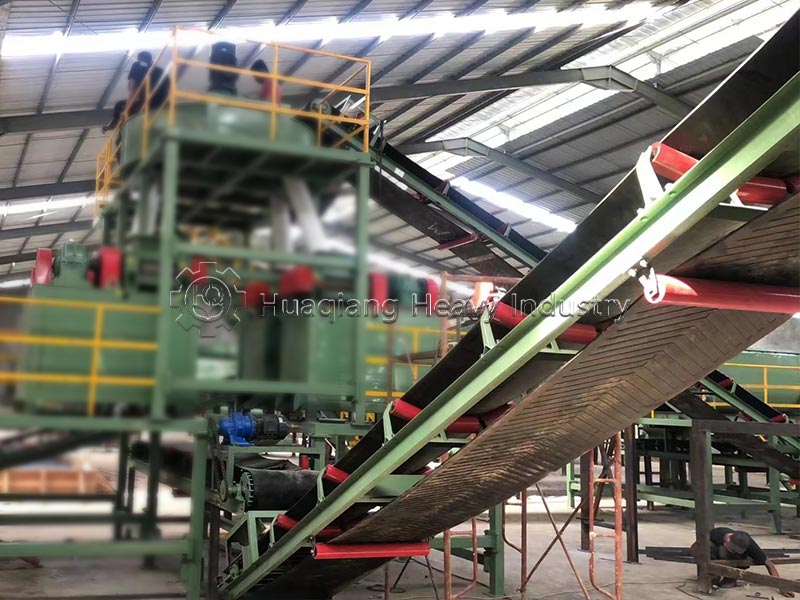
- Seamless Connection, Building Continuous Production Fertilizer production involves multiple stages—crushing, mixing, granulation, drying, cooling, screening, coating, and packaging—with equipment often spread across different areas. The primary task of the belt conveyor is to connect these individual "islands" into a smooth, continuous flow. It delivers crushed powder to the horizontal mixer, sends moist granules into the dryer, and transports the cooled finished product to the packaging workshop. This continuous material flow significantly reduces manual handling and forklift traffic, boosting overall efficiency.
- Gentle Handling, Protecting Granule Integrity After granulation and drying, fertilizer particles are formed but remain relatively fragile. Belt conveyors use rubber or PVC belts to provide a flat, soft carrying surface, preventing granules from breaking due to impact during transport. This is especially crucial for coated slow-release fertilizers, as the conveyor helps protect the outer coating from abrasion, ensuring the fertilizer performs as intended.
- Adapting to Diverse Materials, Resistant to Wear and Corrosion Fertilizer production involves a wide variety of materials: sharp mineral ores, moist organic waste, hot dried granules, and semi-finished products that can be somewhat corrosive. High-quality belt conveyors use belts resistant to heat, oil, acids, and alkalis, paired with reliable idlers and drive units, allowing them to withstand heavy loads and harsh environments for extended periods of stable operation.
- Flexible Layout, Saving Space Belt conveyors can be flexibly designed to suit factory structures: horizontal transport, inclined lifting, or even directional changes using convex and concave curves. This allows for a more compact production line layout, maximizing vertical space and reducing the footprint. For example, material from a ground-level crusher can be lifted to an overhead mixer, and then an inclined belt can feed the mixed material directly into the granulator—all in one seamless flow.
- Environmentally Enclosed, Reducing Dust Emissions Modern fertilizer production places a high priority on environmental protection. Enclosed belt conveyors (such as those with dust covers or using tubular belt designs) can effectively prevent dust generation during transport, improving the workshop environment and protecting materials from external contamination. This advantage is particularly significant when handling powdery raw materials.
- Automated Control, Precise Dosing Belt conveyors equipped with variable frequency drives and electronic belt scales can precisely control material flow and proportions. In batching systems, multiple conveyors run simultaneously, delivering different raw materials to the mixer at set ratios, ensuring every batch of fertilizer is uniform and consistent. This level of automation not only improves product quality but also reduces human error.
- Simple Maintenance, Low Operating Costs The belt conveyor has a simple structure, primarily consisting of a drive pulley, return pulley, idlers, and the belt itself. Daily maintenance mainly involves lubricating idlers and adjusting the belt. Compared to complex process equipment, it has a low failure rate, is easy to repair, and consumes relatively little energy, making it a reliable and long-lasting partner on the production line.
