
NPK compound fertilizer refers to a chemical fertilizer containing nitrogen (N), phosphorus (P), and potassium (K), three essential macronutrients for plants. Due to its balanced nutrients, ease of application, and significant yield-increasing effects, it has become the mainstream choice for fertilization in modern agriculture. Its industrial production relies on a highly integrated automated production line, with the core process flow including six major stages: raw material pretreatment, precise proportioning, mixing and granulation, drying and cooling, screening and coating, and finished product packaging.
 First, basic raw materials such as urea, monoammonium phosphate, potassium chloride, and potassium sulfate are crushed and screened using a fertilizer crusher to ensure uniform particle size and prevent clogging of metering equipment. Subsequently, each raw material is weighed with high precision according to the formula set by the computer, using electronic belt scales or loss-in-weight feeders, and then thoroughly mixed in a twin-shaft mixer or horizontal mixer to ensure uniform nutrient distribution. The mixed powder then enters the granulation system – current mainstream technologies include drum granulation, disc granulation, and high-tower melt spray granulation. Among these, drum granulation is widely used due to its strong adaptability and moderate investment; the high-tower method is suitable for high-nitrogen products, producing round particles with rapid dissolution.
The wet granules after granulation have a high moisture content and need to enter a rotary dryer to remove moisture under the action of hot air. They are then cooled to near room temperature in a cooler to enhance particle hardness and prevent caking. The cooled material is then classified through a vibrating screen: large particles are crushed and returned for reprocessing, fine powder is directly recycled, and qualified granules enter the coating machine, where anti-caking agents or slow-release coating materials are sprayed. Finally, the finished product is automatically weighed, bagged, and palletized for storage and sale.
The entire NPK fertilizer production line emphasizes automated control and quality traceability, with strict standards for temperature, humidity, proportioning accuracy, and dust control. A well-designed NPK production line not only ensures stable fertilizer quality but also effectively reduces energy consumption and emissions, providing solid support for green agriculture.
First, basic raw materials such as urea, monoammonium phosphate, potassium chloride, and potassium sulfate are crushed and screened using a fertilizer crusher to ensure uniform particle size and prevent clogging of metering equipment. Subsequently, each raw material is weighed with high precision according to the formula set by the computer, using electronic belt scales or loss-in-weight feeders, and then thoroughly mixed in a twin-shaft mixer or horizontal mixer to ensure uniform nutrient distribution. The mixed powder then enters the granulation system – current mainstream technologies include drum granulation, disc granulation, and high-tower melt spray granulation. Among these, drum granulation is widely used due to its strong adaptability and moderate investment; the high-tower method is suitable for high-nitrogen products, producing round particles with rapid dissolution.
The wet granules after granulation have a high moisture content and need to enter a rotary dryer to remove moisture under the action of hot air. They are then cooled to near room temperature in a cooler to enhance particle hardness and prevent caking. The cooled material is then classified through a vibrating screen: large particles are crushed and returned for reprocessing, fine powder is directly recycled, and qualified granules enter the coating machine, where anti-caking agents or slow-release coating materials are sprayed. Finally, the finished product is automatically weighed, bagged, and palletized for storage and sale.
The entire NPK fertilizer production line emphasizes automated control and quality traceability, with strict standards for temperature, humidity, proportioning accuracy, and dust control. A well-designed NPK production line not only ensures stable fertilizer quality but also effectively reduces energy consumption and emissions, providing solid support for green agriculture.
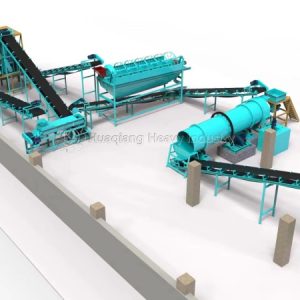 First, basic raw materials such as urea, monoammonium phosphate, potassium chloride, and potassium sulfate are crushed and screened using a fertilizer crusher to ensure uniform particle size and prevent clogging of metering equipment. Subsequently, each raw material is weighed with high precision according to the formula set by the computer, using electronic belt scales or loss-in-weight feeders, and then thoroughly mixed in a twin-shaft mixer or horizontal mixer to ensure uniform nutrient distribution. The mixed powder then enters the granulation system – current mainstream technologies include drum granulation, disc granulation, and high-tower melt spray granulation. Among these, drum granulation is widely used due to its strong adaptability and moderate investment; the high-tower method is suitable for high-nitrogen products, producing round particles with rapid dissolution.
The wet granules after granulation have a high moisture content and need to enter a rotary dryer to remove moisture under the action of hot air. They are then cooled to near room temperature in a cooler to enhance particle hardness and prevent caking. The cooled material is then classified through a vibrating screen: large particles are crushed and returned for reprocessing, fine powder is directly recycled, and qualified granules enter the coating machine, where anti-caking agents or slow-release coating materials are sprayed. Finally, the finished product is automatically weighed, bagged, and palletized for storage and sale.
The entire NPK fertilizer production line emphasizes automated control and quality traceability, with strict standards for temperature, humidity, proportioning accuracy, and dust control. A well-designed NPK production line not only ensures stable fertilizer quality but also effectively reduces energy consumption and emissions, providing solid support for green agriculture.
First, basic raw materials such as urea, monoammonium phosphate, potassium chloride, and potassium sulfate are crushed and screened using a fertilizer crusher to ensure uniform particle size and prevent clogging of metering equipment. Subsequently, each raw material is weighed with high precision according to the formula set by the computer, using electronic belt scales or loss-in-weight feeders, and then thoroughly mixed in a twin-shaft mixer or horizontal mixer to ensure uniform nutrient distribution. The mixed powder then enters the granulation system – current mainstream technologies include drum granulation, disc granulation, and high-tower melt spray granulation. Among these, drum granulation is widely used due to its strong adaptability and moderate investment; the high-tower method is suitable for high-nitrogen products, producing round particles with rapid dissolution.
The wet granules after granulation have a high moisture content and need to enter a rotary dryer to remove moisture under the action of hot air. They are then cooled to near room temperature in a cooler to enhance particle hardness and prevent caking. The cooled material is then classified through a vibrating screen: large particles are crushed and returned for reprocessing, fine powder is directly recycled, and qualified granules enter the coating machine, where anti-caking agents or slow-release coating materials are sprayed. Finally, the finished product is automatically weighed, bagged, and palletized for storage and sale.
The entire NPK fertilizer production line emphasizes automated control and quality traceability, with strict standards for temperature, humidity, proportioning accuracy, and dust control. A well-designed NPK production line not only ensures stable fertilizer quality but also effectively reduces energy consumption and emissions, providing solid support for green agriculture. 