
Is the quality of organic fertilizer produced by a flat die pelleting machine actually any good?

When it comes to granule quality, the flat die pelleting machine is an underrated player in the organic fertilizer sector. While its output performs solidly across key technical metrics, it shouldn't be judged against the "perfect roundness" produced by rotary drum granulators.
  1. Granulation Rate and Material Recirculation
Flat die pelleting machine relies on pressure rollers to force material into die holes, forming granules instantly as they emerge. The initial granulation rate typically exceeds 90%, with a pelletization rate reaching up to 95%. There is very little material that needs to be screened out and recirculated, ensuring a smooth production flow—a major advantage for small- to medium-scale operations.
  1. Granule Strength, Storage, and Transport
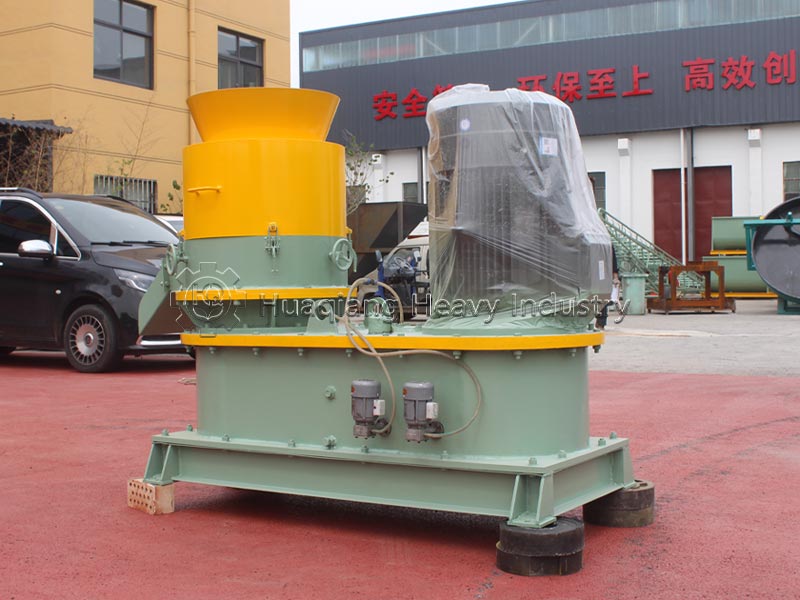
The extruded, cylindrical granules feature a dense internal structure. With a compressive strength typically exceeding 8 Newtons, they exhibit a low breakage rate during long-distance transport. They are resistant to crumbling during bagging, storage, and handling—a level of stability that is often difficult to achieve consistently with wet-process, tumble-formed granules.
  1. Temperature Rise and Biological Activity
Flat die pelleting machine is a physical process that occurs at ambient temperatures. The material’s temperature usually rises by no more than 30°C (with some models keeping it under 50°C). This prevents excessive decomposition of organic matter and minimizes nitrogen loss through volatilization. Furthermore, when producing bio-organic fertilizers, this process ensures a high survival rate for beneficial microorganisms.
  1. Appearance and Application
The finished product consists of uniform, cylindrical granules (which can be rounded into spheres using an additional fertilizer ball shaping machine). Once applied to the soil, these cylindrical granules release nutrients gradually as they are broken down by microorganisms, providing a slow-release effect—making them ideal as a base fertilizer for orchards, vegetable crops, and field crops. The quality of flat die pelleting machine fertilizer is not guaranteed; it depends on specific conditions. The moisture content of the raw material must be strictly controlled—typically between 15% and 25%. If the moisture is too low, the material won't feed into the die; if it is too high, the output will consist of soft, mushy strands. Additionally, the length-to-diameter ratio of the die holes and the gap between the pressure rollers directly determine the hardness of the granules and their disintegration rate. While the equipment sets the baseline for quality, the operator’s skill determines the upper limit. By properly managing moisture levels and roller gaps, a flat die pelleting machine can produce organic fertilizer that excels in terms of strength, biological activity, and slow-release performance.
All Categories

MON-SAT 8:00-9:00

+91 69 863 6420