
Walking into the installation site of a bio organic fertilizer production line, the first thing that hits you isn’t the imagined pungent smell, but the fresh scent of metal and the warmth of welding sparks. Workers connect each conveyor trough with surgeon-like precision, while coordinating the rhythm of cranes and wrenches like orchestra conductors. Here, steel has a pulse, and machinery learns to breathe—would you believe it?
 This core production line is “growing” before your eyes: from raw material pretreatment, fermentation and turning, to crushing, screening, granulation, then drying, cooling, and packaging—every piece of equipment finds its place. Most striking is the massive bio-fermentation tank, like a sleeping giant about to be awakened. Nearby, the batching system for compound fertilizer and the mixing drum for bulk-blend fertilizer stand neatly aligned, as if waiting for a common “start order.” These different fertilizer units don’t work in isolation—overhead and underground belt conveyor and bucket elevator weave them into a dense yet orderly production network.
Sweating profusely, the installers never forget to double-check the torque of every bolt. One seasoned technician smiles and says, “Equipment is like a person: treat it with care, and it will work well for you.” Indeed, from the wiring of variable-frequency control cabinets to the sealing of dust extraction ducts, every detail matters for smooth operation down the road. As the crane slowly positions the granulator drum, a short whistle cuts through the air—a cheer for precision.
Other fertilizer machines also show their prowess: the cooling tower of the prilling tower has taken shape, and the polishing drum of the rotary drum granulator gleams under the sun. They share the same raw material warehouse and finished product packaging line with the bio-organic fertilizer line—independent yet cooperative. You might ask: with so many machines packed together, won’t it become a mess? The answer lies in the neatly organized cable trays and clearly numbered wires that crisscross yet remain perfectly orderly.
When the last control cabinet is switched on, the entire system begins a no-load test run. Motors hum, belts glide smoothly—no strange noises, no jams. At that moment, everyone breaks into spontaneous applause. This production line is about to transform waste—straw, livestock manure, and the like—into “black gold” that nourishes the soil. You see, even cold steel can nurture life. The charm of fertilizer equipment quietly blooms in its tireless rotation and fermentation.
This core production line is “growing” before your eyes: from raw material pretreatment, fermentation and turning, to crushing, screening, granulation, then drying, cooling, and packaging—every piece of equipment finds its place. Most striking is the massive bio-fermentation tank, like a sleeping giant about to be awakened. Nearby, the batching system for compound fertilizer and the mixing drum for bulk-blend fertilizer stand neatly aligned, as if waiting for a common “start order.” These different fertilizer units don’t work in isolation—overhead and underground belt conveyor and bucket elevator weave them into a dense yet orderly production network.
Sweating profusely, the installers never forget to double-check the torque of every bolt. One seasoned technician smiles and says, “Equipment is like a person: treat it with care, and it will work well for you.” Indeed, from the wiring of variable-frequency control cabinets to the sealing of dust extraction ducts, every detail matters for smooth operation down the road. As the crane slowly positions the granulator drum, a short whistle cuts through the air—a cheer for precision.
Other fertilizer machines also show their prowess: the cooling tower of the prilling tower has taken shape, and the polishing drum of the rotary drum granulator gleams under the sun. They share the same raw material warehouse and finished product packaging line with the bio-organic fertilizer line—independent yet cooperative. You might ask: with so many machines packed together, won’t it become a mess? The answer lies in the neatly organized cable trays and clearly numbered wires that crisscross yet remain perfectly orderly.
When the last control cabinet is switched on, the entire system begins a no-load test run. Motors hum, belts glide smoothly—no strange noises, no jams. At that moment, everyone breaks into spontaneous applause. This production line is about to transform waste—straw, livestock manure, and the like—into “black gold” that nourishes the soil. You see, even cold steel can nurture life. The charm of fertilizer equipment quietly blooms in its tireless rotation and fermentation.
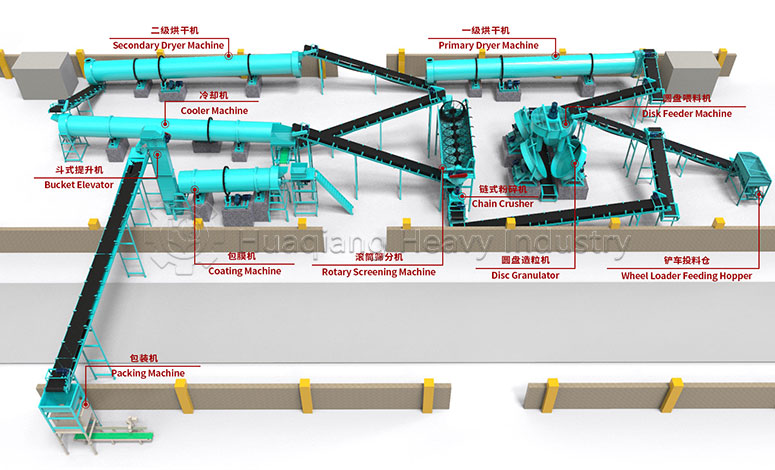 This core production line is “growing” before your eyes: from raw material pretreatment, fermentation and turning, to crushing, screening, granulation, then drying, cooling, and packaging—every piece of equipment finds its place. Most striking is the massive bio-fermentation tank, like a sleeping giant about to be awakened. Nearby, the batching system for compound fertilizer and the mixing drum for bulk-blend fertilizer stand neatly aligned, as if waiting for a common “start order.” These different fertilizer units don’t work in isolation—overhead and underground belt conveyor and bucket elevator weave them into a dense yet orderly production network.
Sweating profusely, the installers never forget to double-check the torque of every bolt. One seasoned technician smiles and says, “Equipment is like a person: treat it with care, and it will work well for you.” Indeed, from the wiring of variable-frequency control cabinets to the sealing of dust extraction ducts, every detail matters for smooth operation down the road. As the crane slowly positions the granulator drum, a short whistle cuts through the air—a cheer for precision.
Other fertilizer machines also show their prowess: the cooling tower of the prilling tower has taken shape, and the polishing drum of the rotary drum granulator gleams under the sun. They share the same raw material warehouse and finished product packaging line with the bio-organic fertilizer line—independent yet cooperative. You might ask: with so many machines packed together, won’t it become a mess? The answer lies in the neatly organized cable trays and clearly numbered wires that crisscross yet remain perfectly orderly.
When the last control cabinet is switched on, the entire system begins a no-load test run. Motors hum, belts glide smoothly—no strange noises, no jams. At that moment, everyone breaks into spontaneous applause. This production line is about to transform waste—straw, livestock manure, and the like—into “black gold” that nourishes the soil. You see, even cold steel can nurture life. The charm of fertilizer equipment quietly blooms in its tireless rotation and fermentation.
This core production line is “growing” before your eyes: from raw material pretreatment, fermentation and turning, to crushing, screening, granulation, then drying, cooling, and packaging—every piece of equipment finds its place. Most striking is the massive bio-fermentation tank, like a sleeping giant about to be awakened. Nearby, the batching system for compound fertilizer and the mixing drum for bulk-blend fertilizer stand neatly aligned, as if waiting for a common “start order.” These different fertilizer units don’t work in isolation—overhead and underground belt conveyor and bucket elevator weave them into a dense yet orderly production network.
Sweating profusely, the installers never forget to double-check the torque of every bolt. One seasoned technician smiles and says, “Equipment is like a person: treat it with care, and it will work well for you.” Indeed, from the wiring of variable-frequency control cabinets to the sealing of dust extraction ducts, every detail matters for smooth operation down the road. As the crane slowly positions the granulator drum, a short whistle cuts through the air—a cheer for precision.
Other fertilizer machines also show their prowess: the cooling tower of the prilling tower has taken shape, and the polishing drum of the rotary drum granulator gleams under the sun. They share the same raw material warehouse and finished product packaging line with the bio-organic fertilizer line—independent yet cooperative. You might ask: with so many machines packed together, won’t it become a mess? The answer lies in the neatly organized cable trays and clearly numbered wires that crisscross yet remain perfectly orderly.
When the last control cabinet is switched on, the entire system begins a no-load test run. Motors hum, belts glide smoothly—no strange noises, no jams. At that moment, everyone breaks into spontaneous applause. This production line is about to transform waste—straw, livestock manure, and the like—into “black gold” that nourishes the soil. You see, even cold steel can nurture life. The charm of fertilizer equipment quietly blooms in its tireless rotation and fermentation. 