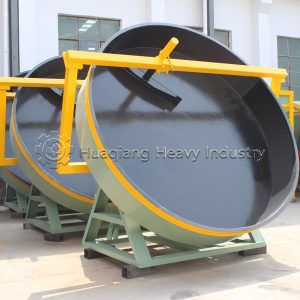
Disc and drum granulators are the two main forces in wet granulation of organic fertilizers

As two core equipment with a long history and wide application in the wet granulation process of organic fertilizers, the disc granulator and the drum (rotary drum) granulator each occupy a place in the production of organic fertilizers of different scales and types with their unique advantages. A deep understanding of their working principles, technical characteristics, and applicable boundaries is crucial for optimizing production processes and improving particle quality. This article will provide a detailed technical comparison between these two mainstream wet granulation machines.
  1. Disc granulator
Technical parameters: Working principle: It mainly relies on the synergistic effect of centrifugal force, frictional force, and gravity. Powdered materials gradually aggregate into spherical particles through continuous rolling, bonding, and timely addition of water (or binder) by a water spray device in a tilted rotating disk. Structural features: The core components include a disc with adjustable tilt angle, a transmission device, a scraper device (to prevent the material from sticking to the wall and control the particle shape) and a spray system. Ball formation rate: relatively high, under suitable process conditions, the ball formation rate can reach over 93%. Particle size control: mainly achieved by adjusting the tilt angle, rotation speed, material humidity, and addition amount of the disc. The particle size is generally between 0.3-5mm, with good sphericity. Applicable raw materials: Widely applicable to various powdered organic materials, such as livestock manure, compost, urban sludge, peat, etc. There are certain requirements for the fineness and moisture content of raw materials, usually requiring a moisture content between 25% and 35%.
  1. Drum/drum granulator
Technical parameters: Working principle: It belongs to the wet granulation method of agglomeration. The material inside the rotating cylinder is bonded and agglomerated into particles through the frictional force of the cylinder wall and the squeezing and rolling effects between the materials, supplemented by steam or moisture to adjust humidity. Structural features: The main body is a tilted rotating cylinder, which can be lined with rubber plates or acid resistant stainless steel plates to prevent sticking and corrosion, and is equipped with inlet and outlet devices. Some models can be equipped with steam to increase material temperature and granulation efficiency. Ball strength: The finished particles have high strength and are not easily broken. Applicable raw materials: The raw materials have a wide adaptability, not only suitable for organic fertilizers, but also commonly used for cold and hot granulation of compound fertilizers, as well as large-scale production of high, medium, and low concentration compound fertilizers. The range of moisture requirements for raw materials is relatively wide. For enterprises that pursue rounded particle appearance, have relatively limited investment budgets, and have production demands in small and medium-sized enterprises, disc granulators are a highly cost-effective choice. For large and medium-sized enterprises with high production demand, high requirements for particle strength, or plans to produce compound fertilizers, drum granulators have more advantages due to their high efficiency and strong adaptability. It is recommended that users fully evaluate their material characteristics and production goals before selecting, and comprehensively consider the technical solutions of equipment suppliers.

MON-SAT 8:00-9:00

+91 69 863 6420