
What are the differences in the types of fertilizers suitable for rotary drum granulation versus disc granulation production lines?

In fertilizer manufacturing, both rotary drum and disc granulation production lines can process powdered raw materials into granules. However, due to differences in their granulation principles, material movement patterns, and production capacities, each is better suited to specific types of fertilizers.
  1. Rotary Drum Granulation Production Lines: Suitable for Large-Scale Compound Fertilizer Production
Rotary drum granulation relies on the rotation of a drum, which causes materials to continuously tumble and roll, gradually forming granules. This type of production line is commonly used for NPK compound fertilizers, base granular fertilizers (for subsequent blending), and certain organic-inorganic compound fertilizers. It is highly adaptable for projects requiring continuous processing and multi-component formulation, making it particularly well-suited for medium-to-large-scale fertilizer production facilities.
  1. Disc Granulation Production Lines: Suitable for Various Organic Fertilizers and Small-Batch Production
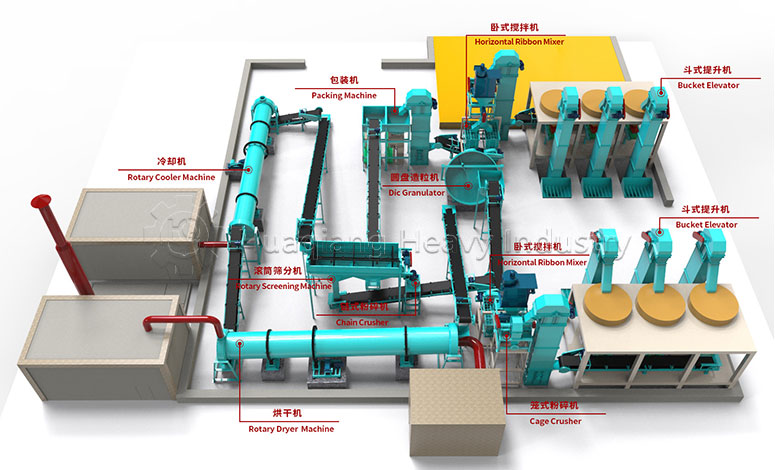
Disc granulation utilizes a rotating, inclined disc. As the disc spins, powdered materials roll and aggregate within it, gradually forming uniform granules. This method is frequently used for producing organic fertilizers—such as those derived from chicken or cattle manure—as well as fermented organic fertilizers and some types of compound fertilizers. By adjusting the disc’s inclination angle, rotational speed, and the amount of water sprayed, operators can control granule size, making this method ideal for projects that require diverse product specifications and flexible production scales.
  1. Selecting a Granulation Method Based on Raw Materials
The choice between these two fertilizer production lines cannot be determined solely by the name of the fertilizer. Instead, the selection process must account for factors such as the raw materials' moisture content, adhesiveness, powder fineness, and specific formulation requirements. For instance, materials with high organic content require careful attention to binding properties, whereas the production of NPK compound fertilizers prioritizes the uniformity of the raw material mix and the capacity for continuous operation. Ultimately, the decision to use either rotary drum or disc granulation should be based on a comprehensive assessment of the fertilizer type, target production volume, desired granule specifications, and investment budget—ensuring both high granulation efficiency and superior finished product quality.
All Categories

MON-SAT 8:00-9:00

+91 69 863 6420