
Large Wheel Compost Turner
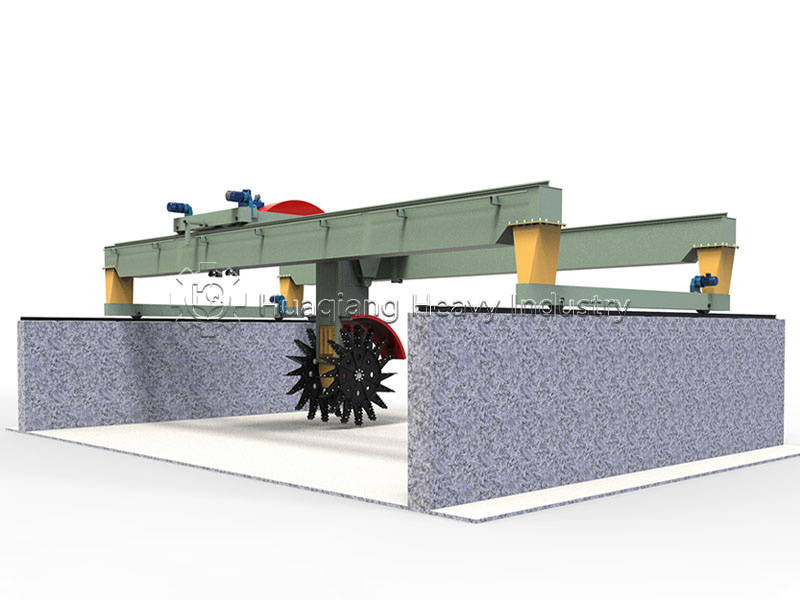
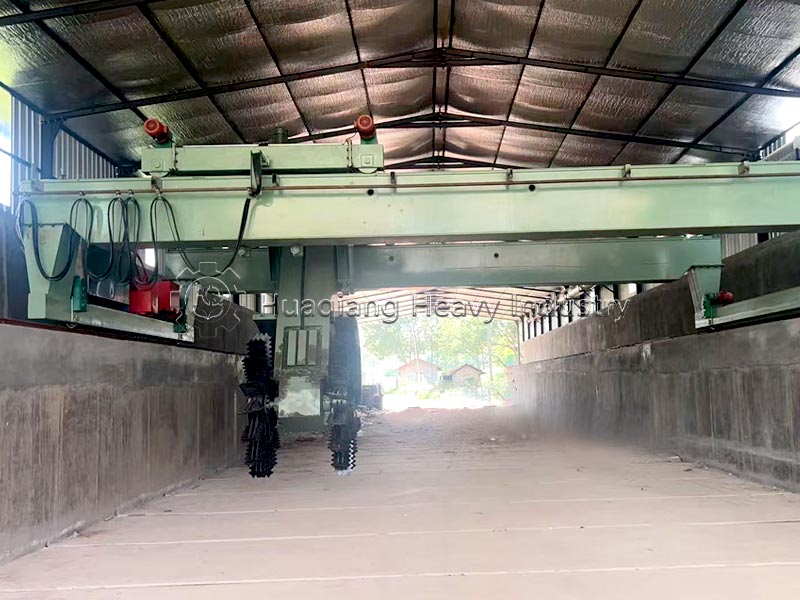
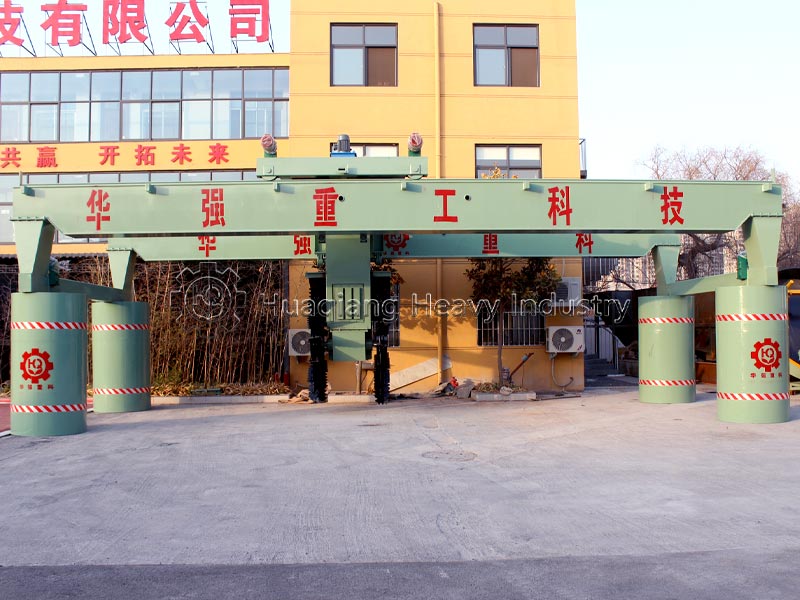
Large Wheel Compost Turner
The large wheel compost turner is a piece of equipment commonly used in aerobic windrow composting processes. It utilizes one or two large-diameter rotating wheels to cut into the material pile, scooping up the material and casting it backward to achieve both turning and displacement. Its primary advantage over trough-style turners is that it requires no fixed concrete fermentation troughs or rail installations; equipped with its own drive mechanism, it operates automatically along the windrow on level ground. This mobility makes it highly advantageous for composting projects with irregular site conditions, moderate processing volumes, or a need for flexible windrow layout adjustments. Featuring a compact structure, deep turning capability, and excellent material-breaking performance, the machine can be operated by a single person, making it a popular choice for small-to-medium-sized livestock farms and organic fertilizer processing facilities.
How does the large wheel compost turning machine process organic fertilizer raw materials?
Step 1: Raw material mixing and windrow formation. Livestock manure is mixed in specific proportions with bulking agents such as crushed straw or rice husks. Moisture content is adjusted until the mixture forms a clump when squeezed by hand—showing moisture between the fingers but not dripping. The mixed material is piled on the ground into a long windrow with a triangular cross-section; the height ranges from approximately 1 to 1.6 meters, and the base width matches the turner’s working width. When forming the windrow, the alignment should be kept as straight as possible to facilitate the turner’s movement along the pile.
Step 2: Turning for oxygen supply and temperature rise. One to two days after formation, the internal temperature naturally rises above 50°C; at this point, the first turning operation is performed using the large wheel compost turning machine. As the machine moves along the windrow, the rotating wheels cut in from the base, and the turning tines scoop up and cast the material backward. The material makes full contact with the air while airborne before landing back on the pile. After turning, the pile becomes loose and permeable, providing aerobic microorganisms with ample oxygen, and the temperature rises back into the high range within 24 hours.
Step 3: Repeated turning and maturation. During the high-temperature phase, the pile is turned once daily to move cooler outer material into the high-temperature zone within the pile, ensuring that all material uniformly undergoes the 50–70°C high-temperature stage. As the turning process proceeds, the windrow gradually shifts backward; the material’s color darkens, and its odor transitions from pungent to an earthy, fresh scent. Once the temperature naturally subsides, the material enters the maturation phase, during which it is turned every two to three days to undergo final stabilization through low-intensity agitation.
Step4: Involves material discharge and site turnover. After 15 to 20 days of turning operations, the material has moved from the start to the end of the windrow, completing the maturation process. The matured material is cleared away to free up the site for building new windrows and commencing the next fermentation cycle. The cleared material can be used as a raw ingredient for organic fertilizer after undergoing crushing and screening.
What are the common issues associated with large wheel compost turning machines, and what are the solutions?
| Common Problems | Cause Analysis | Solutions |
| Pile temperature fails to rise promptly after turning | Excessive moisture content leads to poor aeration; or C/N ratio imbalance causes insufficient microbial nutrition | Mix in dry straw powder or rice husks to adjust moisture to 55%–65%; check C/N ratio and supplement with manure if high‑carbon materials are insufficient |
| Rotary disc turning tines get heavily entangled with long fibers | Long‑fiber materials (e.g., straw) are not sufficiently shredded, with length exceeding 20 cm | Shred long‑fiber materials to <10 cm before windrow formation; clean entangled debris from tines after each shift |
| Uneven material throwing during turning, resulting in loose and irregular windrow shape | Mismatch between disc rotation speed and travel speed; or uneven tine wear (varying lengths) | Reduce travel speed for more thorough turning; inspect and replace excessively worn tines to maintain uniform length |
| Machine deviates from windrow centerline during operation | Uneven tire pressure or wear on the two drive wheels; or uneven ground surface | Check and adjust wheel conditions; level the ground before operation; keep windrows straight during formation |
| Insufficient turning depth, leaving lower layer material untouched | Improper adjustment of the disc lifting mechanism; or shortened tine length due to wear | Lower the disc to 3–5 cm above ground level before each operation; replace worn tines promptly |
| Increased vibration and abnormal noise during operation | Loose or missing tines causing disc imbalance; or increased bearing clearance due to wear | Stop immediately; tighten or replace missing tines; inspect the main bearing of the disc and replace if wear exceeds limits |
For which types of producers is the large wheel compost turner suitable?
Small- to medium-sized livestock and poultry farms. Farms raising chickens, pigs, or cattle generate manure that requires timely processing; by purchasing a large wheel compost turner and creating compost windrows on open ground near the farm, they can convert manure into organic fertilizer for their own use or for sale. The equipment requires a modest investment, is easy to operate, and has minimal site requirements—existing open areas at the farm can be used after only minor leveling.
Small-scale organic fertilizer processing facilities in townships. These facilities often operate with limited capital and space, making the construction of large concrete fermentation tanks unfeasible. The large wheel compost turner requires no civil engineering investment and is relatively affordable; combined with the windrow composting process, it allows for rapid production startup.
The large wheel compost turner offers distinct advantages in mobility when used for composting at planting bases and agricultural parks. Windrow locations can be flexibly adjusted based on crop rotation schedules and fertilizer needs, and the equipment can be stored in a warehouse when not in use, avoiding the need for a dedicated, permanent site. Crop residues—such as stalks and vines—can be shredded and composted on-site, then returned to the fields after decomposition, creating a closed-loop system within the park.
Large wheel compost turning machines are also well-suited for temporary or seasonal composting projects. Examples include sugar mills processing filter mud during the crushing season or vegetable-producing regions handling crop waste during harvest; since these projects do not require year-round operation, investing in fixed fermentation tanks is not cost-effective, making the highly mobile large wheel compost turner a more economical choice.
Specifications of the Large Wheel Compost Turning Machine
| Model | Main Motor | Small Car Moving Motor | Big Car Moving Motor | Hydraulic Pump Motor |
| LP-10m | 55KW | 1.5KWX4 | 1.5KWX2(4) | 4KW |
| LP-12m | ||||
| LP-15m | ||||
| LP-20m |
