
Chain Turning Machine
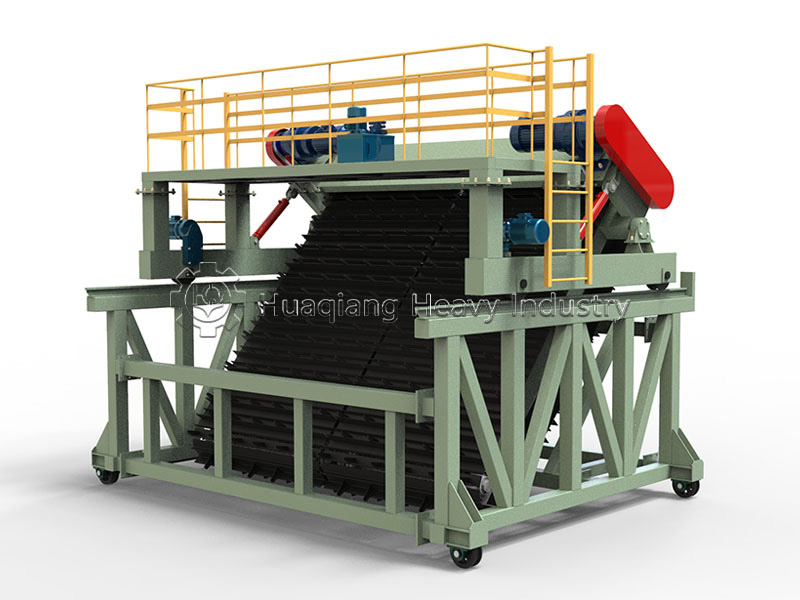

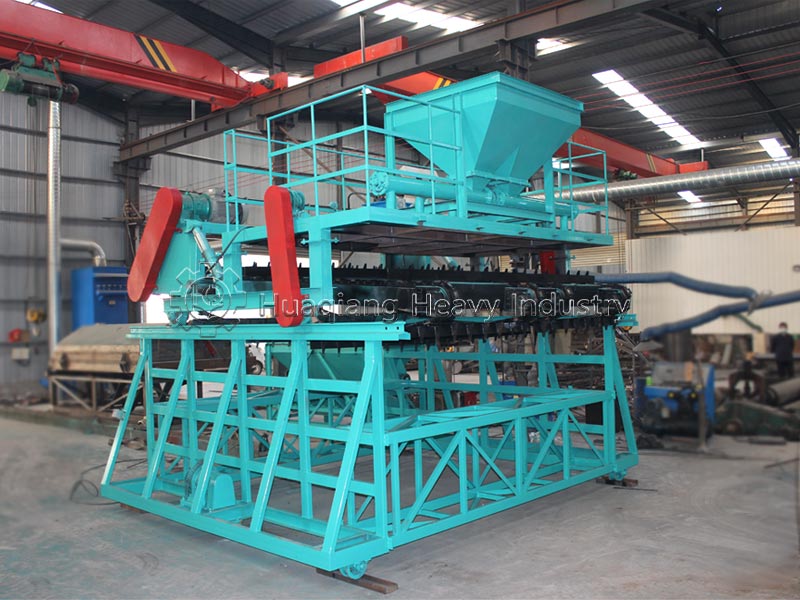
Chain-type compost turner
The chain compost turning machine is a type of composting equipment used in trough-type aerobic fermentation processes, with chains and scrapers as its core turning components. It uses a ring chain to drive multiple sets of transverse scrapers to circulate within the material layer, scooping up the entire layer of material from the bottom of the trough, turning it backward, and smoothly pushing it forward. The scraper pushing action of the chain compost turning machine is gentle and orderly, resulting in clear layers of material after displacement, preventing it from being scattered everywhere. This working method is well-suited for mixtures with high straw content and long fibers; the scrapers push the material without tangling or jamming, ensuring smooth operation. The equipment has a simple structure, and the chains and scrapers are common wear parts, allowing for routine maintenance by the operator. For small and medium-sized organic fertilizer processing users, the chain compost turning machine is a practical choice worth considering.
How does a chain compost turning machine process organic fertilizer raw materials?
The first step is raw material preparation and loading into the trough. Livestock manure and crushed straw, rice husks, and other auxiliary materials are mixed evenly in a specific ratio, and water is added to adjust the moisture content to a suitable level. A simple way to determine the appropriate moisture content is to squeeze a handful of material; if it clumps together and leaves some moisture between your fingers but doesn’t drip, it’s in the right state. The mixed material is loaded into the fermentation tank using a loader from the inlet end, piled to a height of about 1.2 to 1.5 meters, and the surface is roughly leveled.
After being placed in the tank, wait one or two days for the material to heat up internally, reaching a temperature of 50-60 degrees Celsius. At this point, start the chain compost turning machine for the first turning. The equipment slowly moves forward along the track, the chain carrying scrapers circulating within the material layer. The scrapers scoop up the material from the bottom of the tank, pushing it to a certain height before it naturally falls back down. The entire tank of material is turned over, with the bottom layer moving to the top and the outer layer to the inside, moving the material a short distance towards the outlet. After turning, the material becomes loose and airy, and the temperature drops briefly before quickly rising again.
During the high-temperature period, turn the compost once or twice a day for seven to ten days, maintaining the temperature inside the tank at 50-70 degrees Celsius. At this temperature, pathogens and weed seeds are killed, and organic matter decomposes rapidly. After the high temperature, the temperature gradually decreases, and turning the compost pile is changed to every two or three days, allowing the material to complete its final composting through slow turning.
From entering the pit to completion of composting takes approximately fifteen to twenty days, with the material moving step by step from the feed end to the discharge end. Well-composted material becomes darker in color, softer in texture, and has an earthy smell. It can then be removed with a loader and proceed to subsequent processes such as crushing, screening, or granulation.
What problems are common with chain compost turners and what are their solutions?
| Common Problems | Cause Analysis | Solutions |
| Scraper blades deformed or broken | Hard objects (e.g., stones) stuck at the trough bottom, or reduced strength due to long-term wear | Screen and remove debris before feeding; replace blades immediately if cracks or more than half wear are found; use original specification parts |
| Chain slack or disengagement | Chain links elongated by wear after prolonged operation, or tensioning device not adjusted in time | Check chain tightness weekly and adjust the tensioning device; replace the entire chain when elongation exceeds 3% of original length |
| Incomplete material turning by scrapers, with material accumulation at the bottom | Excessive clearance between scraper and trough bottom, or severe wear on the lower edge of scrapers | Adjust clearance to 3–5 cm between scraper and trough bottom; replace excessively worn scrapers promptly |
| Material temperature fails to rise after turning | Low moisture content or unsuitable C/N ratio, restricting microbial activity | Add water to adjust moisture to 55%–65%; check C/N ratio and adjust the proportion of manure to bulking agents |
| Drive wheels slip or deviate on the track | Wet material residue on the track surface, or uneven wear of the drive wheels | Clean accumulated material from the track surface every shift; check wheel wear on both sides and replace severely worn ones |
| Abnormal noise or impact sound during operation | Poor meshing between chain and sprocket, or loose scraper fixing bolts | Stop and inspect chain–sprocket engagement; replace sprockets with excessive wear; tighten all scraper bolts |
Which manufacturers are suitable for chain compost turners?
Small and medium-sized livestock and poultry farms building their own organic fertilizer workshops. These farms have a stable daily output of manure that needs processing. Chain compost turners are easy to operate; farm workers can learn to use them with minimal training. Routine tasks such as changing scrapers and tightening chains can be done independently, without relying on external maintenance. The equipment has low electricity costs and low-cost wear parts, making it a low-burden operation for farms.
Township organic fertilizer processing points. The equipment has a transparent structure, making any problems easily identifiable. Tightening a loose chain or replacing a worn scraper are routine operations. Unlike hydraulic or screw-type equipment that requires specialized maintenance, chain compost turners can be maintained by a regular operator.
Suitable for agricultural areas with abundant straw resources. The scraper-pushing method of chain compost turners is insensitive to straw fibers, allowing straw to enter the trough without fine crushing, eliminating the need for fine crushing and reducing energy consumption. For projects involving large-scale straw and manure composting, the stable operation and resistance to tangling of chain compost turners are significant advantages.
Suitable for businesses with existing trough fermentation facilities that need to replace or add compost turning equipment. The equipment price is relatively low among trough compost turners, and the civil engineering utilizes existing fermentation troughs, making the overall investment manageable. Suitable for production projects with limited budgets but requiring stable turning equipment to ensure fermentation quality.
