
Rotary Drum Granulator
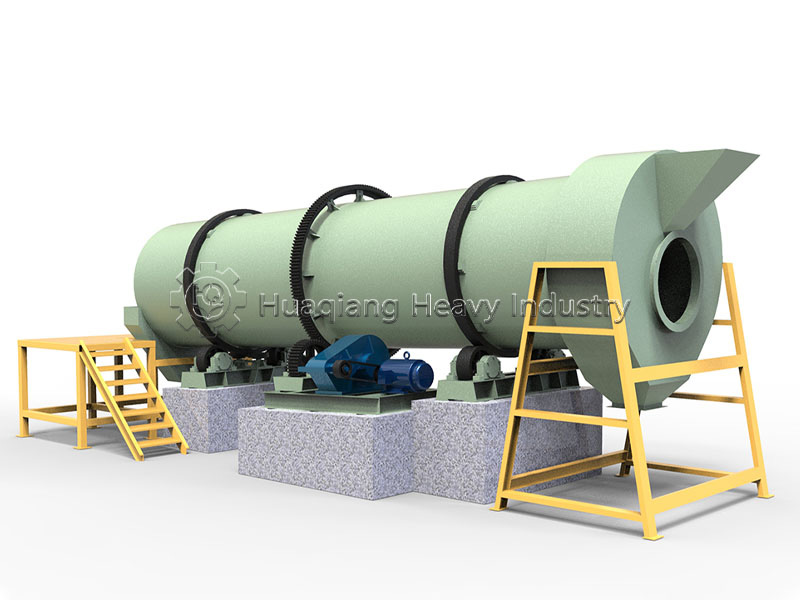
Rotary Drum Granulator
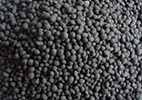
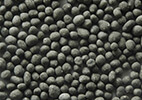
The rotary drum granulator enables continuous granulation with daily outputs ranging from hundreds to over a thousand tons. The equipment consists of a massive rotating cylinder—typically over ten meters long and two to three meters in diameter. Powdered material enters at one end and, driven by the dual action of steam heating and the cylinder’s tumbling motion, gradually agglomerates while rolling; by the time it reaches the other end, it has transformed into uniform, spherical granules. Operating as a closed system, it is ideally suited for high-throughput, continuous industrial production. With a long-standing presence in the fertilizer industry, this granulator features mature technology and reliable performance, making it a proven, practical choice for fertilizer enterprises requiring stable, large-scale output.
Working Principle of Rotary Drum Granulator
Simply put, the granulation process works like making a “snowball” inside a large rotating cylinder. The cylinder rotates at a constant speed and a specific inclination angle. As powdered material continuously enters the feed end, it is carried upward by the inner cylinder wall before tumbling back down; this cycle creates a continuous curtain of material within the drum. Simultaneously, low-pressure steam is piped into the cylinder, heating the material to 50–70°C. Under this thermal influence, the various fertilizer components in the formulation undergo chemical reactions, generating a liquid phase. This liquid evenly coats the surface of the powder particles, acting as a natural binding agent. As the particles tumble and collide, they adhere to one another and gradually agglomerate; while growing by picking up new powder, they move toward the discharge end—driven by the cylinder’s tilt and rotation—and are finally discharged to complete the granulation process.
Common Issues for Rotary Drum Granulator
Granules fail to form or lack sufficient strength. This is usually caused by insufficient steam heat or a failure to raise the material temperature adequately, resulting in an insufficient liquid phase. If low steam pressure or poor condensate drainage prevents the internal temperature from meeting requirements, the powder particles lack the necessary binding force, resulting in loose, fragile granules.
Material sticking to the inner cylinder wall. Excessive steam or high initial moisture content in the feed material can cause a layer of wet material to paste onto the cylinder wall. This layer accumulates and thickens, eventually forming large clumps that break off and block the discharge outlet. Such buildup not only hampers production output but also risks damaging the cylinder’s lining plates when large clumps detach.
Excessive wear or abnormal noise during operation of the support rollers and thrust rollers. This is usually caused by inadequate lubrication or excessive axial movement (float) of the drum. The drum weighs tens of tons and relies entirely on sets of support rollers for load-bearing; if lubrication fails, the bearings will quickly burn out. If axial movement is not properly controlled, the thrust rollers are subjected to excessive force, exponentially accelerating wear.
Impact sounds or abnormal vibrations at the drive end of the large girth gear. This may be due to severe gear tooth wear or misalignment (lack of parallelism) between the axes of the pinion and the girth gear.


Maintenance Methods for Rotary Drum Granulator
Daily maintenance. Check support roller bearing temperatures and lubrication status; listen for abnormal noises during drum operation; observe the lubrication at the mesh point between the girth gear and pinion. Regularly inspect the discharge outlet for blockages caused by large material lumps. Inspect steam pipeline steam traps and strainers at least once per shift to ensure they remain unobstructed.
Weekly maintenance focuses on tightening and cleaning. Inspect and tighten anchor bolts for the support roller housings, thrust roller housings, and drive base, as these bolts tend to loosen under prolonged vibration. Clean accumulated deposits from the drum tire surfaces and keep the contact areas between support rollers and tires clean. Check the clearance between the scraper and the drum wall, maintaining it at 5–10 mm; adjust or replace severely worn scrapers promptly.
Monthly maintenance. Inspect the contact between the drum tires and support rollers; contact should be uniform without uneven loading—adjust roller positions if unevenness occurs. Measure axial drum movement and adjust thrust roller clearance to keep movement within the 3–5 mm range. Check the backlash between the girth gear and pinion using a feeler gauge and adjust if it exceeds standard limits.
Annual maintenance. Inspect all drum liner plates; replace or tighten any that are loose or worn beyond limits. Open support roller bearing housings to check internal clearance; replace bearings if values exceed limits. Measure the roundness of the girth gear and tires; realign or repair via machining if deformation exceeds limits. Perform a comprehensive overhaul of the motor and gearbox according to the maintenance manual, replacing aged seals and wear parts.
Target Users
Large-scale compound fertilizer production plants. Enterprises of this type typically have a daily output exceeding 200 tons—and an annual output ranging from tens of thousands to hundreds of thousands of tons—requiring equipment capable of stable, continuous 24-hour operation; the capacity and reliability of rotary drum granulators are perfectly suited to these needs. Rotary drum granulation is virtually standard equipment for production lines manufacturing high-concentration compound fertilizers and ammonium phosphate-based fertilizers.
Medium-sized fertilizer enterprises. For companies facing capacity bottlenecks with existing disc granulation lines, adding a drum granulation line can significantly boost daily output while maintaining consistent granule quality.
Enterprises with in-house steam generation capabilities. When a plant already has boilers or waste-heat steam available for use, the energy costs for drum granulation drop sharply, making the process even more economically advantageous.
Entrepreneurs and investors in large-scale fertilizer projects. Although the initial equipment investment is higher than that for disc granulation, the cost per unit of capacity decreases significantly as the scale of production expands; large-volume fertilizer production relies precisely on the cost advantages derived from economies of scale.
Rotary Drum Granulator Parameters
| Model | Diameter(mm) | Length(mm) | Inclination(°) | Rotation Speed(r/min) | Capacity(t/h) | Motor Power(Kw) |
| ZG1.2*4.0 | 1200 | 4000 | 2.5 | 17 | 1-3 | 5.5 |
| ZG1.5*6.0 | 1500 | 6000 | 2.5 | 11.5 | 3-5 | 7.5 |
| ZG1.8*7.0 | 1800 | 7000 | 2.5 | 11.5 | 6-10 | 18.5 |
| ZG2.0*8.0 | 2000 | 8000 | 2.5 | 11 | 10-15 | 22 |
| ZG2.2*12 | 2200 | 12000 | 2.5 | 10.5 | 15-20 | 37 |
